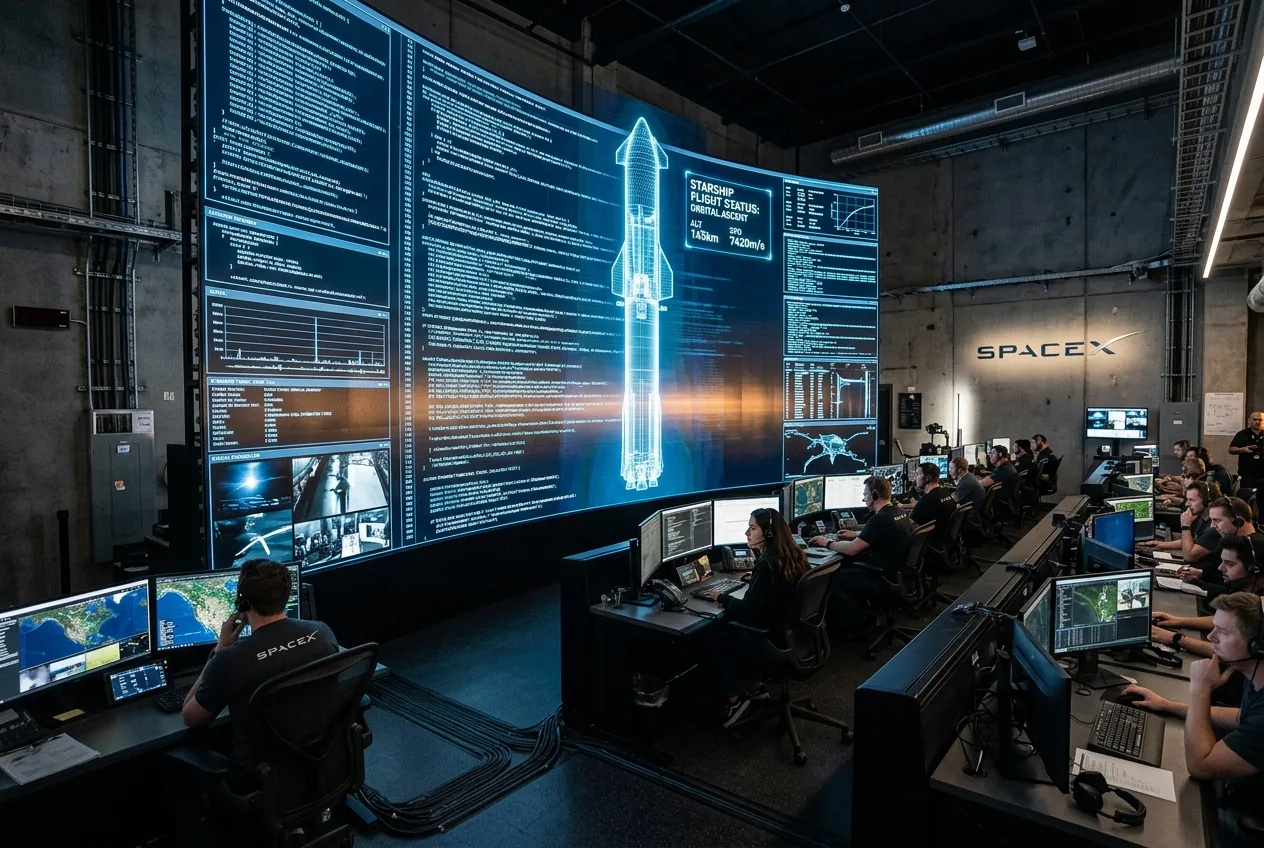
On Friday, August 14, 2026, the industrial landscape of the 21st century shifted. SpaceX officially completed its $60 billion acquisition of Cursor, the AI-powered coding startup that has rapidly become the standard environment for modern software development. The move, which marks one of the largest technology acquisitions in history, represents a fundamental restructuring of Elon Musk’s corporate empire, transitioning SpaceX from a hardware-centric aerospace giant into a vertically integrated intelligence powerhouse.
The deal, which became effective following a regulatory filing on Friday, follows a strategic partnership initiated in April 2026. For those of us tracking the intersection of heavy industry and automation, this is not merely a diversification of assets; it is a calculated bet on the future of autonomous systems. By folding Cursor—and its parent company, Anysphere—directly into the SpaceXAI division, Musk is positioning his aerospace firm to dominate the software layer that governs everything from satellite constellations to autonomous Martian habitats.
The Industrial Logic of a $60 Billion Codebase
To understand why a company that builds the world’s largest rockets would spend $60 billion on a code editor, one must look at the data. Cursor’s primary value proposition is not just its user interface, but the massive repository of high-intent telemetry it generates. Unlike generic Large Language Models (LLMs) that scrape the public web, Cursor has been training on millions of hours of real-time developer interactions, capturing the iterative process of problem-solving, debugging, and architectural design.
This data was instrumental in the development of Grok 4.5, which the companies co-trained using trillions of tokens of Cursor-specific data prior to the deal’s closure. For SpaceX, the utility is immediate. The avionics software for Starship, the network management protocols for the Starlink constellation, and the robotics logic for the Tesla-integrated manufacturing lines all require a level of precision that off-the-shelf AI models have struggled to provide. By owning the tool that writes the code, SpaceX now owns the feedback loop that improves the AI writing it.
The acquisition effectively secures a proprietary pipeline for "machine-assisted engineering." In a recent meeting with SpaceX staffers, Musk was characteristically blunt about the priority shift, stating that the company’s AI revenue is projected to exceed all other SpaceX revenue—including launch services and Starlink—by September of this year. For a company that effectively owns the launch market, this suggests a radical belief in the scalability of enterprise AI software.
Beyond Soft Engineering: Grok 4.5 and the Multimodal Shift
The release of Grok 4.5 and the subsequent 4.6 update provide a technical roadmap for this new era. While Cursor began as a tool for software engineering, the joint models are increasingly multimodal and multidisciplinary. Grok 4.5 was the first iteration built to handle legal, financial, and complex mechanical engineering tasks alongside raw code. This reflects the reality of modern industrial automation: the line between a software bug and a hardware failure is increasingly blurred by the complexity of the systems involved.
From a mechanical engineering perspective, this is a play for the ultimate CAD (Computer-Aided Design) system. Imagine an environment where an engineer can prompt a system to "optimize the thermal shielding of a Raptor engine for 20% higher atmospheric pressure," and the AI—trained on trillions of tokens of proprietary SpaceX data and Cursor’s refined coding logic—generates the necessary simulations, structural code, and manufacturing instructions in minutes. This is the promise of the SpaceX-Cursor merger.
Vertical Integration in the Intelligence Stack
This vertical integration is a defensive maneuver against the increasing costs and restrictive licensing of third-party AI models. Cursor co-founder Aman Sanger has highlighted that this move allows them to provide customers with more capable models at a lower cost. For the enterprise market, which has been wary of the high latency and high price tags associated with top-tier LLMs, a SpaceX-backed Cursor could represent a more viable, industrial-strength alternative.
Furthermore, the introduction of "Grok Bot"—a product described as a team of AI agents capable of fielding and executing assignments autonomously throughout the day—suggests that SpaceX is moving toward a fully autonomous project management framework. In an industrial setting, these agents could theoretically manage supply chains, coordinate robotic assembly, and update firmware across a global network without direct human intervention.
The Economic Calculus of the Cursor Buyout
However, the deal is not without risk. The "vibe coding" era, while transformative for speed, introduces new challenges in terms of code safety and technical debt. In critical infrastructure like aerospace, a hallucinated line of code can lead to catastrophic hardware failure. The burden is now on SpaceXAI to prove that their models—trained on Cursor’s tokens—possess the deterministic reliability required for high-stakes engineering. The market reacted with caution, as SPCX stock (a proxy for the private firm’s valuation in secondary markets) saw a slight dip following the announcement, reflecting concerns over the massive capital outlay and the potential for over-extension.
Architecting the Future of Autonomous Systems
As we look toward the 2030s, the Cursor acquisition will likely be viewed as the moment SpaceX acknowledged that its future is as much about digital intelligence as it is about physical thrust. The integration of Cursor into the Grok ecosystem provides a glimpse into a future where the "engineer" is a supervisor of autonomous agents rather than a writer of manual code. This shift is essential for Musk’s broader goals: you cannot colonize a planet or manage a global satellite network with human engineers writing every line of code by hand. You need a system that builds itself.



Comments
No comments yet. Be the first!