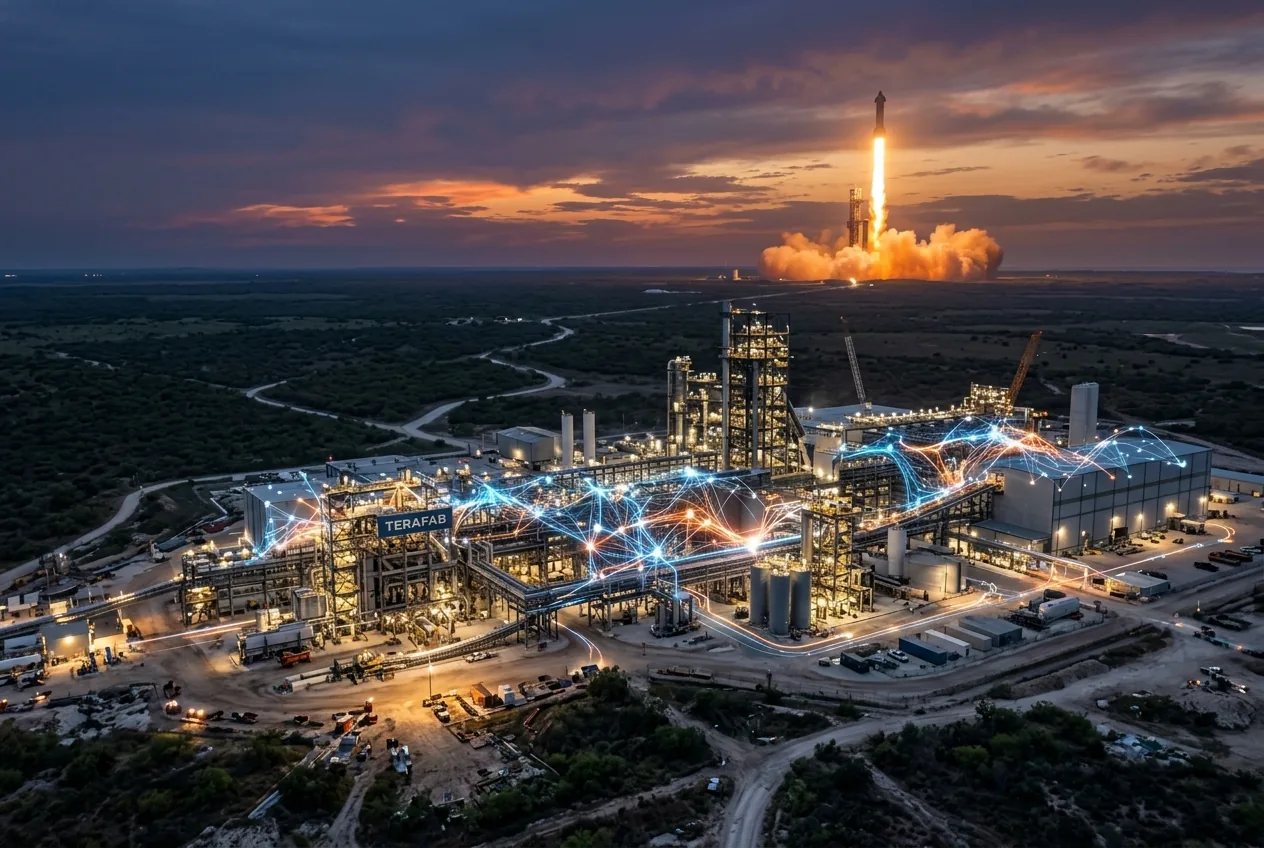
In a move that fundamentally redefines the trajectory of the world’s most successful private aerospace company, Elon Musk has announced that SpaceX—recently rebranded as SpaceXAI following its landmark IPO in June 2024—is on the verge of a historic financial pivot. During a 30-minute all-hands meeting recorded and shared on X, Musk informed employees that revenue from artificial intelligence initiatives is projected to surpass the combined earnings of its rocket launches, Starlink satellite internet, and national security contracts by next month.
Terafab and the Industrialization of Compute
The backbone of this revenue surge is the newly confirmed “Terafab” facility located in Grimes County, Texas. This project, a joint venture between SpaceX and Tesla, is being framed as the world’s largest building with a construction price tag of $119 billion. The sheer scale of the facility is designed to meet the astronomical power demands of next-generation AI training. The complex is targeting one terawatt of annual compute capacity at full scale, with an immediate goal of adding 8 gigawatts (GW) of capacity over the next 18 months.
From an engineering perspective, Terafab represents the apex of industrial automation and thermal management. Musk and Tesla have jointly committed $16.8 billion to the initial build-out of the complex, which will serve as the primary engine for both SpaceX’s AI spacecraft program and Tesla’s Optimus robotics initiative. According to internal projections, SpaceX will consume roughly 75% of the facility's compute capacity to power its orbital data centers, while the remaining 25% will be dedicated to training the neural networks that drive Tesla’s humanoid robots. This synergy suggests a vertical integration of hardware and software that few other hyperscalers can match.
The $60 Billion Logic Behind the Cursor Acquisition
While the hardware is being built in the Texas brushland, the software strategy was solidified through the $60 billion acquisition of the AI coding platform Cursor in June 2026. This acquisition was not merely a tool for internal efficiency; it was a shot across the bow of established AI giants like Anthropic and OpenAI. By integrating Cursor’s sophisticated code-generation capabilities into the SpaceX ecosystem, Musk is building a software stack capable of self-optimization and rapid scaling.
Furthermore, this software play allows SpaceX to compete directly for enterprise AI contracts. As companies look for secure, high-performance environments to train their proprietary models, SpaceX can offer a bundled service: the compute power of Terafab and the coding infrastructure of Cursor. This dual-threat capability is a key reason why analysts are beginning to view SpaceX not as a launch provider, but as a foundational infrastructure platform for the entire AI industry.
Thermodynamics and the Orbital Advantage
Perhaps the most technically ambitious aspect of the SpaceXAI roadmap is the plan to launch data centers into space. Musk has stated that within 36 months, space will become the cheapest place to host AI compute. This claim challenges traditional notions of data center economics, which are usually dominated by the costs of electricity and cooling. In the vacuum of space, cooling presents a unique thermodynamic challenge, as heat can only be dissipated through radiation rather than convection.
Grok and the Digital Inheritance of SpaceX
A more controversial element of the recent all-hands meeting was Musk’s discussion of training Grok, the company’s family of large language models, on the “sum total of all SpaceX information.” Musk told his staff that the AI would essentially be trained on them—their thoughts, ideas, and operational beliefs. “You are the parents of the AI,” Musk told employees, suggesting that the model would inherit the collective institutional knowledge of the world’s most advanced engineering team.
The technical implementation of this training remains opaque. Musk did not specify whether this would involve monitoring internal communications, design documents, or, more controversially, employee keystrokes—a method recently explored and then paused by Meta due to significant backlash. From a mechanical and systems engineering perspective, a model trained on the iterative design processes of SpaceX could potentially solve complex structural problems or optimize fuel mixtures with superhuman speed. However, the ethical and privacy implications for the workforce are significant.
The Financial Transformation of a Trillionaire
The June 2026 IPO of SpaceX, which reportedly propelled Musk to become the world’s first trillionaire, was the catalyst for this aggressive expansion. The capital infusion from the public markets has allowed the company to move beyond the constraints of a traditional aerospace budget. Investors, once wary of the long lead times associated with space exploration, are now flocking to SpaceX as a high-growth AI play. The rebrand to SpaceXAI was a clear signal to the market that the company’s priorities have shifted.
The 9.19% surge in SpaceX (SPCX) stock following Musk’s comments reflects a growing consensus that the company is the only entity capable of bridging the gap between heavy industrial hardware and cutting-edge software. While Tesla faced a minor dip of 1.93% in the same period, the long-term outlook for the Musk ecosystem remains tethered to the success of the Terafab facility and the ability to monetize AI at scale. The company is no longer just aiming for the stars; it is aiming to build the brain that will navigate the digital age.
As September approaches, the industry will be watching closely to see if Musk’s revenue crossover materializes. If AI revenue does indeed eclipse the space business, it will mark the end of one era and the beginning of another. SpaceX started with the goal of making life multi-planetary; it may end up making life primarily digital, hosted on silicon chips both on Earth and in the silent vacuum of orbit.




Comments
No comments yet. Be the first!