When OpenAI chief executive Sam Altman casually remarks that artificial intelligence has arrived at or is rapidly approaching the technological singularity, the tech sector tends to split along ideological lines. To venture capitalists and true believers, it signals the imminent arrival of an era where machine intelligence outstrips the collective cognitive output of human civilization. To engineers, physical scientists, and industrial operators, however, the proclamation raises immediate, practical questions about the physical systems required to sustain such a reality.
Understanding what Altman means requires stripping away the philosophical mysticism and analyzing the engineering mechanisms behind modern artificial intelligence. Today's frontier models are not disembodied minds accelerating through pure thought. They are industrial computational pipelines bound by the availability of high-purity silicon, high-voltage electrical interconnects, and cooling capacity. If we are genuinely at the threshold of the singularity, the bottleneck will not be algorithmic audacity; it will be physical infrastructure.
Deconstructing the Digital Intelligence Explosion
Over the past two years, leading AI laboratories have pursued a variation of this loop through test-time compute scaling and automated code synthesis. Models like OpenAI's o1 series spend computational cycles generating intermediate internal reasoning steps before generating an answer. Concurrently, machine learning engineers use cutting-edge models to draft kernel optimizations, discover novel neural network architectures, and generate synthetic training corpora to train successor models. This dynamic represents a primitive, highly monitored form of self-directed iteration.
Yet, this digital loop encounters severe diminishing returns when insulated from reality. Machine learning researchers increasingly point out that models trained exclusively on model-generated data suffer from model collapse—a mathematical degradation where the underlying probability distributions narrow, accumulating artifacts and statistical errors over successive generations. For a computational system to advance toward genuine superintelligence, it cannot simply recycle its own syntactic predictions. It requires an influx of novel, high-entropy empirical data derived from observation and physical experimentation.
The Compute Substrate: Watts, Silicon, and Thermal Limits
Recursive improvement in code is meaningless if the compute fabric supporting that code cannot expand to meet the explosive demand. In the physical world, training and running inference on frontier models requires vast server clusters that push the outer boundaries of modern electrical engineering. The transition from general-purpose CPUs to specialized accelerators like Nvidia's Blackwell architecture has driven unprecedented density, packing dozens of kilowatts of heat dissipation into single server racks.
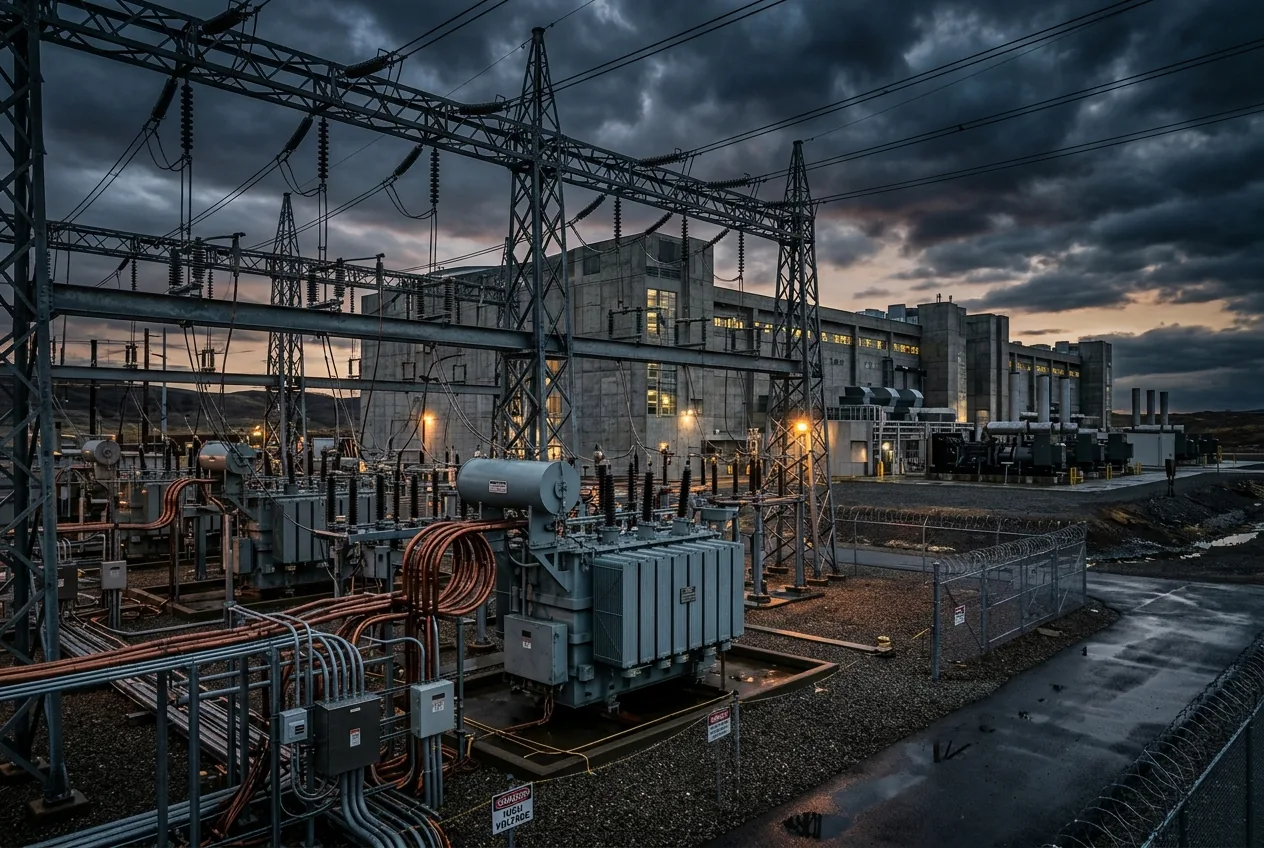
The reality facing hyperscalers is that the power grid does not scale exponentially. Adding a gigawatt of generation and distribution capacity to a data center cluster is not a software patch; it requires multi-year permitting cycles, physical turbine manufacturing, high-voltage transformer fabrication, and massive environmental review processes. While software models might double their parameter efficiency or inference reasoning depth in twelve months, the lead time on high-capacity step-down transformers currently stretches between three and four years.
Furthermore, the semiconductor supply chain that underpins this computational revolution is among the most fragile and capital-intensive manufacturing networks on Earth. Producing sub-two-nanometer chips requires extreme ultraviolet (EUV) lithography systems manufactured by a single Dutch company, utilizing optics ground to atomic tolerances and mirrors moving in synchronized vacuums. The physical laws governing electron mobility, quantum tunneling, and thermal dissipation represent hard constraints on compute scaling that clever token-prediction algorithms cannot hand-wave away.
The Embodiment Gap: Moravec's Paradox in Modern Factories
For an artificial system to reach the traditional definition of the singularity—wherein it fundamentally reshapes industrial production and technological innovation—it must possess physical agency. Digital intelligence alone cannot extract lithium, cast turbine blades, repair deep-sea fiber optic cables, or replace failed cooling pumps inside a data center. The intelligence explosion requires physical embodiment, and this is where Silicon Valley rhetoric collides violently with Moravec’s paradox.
While software agents can write Python scripts or summarize legal contracts with superhuman speed, physical manipulation remains clumsy, fragile, and computationally expensive. Actuators, harmonic drives, battery densities, and tactile sensor arrays have not enjoyed the exponential cost-curve reductions of digital silicon. If an AI system cannot independently interact with the material world to build its own physical chassis, mine its own raw minerals, and assemble its own printed circuit boards, the recursive loop remains fundamentally dependent on human labor.
Industrial Pragmatism Over Esoteric Predictions
Stripping the term singularity of its apocalyptic or utopian framing leaves behind a more mundane, albeit transformative, reality: a massive inflection in industrial design and software tooling. When technology executives declare that the threshold has been crossed, they are observing an acceleration in productivity metrics inside narrow, highly structured software environments. For industrial enterprises, treating these milestones as a mythical threshold can obscure the practical engineering work required to capture value.
The immediate consequence of advanced reasoning models is not the creation of an uncontrollable digital deity, but the rapid compression of the engineering design cycle. Computational fluid dynamics simulations that previously took weeks of manual mesh generation can now be accelerated through neural surrogate models. Firmware engineering, PLC logic generation, and automated structural topology optimization are transitioning from weeks of human iteration to automated parameter searches evaluated in minutes.
These developments represent substantial, measurable shifts in the velocity of hardware development. A mechanical engineer equipped with multimodal reasoning engines can evaluate supply-chain alternate components, review tolerance stack-ups against international standards, and write test automation scripts in fractions of the traditional development window. This is not the end of human history; it is a profound upgrade to human technical capability, bounded at all times by the laws of physics, material chemistry, and economic feasibility.
Sam Altman’s rhetorical embrace of the singularity serves clear commercial and fundraising objectives, maintaining a narrative of inevitable, exponential momentum. But outside the pitch deck, technological progress is stubbornly material. Until an AI can dig its own trenches, lay its own copper cables, build its own power plants, and machine its own silicon wafers, the singularity will remain an abstract software narrative tethered firmly to the limits of our physical world.



Comments
No comments yet. Be the first!