When the Clay Mathematics Institute established the seven Millennium Prize Problems in May 2000, it codified the outer perimeter of human mathematical understanding. Each problem carried a seven-figure bounty, but the real reward was intellectual immortality. For nearly a quarter of a century, only one has yielded: the Poincaré conjecture, resolved by Grigori Perelman in 2003 through a series of dense, idiosyncratic preprints that required years of collective labor by the global geometry community to verify. Every other prize problem—from the computational boundaries of P versus NP to the fluid stability dictated by the Navier-Stokes existence and smoothness equations—has repelled the most sophisticated analytical tools humanity could devise.
Reports that OpenAI has set its sights directly on these foundational bastions, positioning its frontier reasoning architectures to produce candidate solutions for a Millennium Prize problem, mark a critical turning point in computational science. This is not another benchmark sweep or an incremental improvement on synthetic competitive coding ladders. Attempting to resolve a Millennium Prize problem drags artificial intelligence out of the forgiving realm of statistical plausibility and forces it into the binary, unforgiving architecture of formal mathematical proof. For engineers and computational researchers, the development demands an unvarnished audit of the underlying technology: how these models navigate infinite search spaces, where their deductive engines fail, and what a genuine breakthrough would mean for the physical sciences.
The Mechanical Shift From Autoregression to Formal Search
To understand how an artificial intelligence model can credibly approach pure mathematics, one must first dismantle the misconception that next-token prediction alone can navigate a proof of this magnitude. Standard large language models operate on probabilistic associations, generating tokens based on distributional similarities mined from vast human corpora. While this approach produces eloquent prose and passable boilerplate code, it degrades rapidly across extended inferential chains. In higher mathematics, an argument spanning hundreds of steps cannot tolerate a single logical fracture; a single hallucinated lemma invalidates the entire structure.
OpenAI’s recent push into specialized reasoning models relies on scaling test-time compute, shifting computational resources from pure pre-training toward dynamic inference-time exploration. Rather than committing immediately to a single generation trajectory, these systems deploy reinforcement learning frameworks that execute extensive tree searches, evaluating intermediate nodes of logic before committing to subsequent deductions. By coupling deep heuristic policy networks with automated reasoning tools, the model explores alternative analytical pathways, backtracks upon hitting dead ends, and iterates toward a coherent logical chain.
Crucially, the frontier of mathematical AI increasingly bypasses natural language entirely during intermediate reasoning stages, translating classical mathematical statements into interactive proof assistants such as Lean, Coq, or Isabelle. In a formal language environment, mathematics is reduced to computational type theory. A statement is either a syntactically valid proof that compiles against the kernel’s axioms, or it is an error. By turning mathematical proof generation into an optimization game where the reward function is absolute logical compilation, developers bypass the catastrophic hallucination risks inherent in standard conversational AI. If OpenAI is claiming progress on a Millennium-tier problem, it indicates that their search algorithms are successfully generating non-trivial, syntactically verifiable sequences within these deterministic formal kernels.
The Engineering Stakes of Navier-Stokes and Computational Complexity
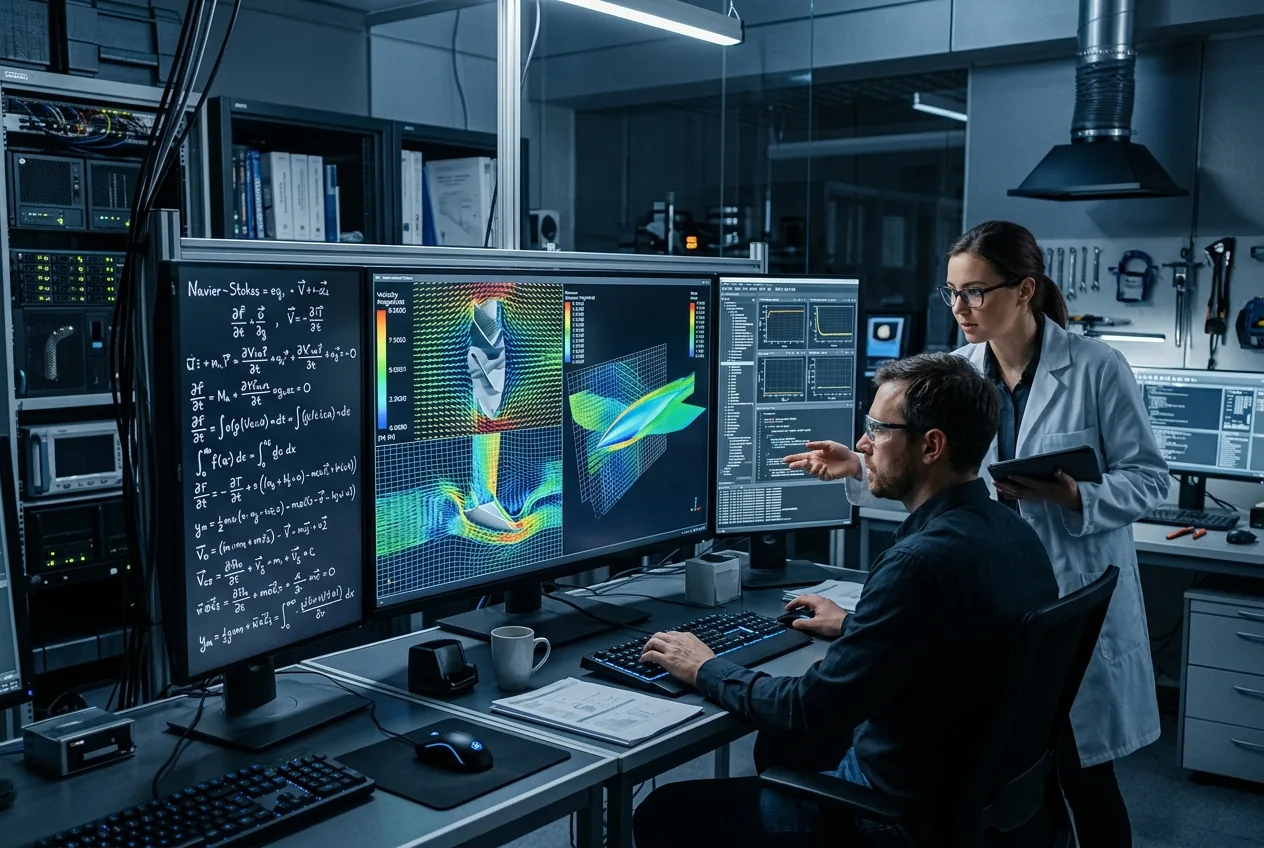
While the mathematical community approaches these developments with disciplined skepticism, the industrial implications of cracking specific Millennium problems are staggering. In mechanical engineering and aerospace design, the Navier-Stokes existence and smoothness problem is far more than an esoteric topological curiosity. The governing equations of fluid motion have underpinned turbine design, aerodynamic profiling, and acoustic modeling for nearly two centuries, yet mathematicians have never proven whether smooth, physically reasonable solutions always exist for all time in three dimensions, or whether finite-time singularities—mathematical blow-ups—can spontaneously manifest.
Engineers currently compensate for this foundational ambiguity through empirical approximations: turbulence closures, Reynolds-averaged Navier-Stokes (RANS) formulations, and resource-intensive Large Eddy Simulations (LES). If an automated system were to prove regularity, or conversely identify the exact conditions under which smooth solutions break down, the downstream effects on computational fluid dynamics (CFD) software would be immediate. Algorithms could be re-engineered to navigate boundary-layer turbulence with unprecedented precision, cutting billions of dollars in wind-tunnel prototyping and fuel consumption optimizations across aviation, maritime logistics, and internal combustion architectures.
Similarly, any breakthrough leaning into the orbit of the P versus NP problem strikes at the heart of global optimization and logistics infrastructure. The question of whether every problem whose solution can be quickly verified can also be quickly solved dictates the mathematical limits of deterministic scheduling, route planning, supply chain allocation, and cryptography. An algorithmic framework capable of systematically bridging polynomial-time verification with polynomial-time discovery would disrupt everything from robotic warehouse orchestration to public-key cryptographic security. Even partial, constructive insights generated by an artificial reasoning system could expose mathematical short-cuts for combinatorial optimization problems that currently paralyze modern supercomputing clusters.
The Gauntlet of Verification and the Human Precedent
If an AI model produces a candidate proof for a problem of comparable gravity, the verification crisis will be inverted. Rather than parsing the dense, idiosyncratic intuition of a human recluse, mathematicians will be forced to audit millions of lines of machine-generated formal logic or an alien analytical path that bears none of the pedagogical guideposts human mathematicians rely on. If the proof is generated natively in a language like Lean, the mechanical kernel will guarantee syntactic consistency, but human mathematicians will still demand semantic comprehension. They will need to know *why* the proof works, what conceptual machinery it introduces, and whether the underlying formulation genuinely addresses the physical or geometric essence of the conjecture, rather than exploiting a subtle degenerate case or an unstated axiomatic loophole.
The Reality Gap Between Machine Intuition and Truth
The prospect of automated systems contributing to field-defining mathematics reveals both the immense computational leverage of reinforcement learning and the profound limits of purely mechanical deduction. Modern reasoning architectures excel at brute-force combinatorial navigation, uncovering non-obvious permutations and applying known transformations across vast contextual windows at speeds no human mind can match. They can scan mathematical literature, identify latent structural analogies between disparate fields, and exhaustively stress-test edge cases with ruthless efficiency.
Yet genuine breakthroughs in pure mathematics historically require more than relentless search; they demand the conceptual synthesis of entirely new mathematical domains. Alexander Grothendieck did not resolve problems merely by calculating faster; he constructed an entirely new universe of algebraic geometry—schemes, topoi, and motives—that reshaped how mathematicians fundamentally conceptualize space and number. When Andrew Wiles proved Fermat’s Last Theorem, he spent seven years linking the seemingly distant worlds of elliptic curves and modular forms via the Taniyama-Shimura-Weil conjecture.
Whether OpenAI’s architectures can exhibit this variety of conceptual reframing remains the defining question. If the reported developments represent a legitimate, rigorously verified leap forward on a Millennium Prize problem, it signals that computational systems have crossed the Rubicon from advanced computational aids into genuine theoretical partners. But until an end-to-end proof withstands the forensic examination of the global mathematical community and the deterministic verification of formal kernels, the claims remain within the domain of speculative engineering. The laws governing the universe do not yield to corporate pacing or public relations cycles; they yield only to absolute, uncompromised logical proof.




Comments
No comments yet. Be the first!