The capital requirements of frontier artificial intelligence have finally outgrown the balance sheets of private venture capital. What began nearly a decade ago as a non-profit research laboratory dedicated to the open development of digital intelligence is now steering toward a traditional public market debut. OpenAI’s transition into a fully realized corporate entity capable of an initial public offering represents not merely an institutional milestone, but an economic concession to the laws of physical infrastructure. Training neural networks at the frontier is no longer a software venture; it is a heavy-industry endeavor bounded by power grids, semiconductor fabrication queues, and gigawatt-scale facilities.
The shift comes as the race to sustain performance scaling across deep neural networks collides with diminishing returns on raw compute. As models expand in parameter count and context window length, the financial burn required to train and deploy them has surged exponentially. Sustaining this pace requires tens of billions of dollars annually—an amount that even the most well-capitalized tech conglomerates cannot absorb through internal cash flow alone without facing intense shareholder scrutiny. By positioning itself for public equity markets, OpenAI is looking to open the taps to institutional global capital to fund a multi-year infrastructure roadmap that extends from bespoke silicon to distributed data center grids.
The Astronomical Physics of the Gigawatt Era
To understand why a public listing has become an operational necessity, one must examine the raw engineering mechanics behind training modern multimodal foundation models. Early transformer models were trained in modest cluster configurations measured in hundreds of graphic processing units, consuming megawatts of electricity. Today, state-of-the-art training runs demand hundreds of thousands of specialized chips working in low-latency synchronization, pushing data center power envelopes past 100 megawatts per campus, with gigawatt-scale campuses already breaking ground across North America.
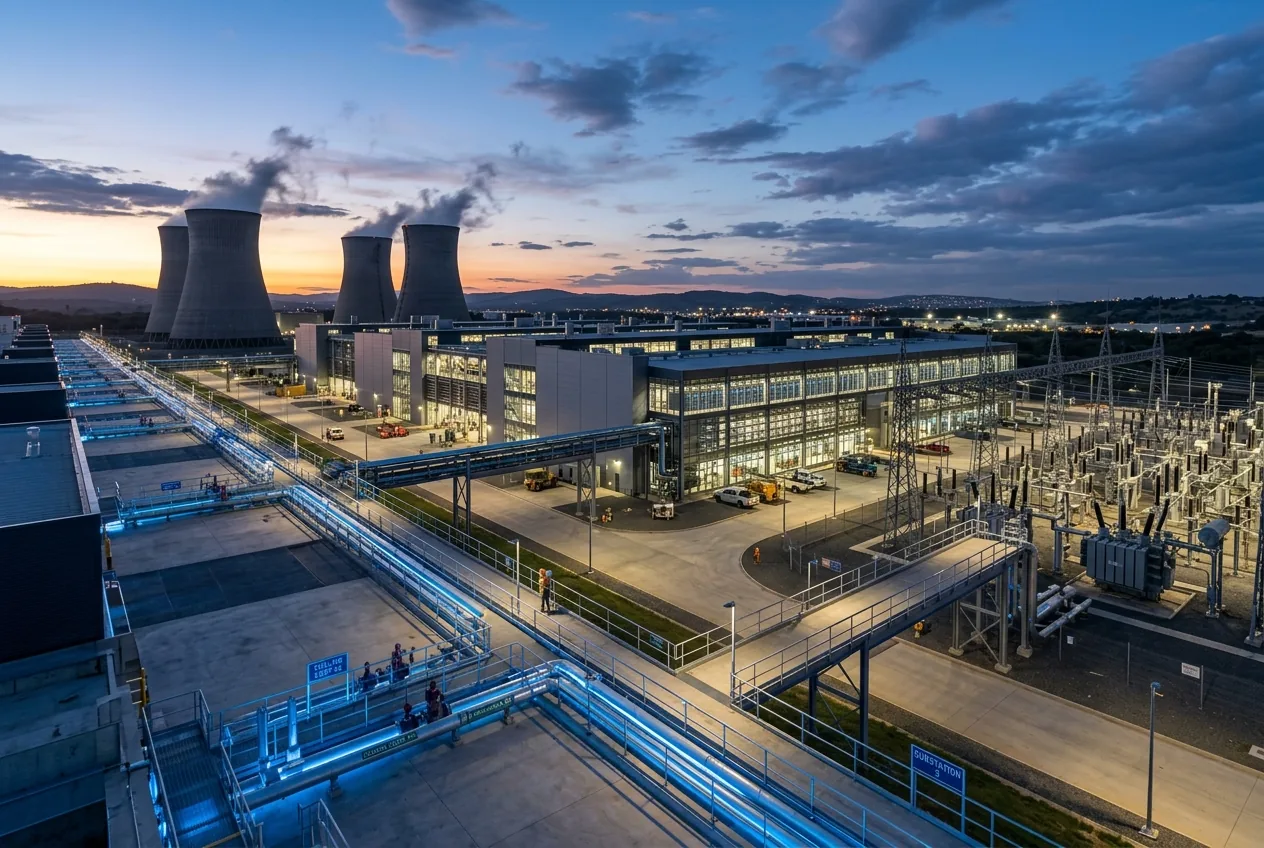
At this physical scale, the engineering challenges shift from software optimization to thermodynamics and grid architecture. High-density server racks hosting current-generation accelerators dissipate tens of kilowatts of heat per unit, rendering traditional chilled-air cooling methods completely obsolete. Data center operators are forced to re-engineer entire facilities around liquid-to-chip closed-loop cooling and immersion systems. The primary capital expenditure is no longer purely digital; it involves substations, high-voltage transformers, water treatment facilities, and direct interconnects to nuclear or natural gas baseload power generation.
These capital outlays are deeply front-loaded. A single frontier cluster running high-end accelerator silicon requires billions of dollars in hardware commitment before the first model weight is even initialized. Furthermore, with hardware replacement cycles occurring every three to four years as architectural improvements deliver superior floating-point operations per watt, amortization schedules are exceptionally brutal. Venture debt and staged equity funding rounds, once sufficient to fuel the software-as-a-service boom of the previous decade, cannot reliably finance industrial projects of this magnitude.
Dismantling the Capped-Profit Governance Model
The structural pathway toward an initial public offering requires an overhaul of OpenAI’s founding corporate architecture. Originally established in 2015 as a 501(c)(3) non-profit, the organization added a capped-profit subsidiary in 2019 to attract the equity financing necessary to purchase thousands of high-performance compute cards. Under that hybrid design, investors’ returns were limited to a predetermined multiple, with any excess economic value legally mandated to revert to the non-profit board tasked with safeguarding humanity.
While this non-standard corporate structure allowed early high-risk research to proceed without immediate commercial monetization pressures, it has proven fundamentally incompatible with the risk-return expectations of public equity markets. Institutional asset managers and pension funds require fiduciary clarity, standard governance mechanisms, and transparent paths to liquidity. The friction generated by this structure became evident during past leadership crises, exposing the deep structural tension between a non-profit board empowered to halt commercialization and external investors who have poured billions of dollars into high-risk computing assets.
Transitioning into a traditional public benefit corporation removes the return cap for equity holders while establishing legal protections that balance commercial growth with safety mandates. This corporate evolution directly aligns OpenAI with the expectations of Wall Street underwriting desks. Public investors will not inject capital into an enterprise where equity can be unilaterally subordinated by an external board without fiduciary accountability to shareholders. Normalizing the capital structure is the direct cost of admission to institutional capital markets.
From Conversational Interfaces to Physical Embodiment
Beyond the immediate software deployment of enterprise reasoning engines and conversational assistants, the mid-term horizon for frontier models increasingly lies in physical systems. The market valuation and long-term narrative underpinning an eventual IPO depend on proving that foundational AI can break out of digital sandboxes to drive tangible, real-world productivity across manufacturing, material handling, and complex logistics.
This shift requires extensive downstream investment in physical AI and embodied robotics. Developing general-purpose spatial perception and motor control models requires immense synthetic data generation pipelines, high-fidelity physics engines, and real-time inference hardware capable of operating on sub-millisecond control loops within strict wattage budgets. Building the foundation models that will govern humanoid robotic arms, autonomous yard trucks, and precision industrial manipulators demands capital expenditure that mirrors the software training costs of the past five years.
The Harsh Accountability of Quarterly Balance Sheets
While an IPO offers an unprecedented influx of liquidity, it simultaneously exposes frontier AI development to the unforgiving cadence of public market performance metrics. In the private domain, a technology lab can weather long stretches of unproductive research, failed architectural experiments, and prolonged training runs that fail to yield performance breakthroughs. In the public market, capital expenditure must be continually defended against quarterly revenue growth, gross margins, and return on invested capital.
This public scrutiny will inevitably force a re-evaluation of how AI services are priced and distributed. Inference costs—the ongoing expense of generating answers for hundreds of millions of daily active users—remain notoriously high compared to traditional web search or software licensing. As inference workloads continue to eclipse training workloads in the operational cost breakdown, OpenAI will face relentless pressure to demonstrate unit-level profitability on every token generated. The market will demand sustained gross margin expansion, which cannot be achieved solely through price hikes given intense open-weight model competition from open-source research consortia and well-funded rivals.
Engineering teams will consequently be forced to optimize model architectures for deployment efficiency rather than raw benchmark dominance. Techniques such as model distillation, parameter quantization, speculative decoding, and mixture-of-experts routing will move from secondary performance engineering considerations to core corporate priorities. In the public theater, algorithmic efficiency is not merely an intellectual pursuit; it is the fundamental lever that preserves operational margins under the eyes of Wall Street analysts.
The Redefined Landscape of Deep Tech Financing
OpenAI’s eventual step onto the public exchange marks the end of AI’s frontier exploration era as an insulated, boutique software pursuit. It establishes artificial intelligence as a foundational utility sector, bearing closer operational resemblances to telecom infrastructure, semiconductor fabrication, and aerospace manufacturing than to consumer internet applications. The massive compute footprints, direct power grid negotiations, and capital depreciation timelines demand corporate financing strategies on a scale historically reserved for sovereign-backed utilities.
As the public prepares to evaluate the first pure-play frontier AI giant on an exchange ticker, the real challenge moves from benchmark evaluations to economic endurance. The institutions that emerge successful from this phase will not necessarily be those that train the largest parameter weights, but those that can transform raw electrical power and silicon throughput into reliable, cash-flow-positive industrial utility before the patience of public equity markets runs out.




Comments
No comments yet. Be the first!