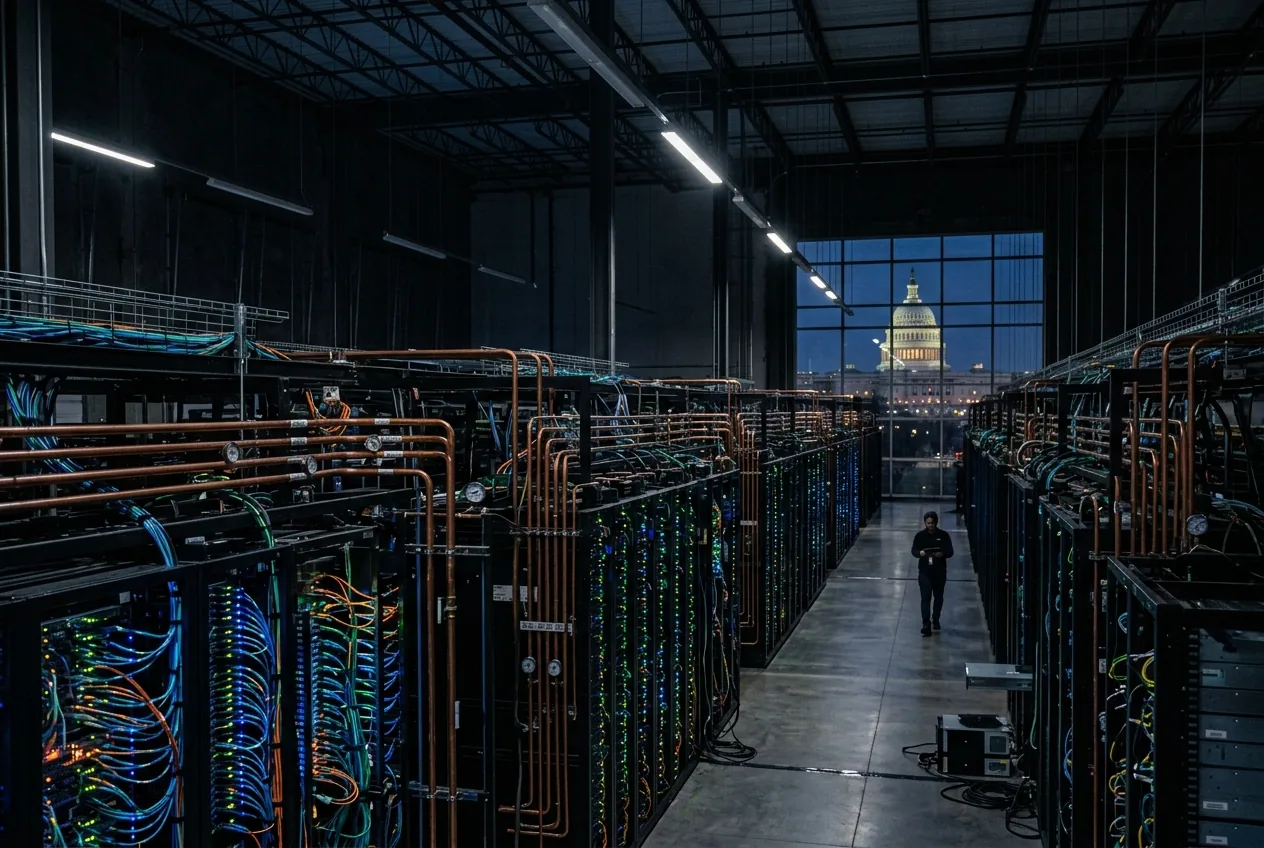
In an unprecedented maneuver to intertwine commercial machine learning infrastructure with sovereign state power, OpenAI has proposed granting the United States federal government an equity stake of roughly five percent. The proposal, initially floated by chief executive Sam Altman in preliminary discussions with the Trump administration, represents a dramatic departure from traditional tech lobbying, trading direct corporate ownership for regulatory immunity and geopolitical alignment.
With OpenAI’s private valuation reaching approximately $852 billion following its latest financing cycle, a five percent holding equates to roughly $42.6 billion. The overture reflects a recognition that frontier artificial intelligence is no longer governed merely by algorithmic innovation or software deployment. Instead, the sector has transitioned into a capital-intensive, energy-dependent industrial utility that requires direct state accommodation to scale.
While presented as a mechanism to distribute the economic windfalls of automation to the American public, the initiative functions as pragmatic risk mitigation. As Washington adopts an aggressive, interventionist posture toward critical compute infrastructure, direct equity stakes could become the price of regulatory clearance, grid access, and cross-border commercial legitimacy.
The Mechanics of Sovereign Equity in Frontier Compute
The proposal envisions a structured equity allotment that gives the executive branch a vested financial interest in OpenAI’s commercial performance. Under the framework discussed, the federal government would effectively become one of the company’s largest single institutional shareholders, trailing only core venture backers and hyperscale cloud partners.
From an accounting perspective, issuing $42.6 billion in equity to a sovereign entity carries significant dilution for existing cap-table participants, including venture capital funds, institutional asset managers, and employee option pools. However, in the capital allocation calculus of advanced artificial intelligence, dilution is an acceptable expense if it offsets existential sovereign risk. The physical requirements of frontier training runs require hundreds of thousands of interconnected accelerator chips, massive liquid-cooling distribution systems, and dedicated high-voltage substation interconnects, all of which fall under stringent federal and municipal regulatory scrutiny.
Reports indicate that Altman has framed the arrangement not as an isolated concession, but as a potential blueprint for the entire frontier compute sector. Under this expanded model, competing domestic developers of foundational models would be expected to tender comparable equity tranches to the federal government, establishing a quasi-nationalized tech conglomerate aligned with domestic industrial priorities.
Washington’s Shift Toward Hard Industrial Intervention
The negotiations unfold within an increasingly aggressive regulatory climate that has fundamentally restructured the relationship between Silicon Valley and the federal apparatus. Under the current administration, the White House has repeatedly leveraged national security instruments, supply chain mandates, and export restrictions to reshape advanced manufacturing and computing.
Precedents for this state-capitalist model have accumulated rapidly over recent months:
- Direct Semiconductor Stakes: The federal government previously orchestrated the acquisition of a 10 percent equity position in Intel, directly tying state industrial subsidies to sovereign ownership in domestic silicon fabrication.
- Bilateral Revenue Capture: Trade officials demanded a 15 percent revenue cut from major semiconductor designers, specifically Nvidia and AMD, on sanctioned compute architectures exported to international markets.
- Regulatory Enforcement Actions: Frontier research lab Anthropic suffered severe operational disruptions after the Department of Defense designated the organization an operational supply chain risk, followed by immediate export controls that forced the sudden withdrawal of flagship models from foreign deployment.
For OpenAI, the lesson of Anthropic’s regulatory bottleneck was unmistakable. The technical capacity to build multi-gigawatt compute clusters is irrelevant if sovereign trade controls or national security designations can paralyze deployment overnight. By offering the administration a multi-billion-dollar direct stake, OpenAI is engineering a structural buffer against similar unilateral interventions.
The Energy Grid and the Gigawatt Bottleneck
To understand why a software-origin enterprise would yield equity to the state, one must analyze the physical infrastructure undergirding modern frontier models. The industry has moved past the era where progress could be sustained within standard multi-tenant cloud facilities. Developing next-generation artificial general intelligence systems requires dedicated physical footprints demanding between one and five gigawatts of baseline electrical power.
Procuring five gigawatts of uninterruptible electricity is not a software optimization challenge; it is a heavy civil engineering and regulatory negotiation. The domestic electrical grid operates under severe transmission constraints, with regional transmission organizations imposing decade-long queues for heavy industrial interconnections. Large-scale transformer manufacturing lead times currently stretch beyond three to four years, and accessing dedicated baseload power increasingly requires long-term power purchase agreements tied to nuclear reactors or specialized natural gas turbines.
Navigating the Federal Energy Regulatory Commission, the Department of Energy, and environmental review procedures requires federal administrative leverage. An artificial intelligence enterprise co-owned by the federal government possesses distinct advantages when petitioning for priority access to regional grid allocations, fast-tracked environmental impact statements, or authorizations to construct private power generation infrastructure. In this context, a five percent equity transfer functions as an upfront capital investment in physical infrastructure acceleration.
Bipartisan Momentum for Public Compute Ownership
While the immediate negotiations center on the current executive administration, political appetite for capturing private AI enterprise value spans the ideological spectrum. Lawmakers have expressed growing anxiety over the socioeconomic displacement anticipated from ubiquitous cognitive automation, prompting calls for sovereign mechanisms to capture sector revenues.
Can Sovereign Ownership and Market Competition Coexist?
The institutionalization of federal equity in private artificial intelligence firms introduces profound distortions to market competition and technical governance. If the federal government assumes an equity position in OpenAI, the commercial boundary between the sovereign regulator and the regulated commercial entity evaporates.
This structural conflict presents acute systemic risks for competing research laboratories and hardware integrators. When the federal apparatus acts simultaneously as customer, regulator, national security arbiter, and equity holder, impartial procurement becomes functionally impossible. Competing developers, whether independent startups or operations financed by established tech conglomerates, would face an uneven procurement landscape where the government’s financial return is directly tied to the commercial dominance of a preferred partner.
Furthermore, sovereign equity creates severe implications for global supply chain coordination. Allied nations, particularly within the European Union and the Asia-Pacific region, already harbor deep concerns regarding the extraterritorial reach of American technology platforms. A frontier model provider operating with explicit federal equity ownership will face intense skepticism from international regulators, potentially accelerating the splintering of global computing architectures into isolated, state-controlled digital blocs.




Comments
No comments yet. Be the first!