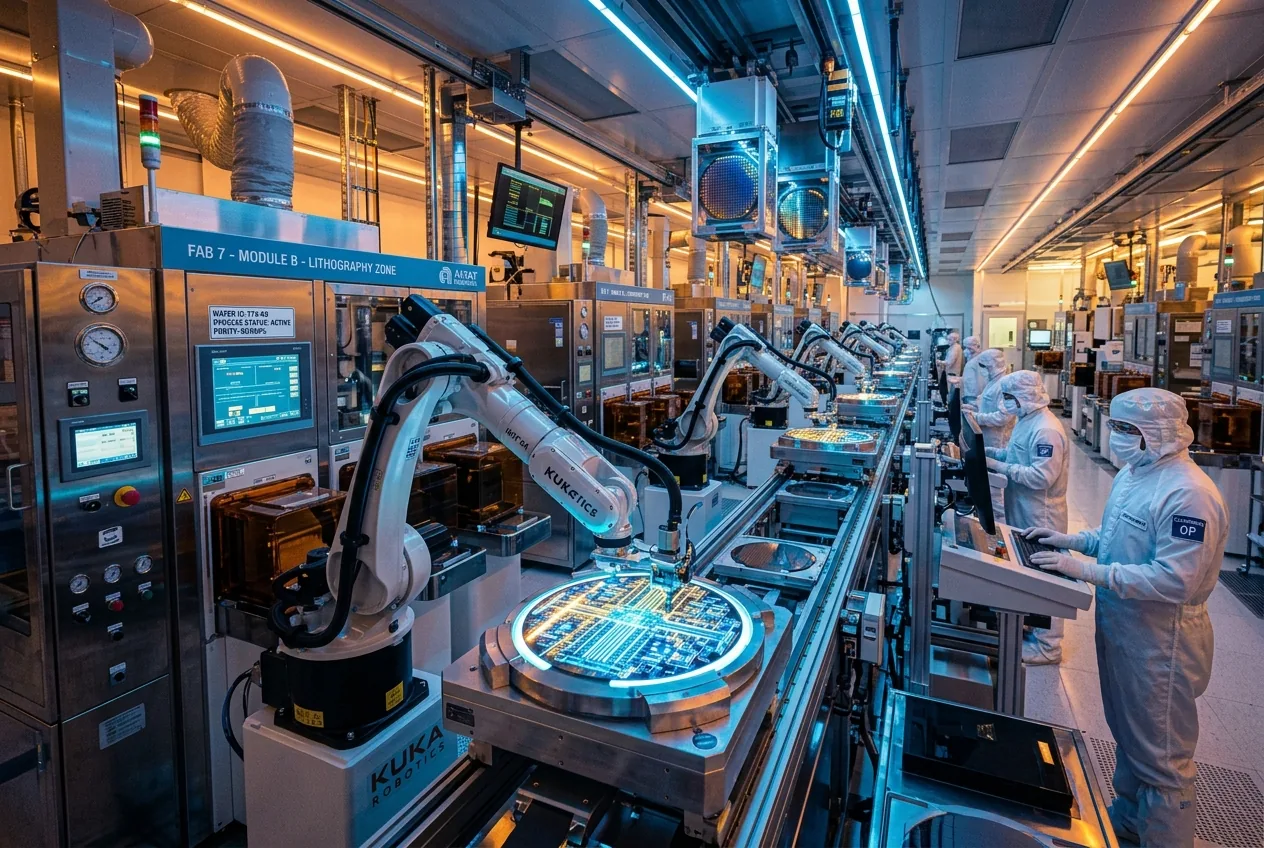
For years, frontier artificial intelligence research has operated primarily as a software enterprise sitting atop rented infrastructure. Model developers trained increasingly massive transformer networks on rented clusters of off-the-shelf accelerators, relying on merchant silicon vendors and public hyperscalers to absorb the immense capital expenditures and supply-chain headaches of physical fabrication. That arrangement is fracturing. OpenAI is aggressively transitioning from a software lab into an industrial powerhouse, moving down the physical technology stack to control its custom silicon, dictate raw semiconductor materials, and finance moonshot biotechnology.
The scale of this shift became unmistakable over the past week. Details emerged regarding “Jalapeño,” an in-house application-specific integrated circuit (ASIC) co-engineered with Broadcom; strategic procurement arrangements intended to secure up to 40 percent of the world’s raw DRAM wafer output through 2029; and a joint $500 million commitment alongside Anthropic, Stripe, and Bill Gates to launch Intercept, an organization engineered to eradicate the common cold and common respiratory pathogens. Viewed in isolation, each announcement represents an ambitious enterprise move. Taken together, they reveal an aggressive, vertically integrated strategy designed to bypass the primary mechanical, thermal, and supply constraints currently capping the scale of autonomous intelligence.
The Jalapeño ASIC and Agentic Hardware Co-Design
Developing bespoke silicon is neither cheap nor swift, historically requiring four to five years from architectural specification to tape-out and final packaging. With Jalapeño, OpenAI and networking silicon giant Broadcom are attempting to compress that development cycle through an aggressive closed-loop methodology: deploying autonomous software agents to write, verify, and optimize the hardware’s instruction set architecture and register-transfer level (RTL) code. By placing specialized agentic models directly in the design loop, logic synthesis and trace routing can be evaluated continuously against targeted inference workloads.
Broadcom brings a proven pedigree to this joint venture. Having spent years co-developing custom Tensor Processing Units (TPUs) for Google, the firm possesses the intellectual property blocks, SerDes high-speed interfaces, and packaging expertise needed to maximize per-die interconnect speeds. Jalapeño is engineered specifically around the operational mechanics of large language model serving, targeted directly at running the ChatGPT fleet, Codex APIs, and high-concurrency autonomous agent workflows. General-purpose graphics processing units (GPUs) carry silicon area and power overhead dedicated to legacy rasterization, double-precision scientific math, and flexible compute paths that transformer matrix multiplication simply does not exploit.
Cornering the Physical Substrate: 40% of Undiced DRAM
Silicon logic is functionally inert without high-bandwidth access to memory. The limiting factor in running frontier models is rarely pure arithmetic operations per second; it is memory bandwidth and capacity. Large models require vast parameters to be shifted back and forth across silicon boundaries with single-digit nanosecond latencies, giving rise to the modern high-bandwidth memory (HBM) stacking architectures that have created acute manufacturing pinches across Taiwan and South Korea.
OpenAI’s response to this memory wall is an audacious supply-chain maneuver: locking down contracts for an estimated 40 percent of global raw, undiced dynamic random-access memory (DRAM) wafer output through 2029. Rather than negotiating standard procurement of finished, packaged memory modules on quarterly cycles, the organization is securing the underlying unprocessed silicon wafers directly from manufacturers such as Micron Technology. This approach insulates the company against wild market cyclicality and manufacturing chokepoints.
From an industrial engineering standpoint, capturing undiced wafers before they undergo testing, cutting, and packaging offers profound advantages for custom system design:
- Bypassing standard merchant memory module interfaces allows engineering teams to implement proprietary 2.5D and 3D heterogeneous packaging schemas, bonding raw DRAM dies directly onto custom interposers adjacent to logic cores.
- Securing long-dated material reservations provides the structural guarantee required to schedule multi-year fabrication runs at foundries like TSMC without the risk of logic units sitting idle for lack of companion memory.
Can Silicon Engineering and AI Solve Biological Entropy?
While OpenAI’s hardware operations are designed to solve the immediate thermodynamic and physical constraints of running digital networks, its third major initiative looks outward toward biological systems. Partnering with primary competitor Anthropic, fintech platform Stripe, and philanthropist Bill Gates, OpenAI has pledged a combined $500 million to back Intercept, an organization chartered to eradicate common respiratory viruses, from seasonal rhinoviruses to influenza.
At first glance, an artificial intelligence company bankrolling clinical virology appears disconnected from its core data-center footprint. In reality, modern structural biology and macromolecular engineering have become computational disciplines governed by the same algorithmic paradigms that underpin natural language transformers. The mathematical frameworks used to model syntax and predict sequential tokens translate directly to predicting amino acid sequences, tertiary protein folding configurations, and macromolecular docking dynamics.
Respiratory viruses present an immense thermodynamic and evolutionary problem: high mutation rates, antigen variability, and varied cellular entry mechanisms. Historically, vaccine development has been reactive, engineering immunogens to counter strains after they emerge. Intercept intends to pivot that paradigm toward generative biology, deploying deep neural architectures to analyze viral fitness landscapes and identify ultra-conserved epitopes—structural regions of viral proteins that cannot mutate without rendering the pathogen non-viable. Compute-heavy screening can simulate billions of candidate binding proteins and broadly neutralizing antibodies in silico before wet labs ever pipette a single microliter of reagent.
The involvement of rival foundation model developers points to a deeper strategic convergence. Both OpenAI and Anthropic are eager to demonstrate that generative compute produces tangible societal dividends beyond synthetic text and automated office workflows. Eradicating systemic viral illness offers a clear return on capital: seasonal respiratory infections siphon hundreds of billions of dollars from global productivity annually, sidelining workers and placing persistent drag on human capital. If computational intelligence can compress a decade of biological discovery into months, the boundary between digital compute and molecular fabrication dissolves.
The Re-emergence of the Industrial Monopoly
What OpenAI is assembling resembles the vertical industrial monopolies of the twentieth century far more than the platform software businesses of the twenty-first. Henry Ford did not merely design automobiles; he built the River Rouge complex, owned the iron ore mines, cultivated rubber plantations, and controlled the rail corridors that moved parts to the line. When external suppliers created bottlenecks, Ford internalized the supply chain.
Yet vertical integration at this velocity carries profound operational fragility. Locking into capital-intensive, multi-year supply-chain arrangements exposes an organization to monumental execution risks if underlying algorithmic architectures suddenly shift. If the dominance of transformer-based attention mechanisms gives way to recurrent state-space models or novel analog neuromorphic architectures that do not require massive high-bandwidth memory pools, millions of secured DRAM wafers could transition from an operational asset into an expensive balance-sheet liability. For now, however, OpenAI is betting its future on a singular premise: that the future of intelligence will not be decided solely by lines of code, but by the physical capacity to reshape silicon, supply chains, and human biology.




Comments
No comments yet. Be the first!