The economic reality of building frontier artificial intelligence has collided with the idealistic corporate governance that birthed it. Reports detailing OpenAI’s decisive moves to dismantle its non-profit governance control and restructure as a conventional for-profit public benefit corporation represent more than an internal boardroom reshuffling. They signal the final transition of artificial intelligence from an academic research endeavor into a capital-intensive, heavy-infrastructure industry. Building and training state-of-the-art models no longer hinges merely on clever algorithms or novel mathematical transformer architectures; it requires the balance sheets, debt mechanisms, and massive equity liquidity typically reserved for energy utilities, semiconductor fabrication, and global transport networks.
For years, OpenAI navigated an awkward corporate structure: a non-profit foundation overseeing a capped-profit commercial arm, an arrangement conceived in 2019 to balance commercial capitalization with safety-first development. That architecture fractured publicly during the late 2023 boardroom coup that briefly ousted chief executive Sam Altman. Now, as the company burns through billions of dollars annually to secure high-performance computing clusters and train its next-generation reasoning architectures, the capped-profit experiment has reached its structural limits. Institutional investors, sovereign wealth funds, and the public markets demand clear ownership rights, transparent liquidation paths, and traditional fiduciary duties. To build the infrastructure of the coming decade, OpenAI has realized it must look like a standard corporate enterprise.
The Astronomical Economics of Megawatt-Scale Infrastructure
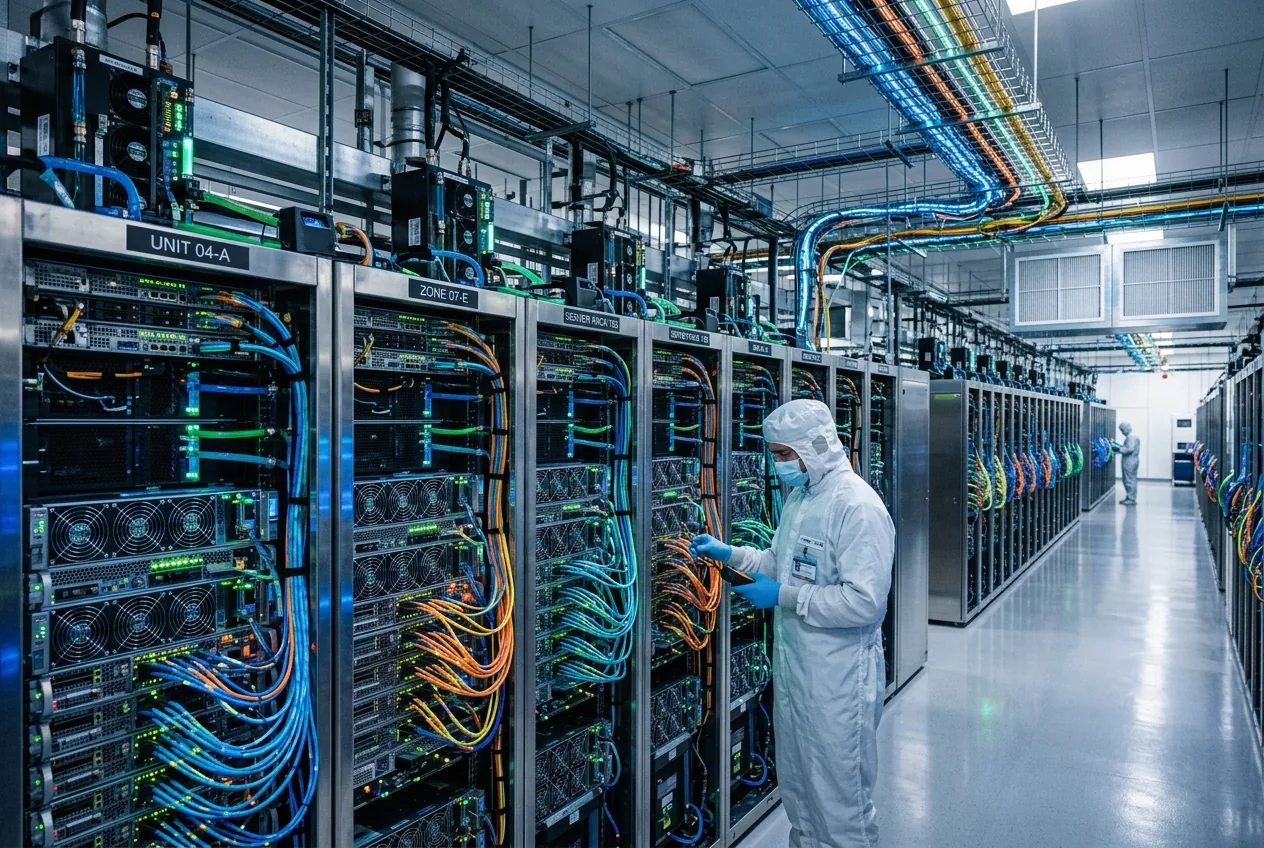
The core catalyst driving this transformation is not corporate ambition alone, but the relentless physical and economic demands of frontier AI infrastructure. Training models at the scale of GPT-4 and its successors has outgrown the financial capacity of typical venture capital syndicates. A single modern frontier training run can command tens of thousands of specialized accelerators, consuming dozens of megawatts of power and racking up hardware, cooling, and operational bills that run deep into nine figures. Operating these models at scale for hundreds of millions of weekly active users amplifies the problem from periodic training spikes into permanent, compounding operating expenditures.
Consider the silicon logistics. Procuring server racks equipped with modern clusters—such as NVIDIA’s Blackwell-generation systems—requires advance capital commitments measured in the billions of dollars. Beyond the raw purchase of silicon, the ecosystem requires high-bandwidth memory (HBM3e), liquid-cooling manifolds capable of dissipating hundreds of kilowatts per rack, specialized optical interconnects, and long-term contracts with regional utility grids to guarantee power delivery. When OpenAI projects capital expenditures scaling toward multi-gigawatt facilities—often discussed under the umbrella of speculative ventures like the $100 billion 'Stargate' data center proposal—it leaves the realm of traditional venture funding entirely. That scale of capital expenditure requires the direct liquidity of sovereign debt markets and publicly traded equities.
Financial estimates underscore this urgency. Reports indicate that despite generating upward of $3.7 billion in annualized revenue, OpenAI faces projected operating losses exceeding $5 billion in the near term, driven largely by compute rental costs and talent acquisition. In traditional tech software, gross margins routinely hover between 70 and 85 percent because distributing code across existing web infrastructure incurs negligible marginal costs. Frontier AI completely upends this SaaS economic model: every single query requires dynamic matrix math across banks of power-hungry GPUs. Without access to broad public capital markets, absorbing these ongoing compute costs while continuing frontier research creates an existential runway problem.
The Shadow of Anthropic and the Battle for Governance
This structural pivot highlights a philosophical and organizational divide that has split the AI industry since 2021. When Dario and Daniela Amodei left OpenAI alongside a cadre of foundational researchers to establish Anthropic, the split was explicitly motivated by concerns over commercial pressures overriding structural safety. Anthropic sought to solve the governance dilemma by establishing itself from the outset as a Delaware Public Benefit Corporation (PBC), paired with an independent Long-Term Benefit Trust designed to oversee model safety without financial stakes in the enterprise.
This corporate convergence exposes an unavoidable reality across the frontier ecosystem: no player, regardless of its original altruistic ethos, can survive without commercial-scale capital. Anthropic’s reliance on Amazon’s hyperscale data centers mirrors OpenAI’s deep dependency on Microsoft’s Azure cloud. The philosophical divergence between the two organizations now centers not on whether they engage with global financial markets, but on how much operational authority their internal governance bodies retain once public shareholders enter the capitalization table.
From Pure Software to Industrial Hardware and Embodied AI
The capital requirements driving OpenAI toward public markets extend beyond server farms and software interfaces. The ultimate economic value of frontier artificial intelligence does not terminate in a browser-based chat window; it lies in embodied intelligence, physical automation, and the orchestration of real-world industrial supply chains. This shift demands hardware deployment, sensor integration, and high-frequency edge compute, areas where operating margins are dictated by mechanical tolerances, physical wear, and complex global logistics.
OpenAI’s revived focus on physical robotics reveals this strategic horizon. After disbanding its internal robotics hardware team in 2020 to focus exclusively on digital large language models, the company has systematically re-entered the physical domain. Through capital allocations and technical partnerships with humanoid robotics developers like Figure AI and 1X Technologies, as well as the rebuilding of an in-house hardware engineering team, OpenAI is positioning its multimodal reasoning models to serve as the cognitive engines for physical machines. Merging complex spatial reasoning with physical actuators requires rigorous mechanical engineering, field validation cycles, and long-tail hardware iteration.
Scaling embodied AI fundamentally alters an enterprise's risk profile. Developing physical systems that operate inside fulfillment centers, automotive manufacturing floors, and unstructured construction environments requires capital reserves to handle inventory depreciation, supply chain disruptions, warranty liabilities, and safety compliance protocols. Software companies do not need to worry about the yield rates of harmonic drive gearboxes or the supply chain bottlenecks of rare-earth neodymium magnets; companies operating at the interface of industrial automation do. A public listing provides the robust balance sheet required to absorb the extended development timelines of complex physical systems.
The Legal and Regulatory Obstacles Ahead
The road to a public debut will not be a straightforward regulatory sprint. Transforming a non-profit entity that holds fiduciary ownership over intellectual property into a private or publicly tradable corporation is a legal minefield. In California, where OpenAI is incorporated, the state Attorney General wields broad authority over non-profit asset conversions. State law dictates that assets developed under a charitable, non-profit charter—which was supported by tax-deductible donations and public goodwill—cannot simply be transferred to private shareholders without fair-market compensation returning to the charitable trust.
Valuing that non-profit asset presents an unprecedented valuation puzzle. What is the fair market value of the foundational intellectual property, algorithmic checkpoints, and engineering research that yielded ChatGPT? If the non-profit wing must be compensated with billions of dollars in equity or cash to satisfy philanthropic oversight mandates, the resulting capitalization table will require delicate structural balance. Furthermore, legacy lawsuits from early founders, most notably Elon Musk, argue that pivoting away from the original open-source, non-profit charter constitutes a breach of the founding contract, adding persistent litigation risk to any future S-1 registration statement.
Simultaneously, antitrust regulators in both the United States and the European Union are already closely examining the interconnected relationships between leading AI labs and hyperscale cloud providers. A formal move toward a public listing will force complete transparency regarding OpenAI's commercial agreements, compute allocation terms, and revenue-sharing mechanisms with Microsoft. Wall Street will demand granular disclosures on gross margins, token subsidization costs, and corporate governance liabilities that have historically been shielded behind private fundraising announcements.
The Maturation of an Industrial Giant
Public markets bring intense, quarterly scrutiny, demanding sustainable unit economics, clear return on invested capital, and operational discipline. The era of hand-waving away multi-billion-dollar compute burn rates in the name of academic pursuit is rapidly closing. As OpenAI positions itself for public investors, it joins the ranks of the world's most critical infrastructure providers—enterprises whose success is measured not in philosophical manifestos, but in gigawatts delivered, physical systems deployed, and the ruthless efficiency of their bottom line.




Comments
No comments yet. Be the first!