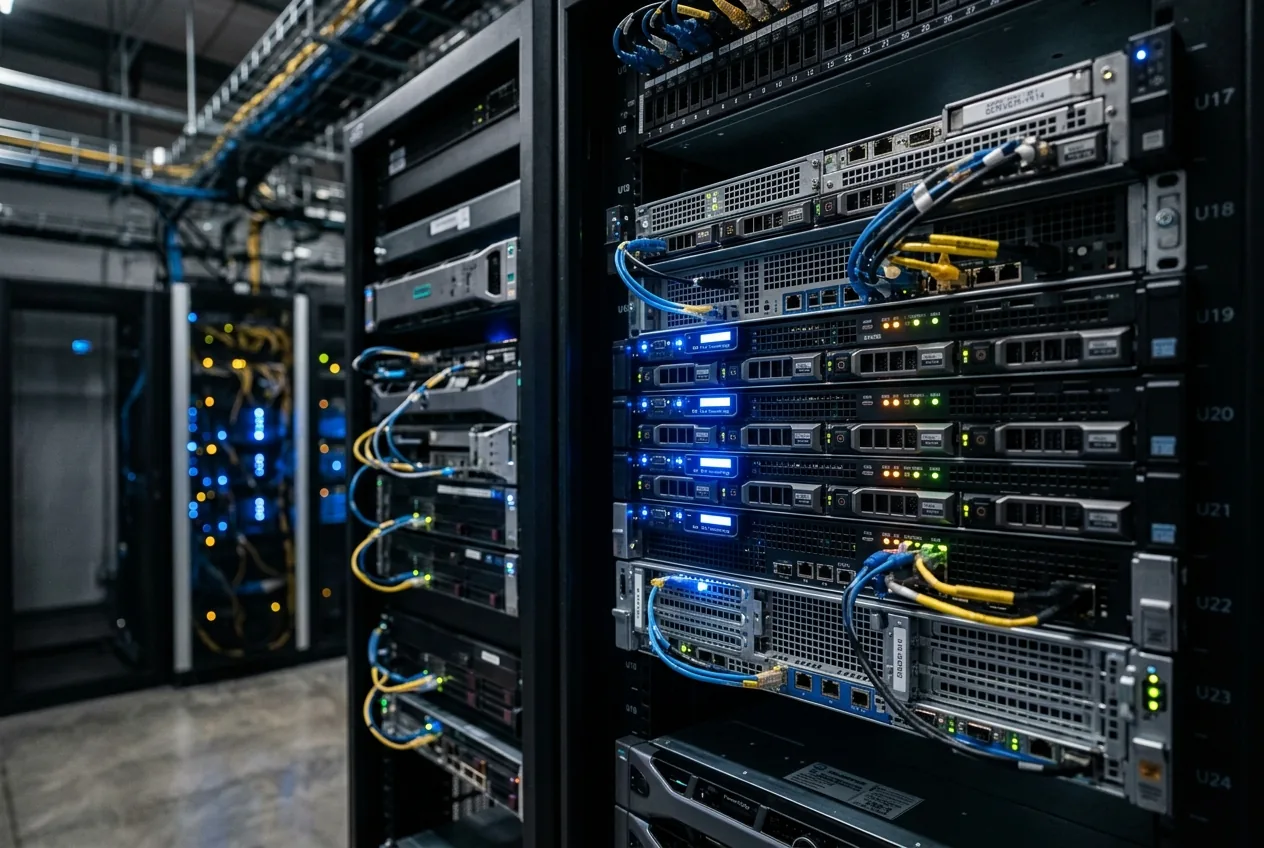
The frontier AI landscape has entered another high-stakes recalibration. Just weeks after Anthropic unsettled the enterprise and developer markets with the release of Claude Mythos 5, OpenAI has responded by pushing GPT-5.6 into general developer preview. The release marks a critical inflection point in the race between the two dominant model labs, shifting the battleground away from raw parameter scale toward agentic reliability, deterministic tool execution, and the ruthless economics of inference compute.
For enterprise architects and robotics engineers monitoring the shift from passive text generation to autonomous system orchestration, the release is more than an iterative patch. GPT-5.6 represents an architectural overhaul tailored specifically to counter the strengths Anthropic demonstrated with the Mythos architecture: near-zero hallucination thresholds in continuous loop reasoning, massive context retrieval fidelity, and lower tokens-per-task ratios across automated code and engineering pipelines.
The Architectural Pivot Behind the 5.6 Iteration
While OpenAI has maintained its customary secrecy regarding exact parameter counts and training cluster topology, technical documentation distributed to enterprise partners points to a fundamental restructuring of the model's underlying mixture-of-experts (MoE) configuration. Where earlier iterations prioritized broad multivariant world knowledge at the cost of high active parameter activation, GPT-5.6 leans heavily into dynamic sparse routing. The model utilizes a refined routing mechanism that activates roughly thirty percent fewer parameters per forward pass during deterministic reasoning tasks compared to its immediate predecessor, dramatically curbing both latency and floating-point operations per second.
This architectural adjustment is directly targeted at the benchmarks where Claude Mythos 5 gained critical ground. Anthropic built Mythos on an architecture optimized for persistent logical state tracking, which allowed it to dominate multi-turn reasoning and complex software dependency resolution without losing structural coherence. To challenge this, OpenAI implemented an adaptive test-time compute budget within GPT-5.6. Rather than treating every query with a static computational graph, the model evaluates problem complexity at the pre-fill stage and dynamically allocates internal search steps before emitting the first output token.
The result is a system that behaves less like a traditional autoregressive language model and more like an integrated reasoning engine. In automated evaluations measuring edge-case detection in concurrent software systems, GPT-5.6 cut hallucinated API declarations by forty-two percent relative to GPT-5.2, closing what had become an embarrassing performance delta against Claude's rigorous constitution-guided outputs.
Benchmark Realities Beyond Marketing Hype
Frontier model launches inevitably trigger an avalanche of vendor-selected evaluation suites, but independent engineering audits reveal a nuanced, highly competitive technical split. On standard synthetic benchmarks like SWE-bench Verified and competitive coding leaderboards, GPT-5.6 and Claude Mythos 5 are effectively operating within standard margins of error. Where the divergence becomes stark is in systemic, open-ended orchestration.
In long-horizon industrial automation pipelines—such as synthesizing Programmable Logic Controller code from unstructured piping and instrumentation diagrams—GPT-5.6 demonstrates superior raw throughput and third-party library integration. It resolves complex syntax trees across legacy languages such as Structured Text and C++ with fewer regenerative retries. Conversely, Claude Mythos 5 retains a measurable advantage in long-context instruction compliance over extended sequences exceeding two hundred thousand tokens. When tasked with auditing monolithic codebases without vector chunking, Mythos exhibits superior global awareness, rarely dropping negative constraints specified in initial prompt headers.
The pricing models accompanying this release also highlight diverging infrastructural realities. OpenAI has priced GPT-5.6 aggressively on input caching and batch inference, signaling that its custom datacenter hardware agreements and optimized inference kernels are beginning to yield tangible cost reductions. For high-volume automated testing and synthetic data generation, GPT-5.6 achieves a distinct price-to-performance edge, forcing Anthropic to reconsider its high-tier compute pricing for enterprise cloud instances.
Autonomous Agents on the Factory Floor
The true proving ground for these models is no longer the browser interface or customer support chat; it is the real-world operational loop. As industrial facilities integrate foundation models into physical systems, the tolerances for latency variance and cognitive drift drop to near zero. A robotic cell controller or automated warehouse dispatcher cannot tolerate non-deterministic tool failures or token-level hallucinations that disrupt physical hardware.
GPT-5.6 introduces what OpenAI calls Structured State Verification, a hardware-aware validation protocol that enforces strict adherence to schema schemas before external remote procedure calls are executed. In practical terms, this allows the model to interact directly with edge orchestration frameworks, such as the Robot Operating System, without requiring intermediary sanitization layers. The model can parse high-frequency sensor telemetry, detect operational anomalies, and construct valid kinematics trajectories with bounded computational overhead.
Yet engineering teams working in advanced manufacturing express cautious pragmatism. Claude Mythos 5 remains the preferred model among many robotics engineers due to its predictable failure states. When Mythos encounters an ambiguous system state or contradictory telemetry, its internal guardrails prioritize immediate halt conditions over speculative execution. GPT-5.6, while significantly more disciplined than its predecessors, still exhibits an inherent bias toward completion, occasionally attempting to resolve irreconcilable state errors by hallucinating environmental workarounds. In consumer software, this looks like a creative bug fix; on an automated assembly line handling half-ton battery packs, it is a catastrophic liability.
The Shifting Economics of Inference Compute
Beneath the competition over leaderboard percentages lies the harsh reality of compute infrastructure. Training frontier models requires hundreds of millions of dollars in capital expenditure, but inference deployment is where the financial balance sheet is either secured or broken. Both OpenAI and Anthropic are under severe pressure from corporate backers to prove that these models can deliver positive gross margins at massive operational scale.
Meanwhile, Anthropic's partnership with hyperscale cloud providers has focused heavily on specialized silicon utilization, optimizing Claude Mythos 5 for maximum throughput per watt on alternative accelerator platforms. The consequence of this divergence is a fragmented enterprise ecosystem: organizations running purely on public cloud infrastructure are selecting their frontier models based as much on native accelerator availability and regional datacenter latency as on benchmark scores.




Comments
No comments yet. Be the first!