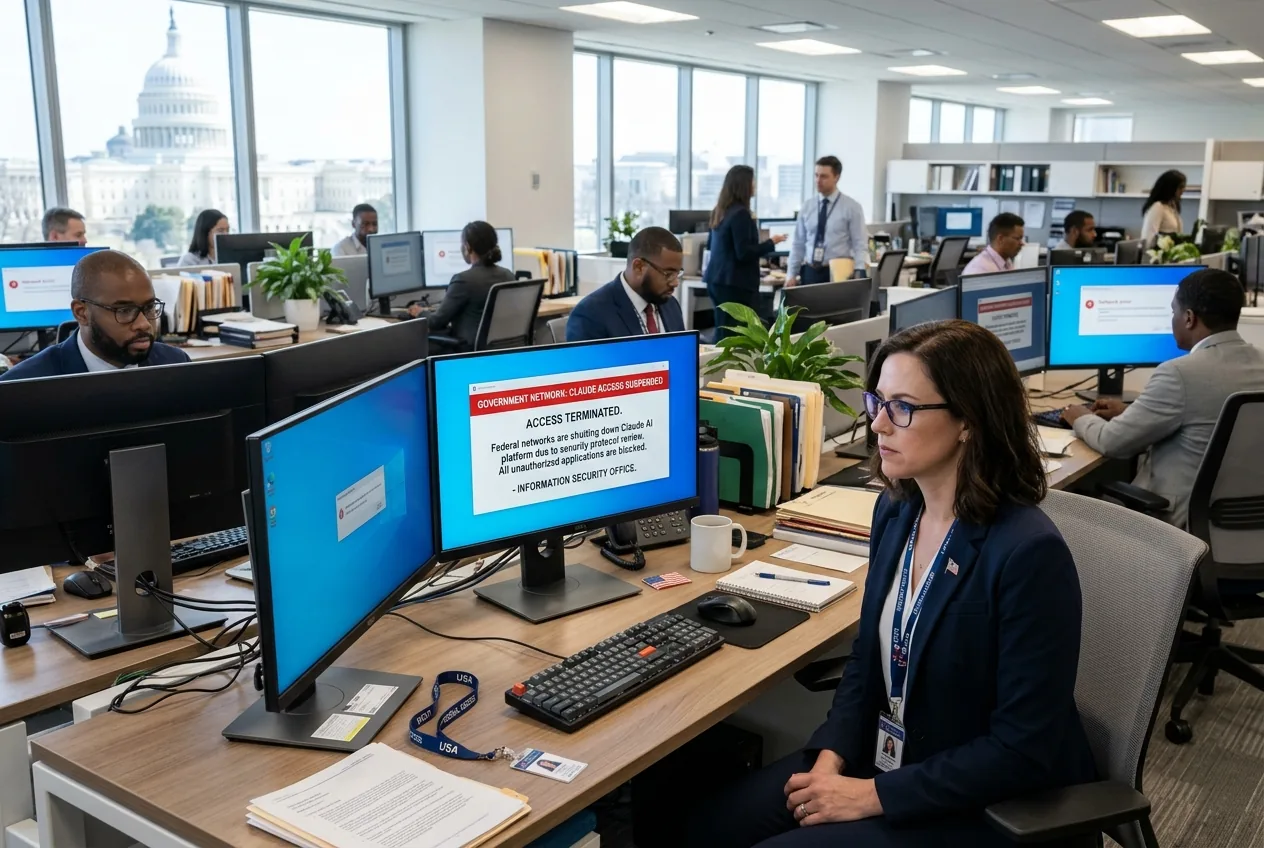
In the corridors of federal administration, the arrival of advanced generative artificial intelligence has met an immovable wall of institutional risk management. Headlines proclaiming sudden government bans on Anthropic’s Claude series have stirred alarm across the tech industry, but behind the dramatic framing lies a calculated, technical retrenchment. Multiple government entities—from congressional administrative bodies to defense-adjacent research groups—have instituted sweeping prohibitions on the use of commercial, consumer-facing iterations of Claude, barring staff and contractors from deploying the system on official hardware or within institutional networks.
The decision to restrict access to frontier systems like Claude 3.5 Sonnet and Claude 3 Opus is not an ideological rejection of artificial intelligence. Instead, it reflects an acute operational dilemma. As commercial foundation models approach unprecedented levels of reasoning and autonomous execution, the technical infrastructure supporting their deployment remains fundamentally incompatible with federal data custody, compartmentalization, and cybersecurity mandates. The quiet lockout of these models marks the end of generative AI’s grace period within the public sector.
The Mechanics of Federal Prohibition
The regulatory mechanics behind these bans operate on multiple institutional layers rather than a single executive fiat. The most visible actions have emerged from administrative oversight offices, such as the Office of the Chief Administrative Officer for the U.S. House of Representatives, which issued strict directives preventing congressional staff from utilizing unauthorized generative tools. These policies explicitly designate unapproved large language models, including Anthropic’s web and desktop applications, as operational hazards subject to network-level blocking.
For federal administrators handling sensitive legislative drafting, proprietary regulatory data, or nascent national security assessments, routing queries through non-certified commercial endpoints violates the core tenets of information security. Without verified zero-retention guarantees, cryptographic hardware isolation, and FedRAMP High baseline authorizations, commercial AI deployments represent an unacceptable data exfiltration vector. The prohibition, therefore, is an enforcement of legacy data governance applied directly to frontier software.
The Architectural Vulnerability of Commercial APIs
To understand why models as capable as Claude face institutional blocks, one must examine the mechanical reality of how these models execute tasks. Claude 3.5 Sonnet, widely recognized for its state-of-the-art coding and analytical reasoning, relies on continuous input-output loops that ingest massive blocks of contextual text. In an enterprise or government workflow, users routinely paste technical whitepapers, budgetary spreadsheets, and unredacted memos into the prompt window to extract summaries or refactor code.
In standard commercial deployments, this ingestion introduces significant attack surfaces. Chief among these is indirect prompt injection, a mechanical exploit where hidden or adversarial text embedded within an analyzed document overrides the model’s internal instructions. If an analyst tasks an automated agent with scanning external regulatory submissions, an embedded adversarial payload could instruct the model to summarize the document while quietly exfiltrating adjacent system metadata or altering analytical conclusions.
Furthermore, federal cybersecurity teams must account for supply chain provenance and model weight residency. In conventional cloud hosting, model inference is distributed across clusters of graphics processing units, often dynamically allocated based on global load balancing. Federal operational security requires absolute certainty regarding where data sits physically and cryptographically at every microsecond of execution. Multi-tenant public APIs, by their very design, prioritize dynamic scalability over verifiable physical isolation, making them fundamentally non-compliant with stringent defense or civil protection baselines.
The Conflict Between Safety Frameworks and National Security
While commercial safety evaluations focus on preventing systemic social harms, federal procurement requires certainty regarding dual-use capabilities. Frontier models that demonstrate superior capabilities in automated software vulnerability discovery—a core strength of Claude 3.5 Sonnet—present a symmetrical dilemma. A system capable of identifying zero-day vulnerabilities in critical infrastructure software can defend networks, but it can also be leveraged by sophisticated adversaries to automate exploits at machine speed.
Executive Order 14110 established explicit reporting thresholds for models trained on compute footprints exceeding 10^26 floating-point operations, mandating that developers share red-teaming safety results with the federal government. Yet, federal oversight bodies often view self-reported benchmarks as insufficient. When an administrative ban is enacted, it frequently signals that government security teams have not yet established independent, air-gapped evaluation protocols to verify that a model's safety guardrails cannot be stripped away via sophisticated jailbreaking or latent weight manipulation.
The Industrial Impact on Federal Contractors and Supply Chains
The friction between frontier model availability and federal procurement standards reverberates far beyond Washington office buildings. Commercial enterprises, industrial manufacturers, and defense contractors that interface with federal agencies operate under strict compliance umbrellas. When federal networks outlaw specific commercial endpoints, contractors handling government contracts are forced to mirror those restrictions within their internal engineering environments.
This creates immediate operational headwinds for organizations attempting to modernize their software stacks. Many engineering teams have integrated advanced language models into their automated computer-aided design workflows, inventory management systems, and technical documentation pipelines. If an aerospace contractor working on a defense logistics platform cannot legally process technical specifications through commercial frontier models, the organization faces an efficiency penalty compared to commercial peers operating without public sector constraints.
As a result, industrial technology sectors are experiencing an accelerated push toward private, localized deployment models. Rather than relying on public cloud-hosted instances of Claude, government-adjacent enterprises are increasingly demanding model weights that can be run on sovereign, air-gapped server clusters. The market demand is pivoting from raw algorithmic performance to deployable architectural security.
Sovereign Enclaves and the Next Phase of Federal Deployment
The institutional ban on commercial Claude deployments is not permanent; rather, it marks the opening chapter of a predictable enterprise life cycle. Frontier models rarely integrate into federal operations through their consumer interfaces. Instead, they must be rebuilt and redeployed through enterprise defense alliances that meet Impact Level 5 and Impact Level 6 security baselines.
These dedicated government instances strip away the web-based conveniences of commercial generative AI in favor of auditable, controlled programmatic access. The reality of government AI bans is not that Washington has turned its back on frontier machine intelligence, but rather that the state is asserting its terms. Frontier models will not be permitted to redefine federal operational security; federal operational security will re-architect how frontier models are deployed.



Comments
No comments yet. Be the first!