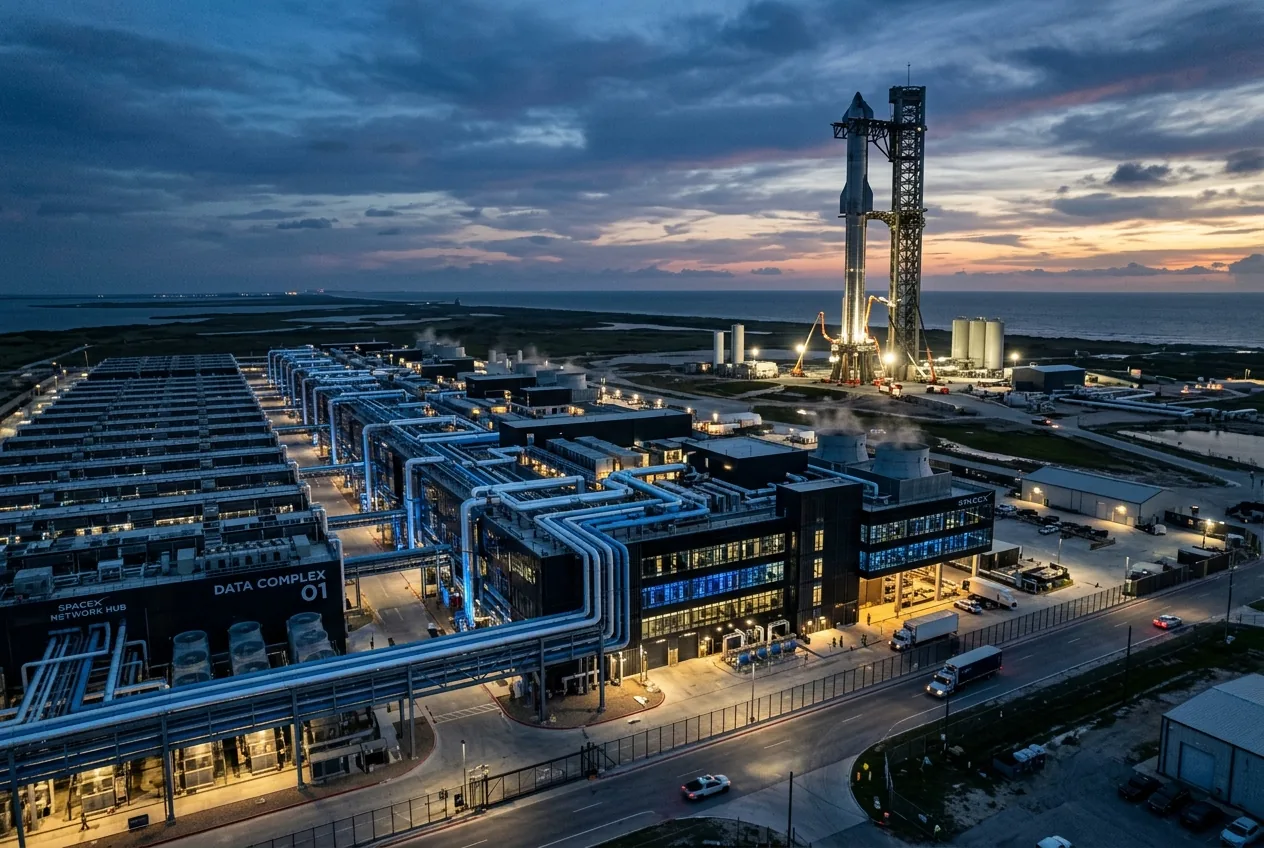
When SpaceX filed its S-1 prospectus with the Securities and Exchange Commission last week, the financial world expected a look into the high-margin world of Starlink and the capital-heavy development of Starship. What they received instead was a revelation that fundamentally shifts the narrative of Elon Musk’s aerospace firm: SpaceX is now one of the world’s most significant AI infrastructure providers. The filing reveals a record-breaking contract with Anthropic, the AI safety and research company, worth a staggering $1.25 billion per month.
The Colossus Infrastructure: Compute as a Commodity
The technical heart of this deal lies in what the filing describes as the "COLOSSUS" supercomputing clusters. Anthropic is not paying for rocket rides; it is paying for access to high-performance computing (HPC) capacity. According to the S-1, Anthropic will maintain this $1.25 billion monthly commitment through May 2029. This arrangement positions SpaceX as a direct competitor to traditional hyperscalers like Amazon Web Services (AWS), Google Cloud, and Microsoft Azure.
From an engineering perspective, SpaceX’s move into massive-scale compute makes logical sense despite the surface-level industry difference. Building and maintaining large-scale satellite constellations like Starlink requires immense ground-station infrastructure, advanced thermal management systems, and a mastery of global power distribution—the same fundamental requirements for running AI data centers. By leveraging its existing expertise in power electronics and cooling, SpaceX has been able to stand up the Colossus clusters with a speed that rivals established tech giants.
The contract includes a strategic "ramp-up" period during May and June of 2026, where fees are reduced as the hardware comes online. This suggests that SpaceX is currently in a heavy capital expenditure phase, building out the physical racks and networking required to support Anthropic’s next-generation large language models. For Anthropic, the deal secures a massive, dedicated block of compute in an era where GPU availability remains the primary bottleneck for AI development.
The AWS Parallel and the Economics of Excess Capacity
Analysts are already drawing parallels between SpaceX’s current trajectory and the early days of Amazon Web Services. Originally, AWS was built to handle Amazon’s internal retail surges; the company eventually realized it could monetize its excess capacity by renting it to others. SpaceX likely developed its supercomputing capabilities to handle the complex physics simulations required for Starship’s orbital mechanics and the real-time routing logic for the Starlink mesh network.
In the world of industrial automation and mechanical engineering, we call this the optimization of "idle time." If SpaceX has built a compute environment capable of handling its peak internal simulation loads, there is significant value in selling that capacity to external partners when it is not being fully utilized by internal engineering teams. The Anthropic deal, however, goes beyond mere "excess capacity." The scale of $1.25 billion a month suggests a dedicated build-out designed to provide a steady, high-margin revenue stream that balances the volatile costs of rocket development.
This "dual-use" infrastructure model—where hardware serves both internal mission-critical functions and external commercial clients—is a pragmatic solution to the high burn rate of space exploration. It effectively turns SpaceX into a diversified technology conglomerate where the AI business subsidizes the Mars mission, and the Mars mission provides the engineering breakthroughs that keep the AI business competitive.
Risk Management and the 90-Day Termination Clause
A notable detail in the S-1 filing is the flexibility granted to both parties. Either SpaceX or Anthropic can terminate the agreement with just 90 days' notice. On the surface, this might seem like a risk for SpaceX, given the massive capital required to build out the Colossus clusters. However, in the context of the current AI arms race, compute is a fungible and highly liquid asset. If Anthropic were to walk away, SpaceX would likely have a line of other AI developers—ranging from OpenAI to Meta—eager to step into that capacity.
For Anthropic, the 90-day window provides a safeguard against the rapid obsolescence of hardware. As new AI chips from NVIDIA or AMD hit the market, Anthropic retains the ability to pivot if SpaceX fails to keep the Colossus clusters at the cutting edge of performance. This creates a high-stakes environment for SpaceX’s hardware engineers, who must now ensure that their data center operations evolve as quickly as their rocket engines.
The Trillion-Dollar Valuation Debate
The filing reveals that Elon Musk retains 85.1% voting control over SpaceX. This concentration of power is a double-edged sword for IPO investors. On one hand, it allows for the kind of long-term, high-risk decision-making that led to the success of the Falcon 9 and Starlink. On the other hand, it means shareholders are essentially along for the ride, with limited ability to influence the company’s direction or the allocation of the massive revenues generated by the Anthropic deal.
The $1.75 trillion target valuation is bold, especially given the Q1 losses. However, the Anthropic contract changes the math. Investors are no longer just valuing a launch company; they are valuing a vertically integrated energy, communications, and intelligence utility. If SpaceX can reliably deliver $15 billion in annual revenue from a single AI client, the path to profitability becomes much clearer. The market is betting that the synergy between space-based data transit (Starlink) and ground-based data processing (Colossus) creates a moat that is virtually impossible for competitors like Blue Origin or even traditional cloud providers to cross.
Furthermore, the filing suggests that other tech giants, such as Meta, are watching this model closely. Mark Zuckerberg’s company has invested tens of billions into H100 GPU clusters. If Meta finds itself with underutilized compute between training cycles for its Llama models, the SpaceX-Anthropic deal provides a blueprint for how to monetize that silicon. We may be entering an era where the world’s most valuable companies are those that can most efficiently flip the switch between internal innovation and external infrastructure sales.
A New Frontier for Industrial Technology
As SpaceX prepares for its Nasdaq debut, the focus will remain on the spectacular launches at Starbase and the growing number of Starlink dishes on rooftops. But the real story for the pragmatic investor is found in the rows of servers and the complex cooling loops of the Colossus clusters. The Anthropic deal marks the maturation of SpaceX from an experimental rocket firm into a foundational pillar of the global economy.




Comments
No comments yet. Be the first!