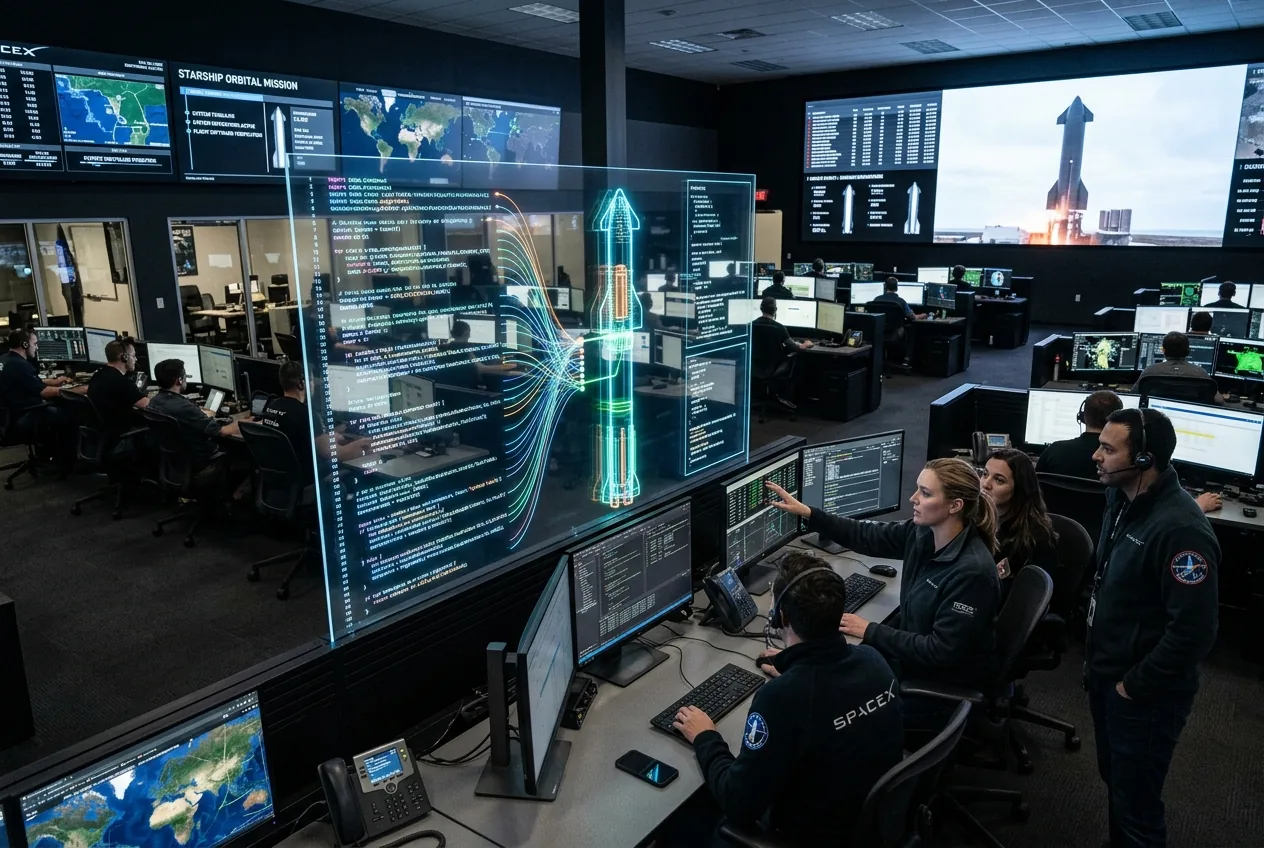
In a move that has sent shockwaves through both the aerospace and software sectors, SpaceX has announced the acquisition of Cursor, the AI-native code editor startup, for a staggering $60 billion. This acquisition marks one of the largest in the history of the technology industry, placing SpaceX—a company primarily known for rockets and satellite constellations—at the epicenter of the generative artificial intelligence arms race. While the price tag is astronomical, the strategic logic behind the deal suggests that SpaceX is no longer content with being a hardware manufacturer. It is positioning itself as an end-to-end intelligence powerhouse capable of out-coding the likes of OpenAI and Anthropic.
For those of us observing from the perspective of mechanical engineering and industrial automation, this isn't just about a flashy valuation. It is about the fundamental infrastructure of modern engineering. SpaceX’s success has always been predicated on its ability to iterate faster than any government agency or legacy aerospace contractor. By bringing Cursor’s advanced codebase-indexing and autonomous coding capabilities in-house, SpaceX is essentially building a specialized nervous system for its engineering teams, one designed to handle the crushing complexity of multi-planetary logistics and autonomous satellite fleet management.
The Architecture of an AI-Native Engineering Firm
To understand why a rocket company would pay $60 billion for a text editor, one must look at the technical bottleneck of modern aerospace: software. A modern Starship flight controller or a Starlink v3 satellite is a marvel of hardware, but its functionality is entirely dependent on millions of lines of C++ and Rust code. This code must be mission-critical, low-latency, and capable of handling edge cases in environments—such as the vacuum of space or the high-heat re-entry of Earth’s atmosphere—where hardware failure is often final.
Breaking the Dependency on OpenAI and Anthropic
The strategic risk of relying on third-party AI providers is significant for a company with high-security government and military contracts. Relying on an external API to process proprietary flight algorithms or encryption protocols for Starshield (the military-focused version of Starlink) represents a vulnerability. By owning Cursor, SpaceX can develop proprietary, air-gapped models trained specifically on its secret internal datasets—data that captures decades of launch successes and failures. This creates a proprietary feedback loop: the AI learns from the physics of real-world rockets, and the rockets become safer and more efficient because of the AI.
Accelerating Hardware-in-the-Loop Testing
From an industrial automation standpoint, the most compelling aspect of this deal is the potential for automated Hardware-in-the-Loop (HIL) testing. In traditional aerospace engineering, the gap between writing code and testing it on actual hardware is a significant drag on time. Engineers must write the code, simulate it, then deploy it to a test rig that mimics the rocket's hardware environment. Errors found at the HIL stage often require cycles of manual debugging that can take weeks.
With Cursor’s technology integrated into the SpaceX workflow, the AI can theoretically predict how a code change will affect hardware performance before the code is even compiled. If the AI understands the mechanical constraints of a Raptor engine’s gimbal system, it can prevent a software engineer from writing an instruction that would exceed the physical limits of the actuators. This integration of 'physics-aware' coding is likely the ultimate goal of the acquisition. It moves the development process from a reactive model—fixing errors as they occur—to a predictive model where the software is optimized for the physical world in real-time.
The Economic Viability of a $60 Billion Bet
Critics will argue that $60 billion is an overpayment for a startup that, until recently, was seen as a niche tool for developers. However, the valuation must be viewed through the lens of SpaceX's long-term ambitions. If SpaceX can reduce the development time of the Mars-bound Starship by even 20% through AI-augmented engineering, the saved capital in hardware testing and fuel alone could run into the billions. Furthermore, the Starlink constellation requires constant software updates to manage orbital debris avoidance and data routing for millions of users. Automating the maintenance of this global network is not just a luxury; it is a necessity for scaling to a multi-billion-dollar revenue stream.
There is also the matter of talent. In the current market, the world's most talented AI researchers are more likely to work for a company that offers them the chance to apply their models to the most challenging problems in the solar system. By acquiring Cursor, SpaceX is effectively building a 'center of excellence' for AI that rivals Google or Meta. They are no longer just hiring rocket scientists; they are hiring the architects of the future's digital logic.
How Does This Change the Competitive Landscape?
The move puts immense pressure on Anthropic and OpenAI, who have both positioned themselves as the go-to platforms for enterprise AI. If SpaceX succeeds in creating a superior, specialized coding environment that outshines the general-purpose offerings of the tech giants, it could lead to a fragmentation of the AI market. We may see a shift away from 'one-size-fits-all' models toward hyper-specialized intelligences designed for specific industries like aerospace, medicine, or robotics.
Furthermore, this acquisition likely intensifies the rivalry between Elon Musk’s various ventures and the rest of Silicon Valley. With xAI (Musk’s separate AI company) already in existence, the acquisition of Cursor by SpaceX suggests a tightening of the ecosystem. We can expect a high degree of cross-pollination between Cursor’s coding tools, xAI’s large language models, and Tesla’s Optimus robotics program. The common thread is the translation of digital intent into physical action—whether that action is a robot arm moving a part or a rocket engine firing in orbit.
The Technical Reality of the Transition
The immediate challenge for SpaceX will be the integration. Moving a startup’s culture into the rigorous, safety-conscious environment of a launch provider is no small feat. However, SpaceX has a history of absorbing technologies and scaling them rapidly. The goal will likely be to transition Cursor from a general-purpose tool to a specialized 'SpaceX IDE.' This tool would come pre-loaded with every engineering standard, material property, and flight history data point available to the company.
For the broader engineering community, this acquisition is a signal that the era of 'manual' coding in high-stakes industry is coming to an end. The role of the engineer is shifting from a writer of syntax to a curator of logic and a validator of AI-generated systems. In the context of SpaceX, this means that the next generation of rockets will not just be designed by humans using computers, but by humans working in a seamless partnership with an AI that understands the laws of physics as well as it understands the laws of code.
As we look toward the next decade of space exploration, the $60 billion price tag for Cursor may eventually look like a bargain. In the race to Mars, the most powerful engine may not be the one burning liquid oxygen and methane, but the one processing lines of code at the speed of thought.




Comments
No comments yet. Be the first!