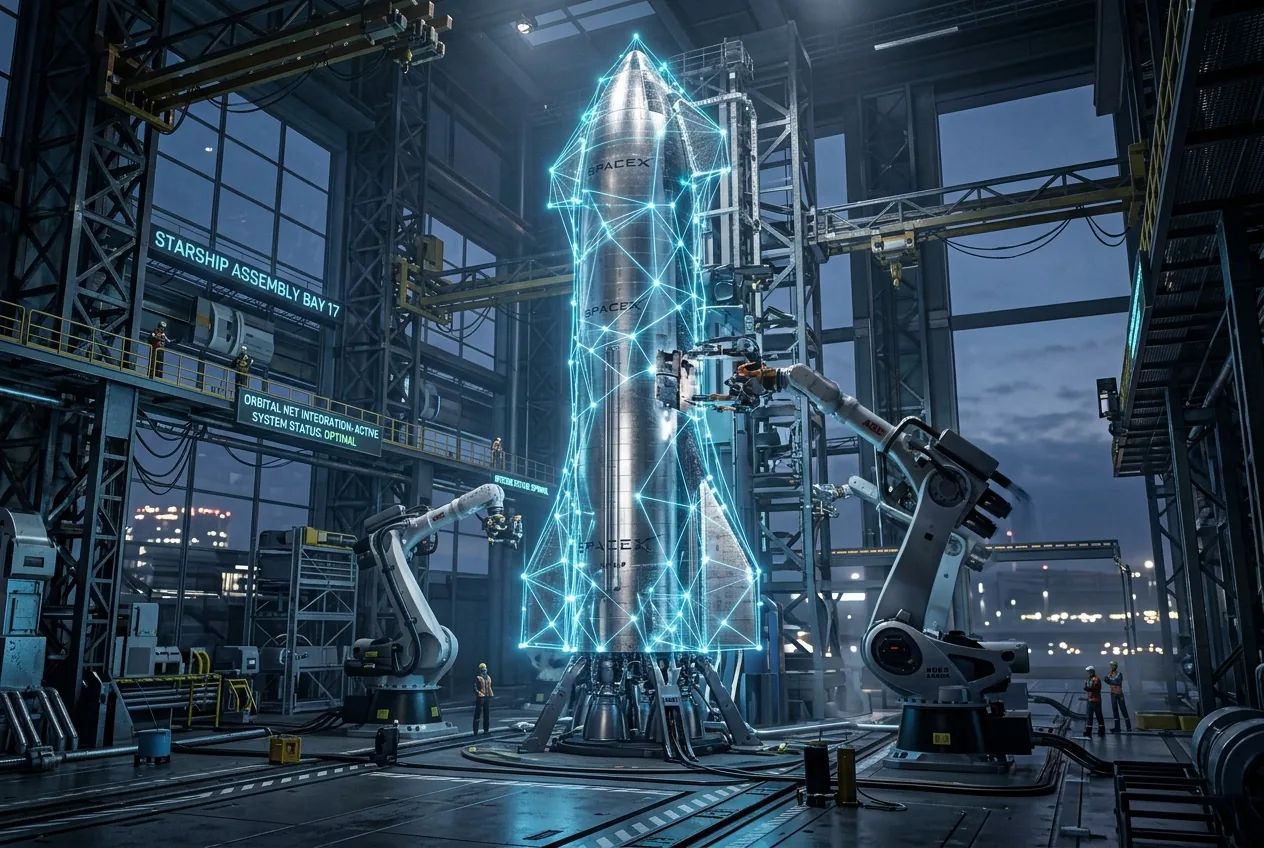
In a move that fundamentally redraws the boundaries between heavy industry and artificial intelligence, SpaceX has reportedly moved to acquire Anthropic in a deal valued at approximately $60 billion. This acquisition, which represents one of the largest consolidations of technical capital in history, signals a shift from AI as a digital assistant to AI as a core mechanical component. For SpaceX, the move is less about competing with search engines and more about the immediate requirement for high-level reasoning in the harsh, high-latency environments of deep space and automated orbital manufacturing.
From a mechanical engineering perspective, the synergy between SpaceX’s Starship development and Anthropic’s Claude models offers a solution to the most significant bottleneck in space exploration: the autonomy gap. As we move beyond low Earth orbit (LEO), the speed-of-light delay makes real-time human intervention impossible. By integrating Anthropic’s Constitutional AI frameworks directly into the avionics and telemetry stacks of its fleet, SpaceX is not just building a better rocket; it is building a self-contained, decision-making entity capable of managing complex logistics on the lunar or Martian surface without a tether to Houston.
The Engineering Logic of Integrated Reasoning
To understand why a rocket company would spend $60 billion on a software firm, one must look at the telemetry data. Modern aerospace systems generate petabytes of sensor data per second. Currently, much of this is processed via heuristic algorithms—fixed rulesets that can fail when faced with non-linear environmental stressors. Anthropic’s models, which utilize a transformer architecture designed for reasoning over massive datasets, offer a more robust alternative for system health monitoring and predictive maintenance.
In a vacuum, hardware failure is often catastrophic. Integrating a localized LLM into the flight computer allows for real-time diagnostic synthesis. Instead of throwing a generic error code, the system can cross-reference current thermal gradients with historical flight logs and material stress tolerances to provide a probabilistic solution. This is not mere speculation; it is the logical evolution of Digital Twin technology. By placing Anthropic’s neural networks at the heart of the SpaceX fabrication and launch process, the company can accelerate its iterative design cycle, using AI to predict structural weaknesses in stainless steel alloys before a prototype even hits the test stand.
Closing the Loop on Robotics and Automation
While Tesla has been the primary vehicle for Musk’s robotics ambitions through the Optimus program, the SpaceX-Anthropic merger provides the high-level cognitive layer that has been missing from industrial automation. In the context of SpaceX’s 'Starfactory' in South Texas, the goal is high-cadence production of the most complex machine ever built. The bottleneck in such environments is rarely the speed of the robotic arm, but rather the arm’s ability to adapt to variability in parts or environmental conditions.
Anthropic has distinguished itself through 'Constitutional AI,' a method of training models to follow a set of internal principles rather than just mimicking human data. This makes their models uniquely suited for industrial safety. In a high-stakes environment like a launch pad or an orbital refueling station, you need an AI that understands physical constraints and safety protocols as rigid laws, not suggestions. This deal suggests that SpaceX intends to use Anthropic’s R&D to create a specialized 'Industrial Claude'—a model optimized for spatial reasoning, material science, and mechanical troubleshooting.
The Starlink Compute Network
One of the most overlooked aspects of this acquisition is the infrastructure. Anthropic requires massive amounts of compute to train and run its models; SpaceX owns the world’s most expansive satellite constellation. While Starlink is currently marketed as a broadband provider, its long-term value lies in its potential as a global, decentralized edge computing network. By installing AI hardware on future generations of Starlink satellites, SpaceX could provide low-latency inference services to every corner of the globe, effectively creating an orbital 'brain' that bypasses traditional terrestrial data centers.
This provides SpaceX with a dual-stream revenue model. They can sell the connectivity (Starlink) and the intelligence (Anthropic) as a bundled service for defense, maritime, and research sectors. For an engineering firm, the vertical integration here is staggering. They control the launch vehicle, the satellite hardware, the communication protocol, and now, the cognitive software layer. This reduces 'technical friction'—the lag and overhead associated with integrating third-party software into proprietary hardware systems.
Economic Viability and Market Positioning
Critics will point to the $60 billion price tag as a sign of overextension. However, when viewed against the backdrop of the global defense and aerospace market, the numbers begin to align. The United States Department of Defense has increasingly prioritized 'AI at the Edge' for its Joint All-Domain Command and Control (JADC2) initiative. A SpaceX-Anthropic entity is uniquely positioned to capture these contracts, offering a level of hardware-software cohesion that traditional contractors like Lockheed Martin or Boeing currently lack.
The Future of Constitutional Aerospace
Perhaps the most compelling technical outcome of this merger is the application of Constitutional AI to mission parameters. Anthropic’s focus on 'AI safety' is often dismissed as mere ethics, but in the context of a Mars mission, safety is an engineering requirement. An AI responsible for life support systems must have an immutable set of priorities. By utilizing Anthropic’s expertise in recursive reward modeling, SpaceX can develop flight systems that are inherently aligned with human survival, even when faced with unforeseen 'black swan' events in deep space.
As we analyze the $60 billion deal, we must look past the headlines of Silicon Valley rivalries. This is a cold, calculated bet on the convergence of atoms and bits. SpaceX has mastered the hard part of physics—getting mass to orbit. Anthropic has mastered the hard part of software—replicating complex reasoning. Together, they represent the first true 'General Purpose Engineering' firm. The acquisition suggests that the next decade of space exploration will not be defined by who has the biggest rocket, but by who has the smartest one.
The era of the 'dumb' machine is ending. Whether it is a robotic welder in Brownsville or a rover on the lunar south pole, the integration of Anthropic’s models into SpaceX’s hardware stack ensures that the future of the aerospace industry will be characterized by machines that don't just follow instructions, but understand the mission.




Comments
No comments yet. Be the first!