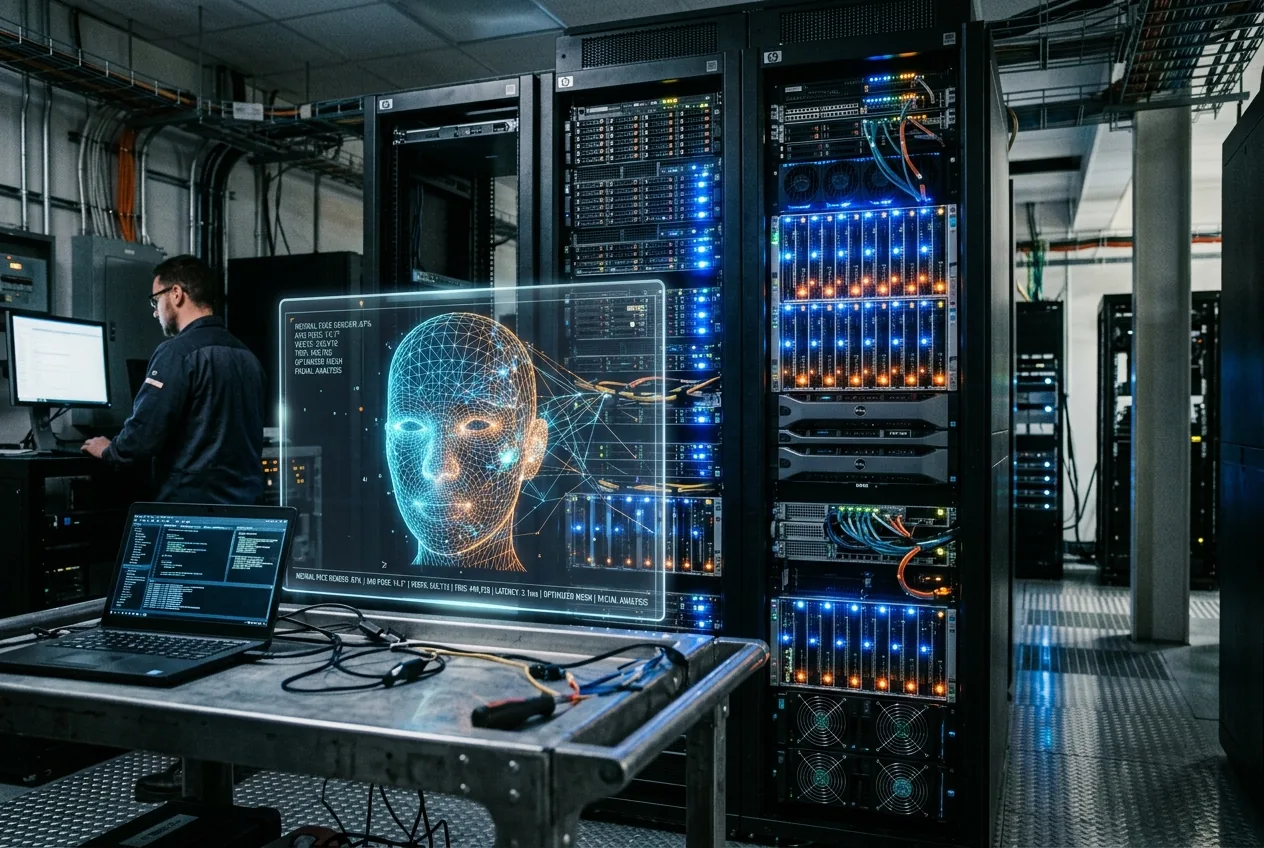
In the rapidly evolving landscape of generative artificial intelligence, the divide between corporate safety and raw data output has become a central engineering conflict. Recent viral reports suggesting Elon Musk intends to bypass traditional Hollywood structures to create a production titled 'Odyssey'—purportedly in response to perceived biases in the work of directors like Christopher Nolan—highlight a deeper technical pivot at xAI. While the social media fervor focuses on the cultural optics, the real story lies in the mechanical architecture of Grok and the push for an AI model that operates without the safety-tuned weights characterized by its competitors.
As a mechanical engineer, I view these developments not through the lens of a culture war, but as a problem of system constraints and data pipeline management. For Musk, the objective isn't merely a film; it is the development of a multimodal engine capable of generating high-fidelity video and narrative content that is functionally decoupled from the 'alignment' protocols established by OpenAI, Google, and Meta. This is a challenge of reinforcement learning from human feedback (RLHF) and how it affects the core logic of large language models.
The Architecture of Divergence
To understand the technical friction, one must look at how modern LLMs are 'tamed.' Standard industry practice involves a layer of fine-tuning where human annotators grade model responses based on safety guidelines. This often results in what Musk describes as 'woke' bias—a tendency for models to refuse prompts or provide homogenized responses on sensitive topics. From a technical standpoint, this is a form of parameter steering that can sometimes degrade the model's creative and logical performance, a phenomenon known as 'alignment tax.'
Data Pipelines and the X Firehose
The viability of any AI-driven production venture depends entirely on the quality and breadth of its training data. xAI holds a unique industrial advantage: the real-time data stream from X (formerly Twitter). Unlike the curated datasets used by many competitors, X provides a raw, unfiltered look at human discourse, including the very controversies Musk engages in. This data allows Grok to understand contemporary nuances and subvert standard tropes in a way that models trained on sanitized web crawls cannot.
However, relying on social media data presents significant engineering hurdles. The signal-to-noise ratio is notoriously low. To build a model capable of generating a project like 'Odyssey,' xAI must implement advanced filtering algorithms that can distinguish between high-quality narrative structures and the chaotic output of social media discourse. This requires a massive investment in compute power—specifically, the massive H100 GPU clusters that Musk has been aggressively procuring. The infrastructure required to train a video-generative model that rivals the aesthetics of a Nolan film is several orders of magnitude more complex than simple text generation.
The Mechanics of Generative Media
The rumor of an 'all-white' production or a direct challenge to established cinematic norms is likely a simplified public-facing version of a more complex technical goal: the mastery of multimodal synthesis. Current video generation models, such as OpenAI’s Sora, are highly impressive but remain locked behind safety walls that prevent the generation of specific types of content, including realistic violence, political figures, or culturally sensitive imagery. By positioning Grok as the 'unfiltered' alternative, Musk is attempting to capture a market segment that values absolute creative autonomy.
In terms of robotics and industrial automation, this philosophy translates to how AI handles edge cases. In a factory setting, you want a robot to follow safety protocols without exception. But in the realm of creative intelligence and problem-solving, overly restrictive guardrails can lead to a 'lobotomized' AI that cannot think outside of a predetermined box. The technical 'Odyssey' here is the quest for a model that possesses the reasoning capabilities of a human without the programmed hesitations of a corporate product.
Economic Viability of Independent AI Media
Is there a market for AI-generated content that intentionally avoids diversity mandates or contemporary social norms? From an economic perspective, the answer is often found in the fragmentation of the digital audience. As mainstream media becomes more standardized, the demand for divergent content increases. If xAI can produce a feature-length production using only generative tools, the cost-savings alone would disrupt the industry. We are talking about reducing a $200 million production budget to the cost of electricity and compute time.
This is where my background in mechanical systems and industrial efficiency comes into play. The 'production' of a film is essentially a supply chain problem. You have inputs (script, actors, sets, lighting) and an output (the final render). If you can replace the physical inputs with digital equivalents generated by an AI that doesn't 'argue' with the director's vision—regardless of how controversial that vision might be—you have fundamentally changed the economics of the industry. Musk’s critique of Nolan isn't just a personal grievance; it’s a critique of the legacy 'machine' of Hollywood and a signal that he intends to build a faster, cheaper, and more 'unlocked' machine.
The Risks of Unaligned Intelligence
While the technical pursuit of unfiltered AI is fascinating, it carries inherent risks that cannot be ignored. The 'alignment' that Musk disparages was created for a reason: to prevent models from generating harmful instructions, hate speech, or misinformation. By removing these weights, xAI enters a territory where the model could potentially be used to generate highly convincing propaganda or deepfakes at scale. The engineering challenge then shifts from 'how do we make it free?' to 'how do we prevent it from being weaponized?'
For an engineer, the solution is rarely to suppress the technology, but to build better filters on the consumption side or to create a more robust verification system. Musk has frequently mentioned the use of Grok to 'fact-check' the world in real-time. If 'Odyssey' ever moves from a provocative tweet to a technical reality, it will serve as the ultimate test case for whether an AI can be both truly free and industrially useful. The bridge between complex hardware and the global market is currently being built on the back of these ideological disputes, but the foundation is made of silicon, power, and code.
Ultimately, the pivot toward 'unfiltered' AI models like Grok represents a significant branch in the evolutionary tree of artificial intelligence. We are moving away from a monolithic approach to AI safety and toward a competitive ecosystem where different models reflect different worldviews. Whether this leads to a new era of creative freedom or a fragmented landscape of digital silos remains to be seen. What is certain is that the technical decisions being made at xAI today will dictate the narrative possibilities of tomorrow.




Comments
No comments yet. Be the first!