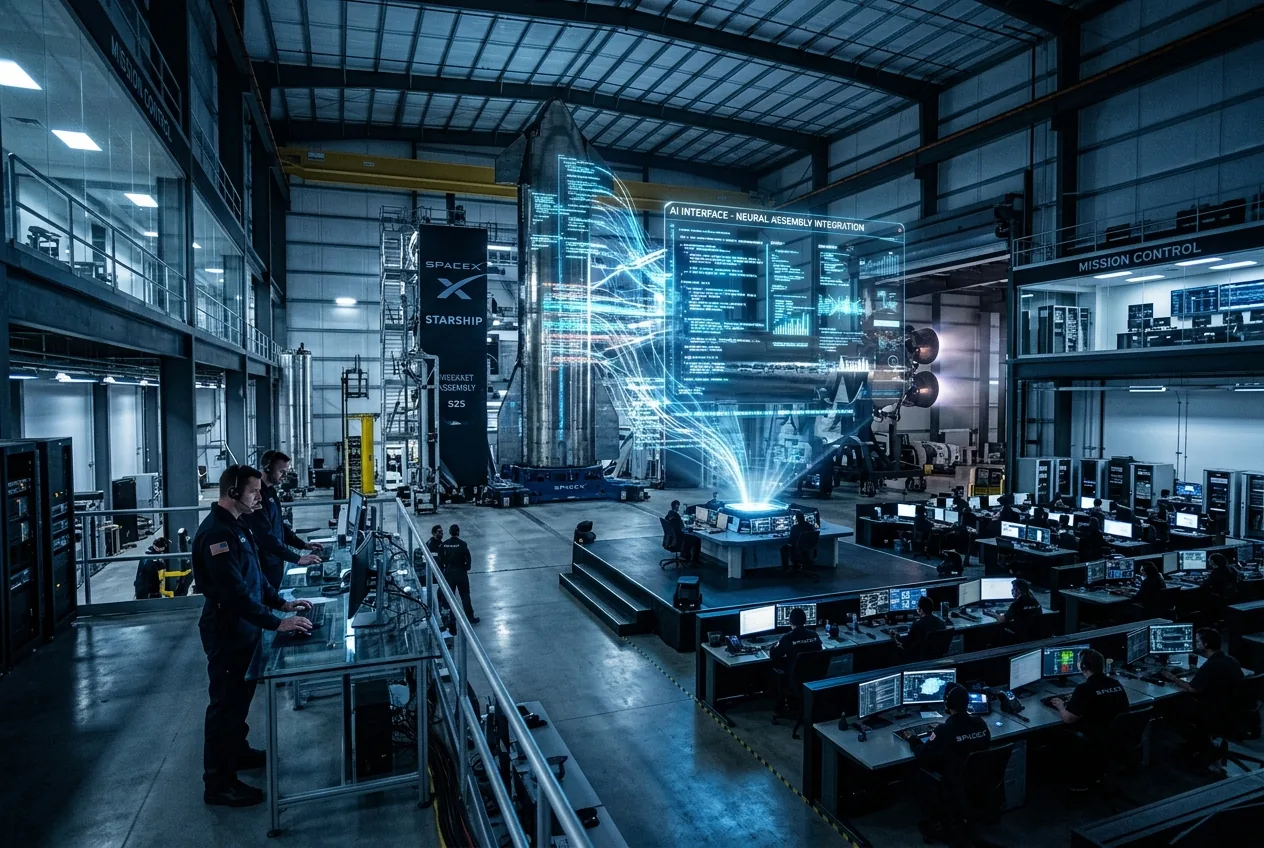
In a move that underscores the sheer gravitational pull of Elon Musk’s industrial empire, SpaceX has officially announced its intent to acquire the AI-driven coding startup Cursor for $60 billion. The all-stock transaction, which followed just days after SpaceX’s historic $85.7 billion initial public offering (IPO), represents one of the largest software acquisitions in history. For SpaceX, a company recently valued at over $2 trillion, the purchase is not merely a diversification of its portfolio; it is a calculated strike aimed at vertically integrating the very foundation of modern engineering: the code itself.
The acquisition of Cursor, the flagship product of San Francisco-based Anysphere, signals a paradigm shift in how aerospace and technology giants view software development. While the world has watched SpaceX dominate the launch industry and satellite internet through Starlink, the company’s internal reliance on high-reliability, mission-critical software has grown exponentially. By bringing Cursor’s advanced AI coding assistant under the SpaceX umbrella—and specifically within the orbit of its xAI division—Musk is positioning his enterprise to own the toolchain used to build the next generation of autonomous systems, from Starship flight controllers to the Grok large language models.
The mechanics of a $60 billion 'supercurrency' deal
From a technical and financial perspective, the deal is a masterclass in leveraging market momentum. Following its IPO, SpaceX saw a surge in stock price that effectively added the entire $60 billion valuation of Cursor to its market cap within hours of trading. Financial analysts have begun referring to SpaceX stock as a "supercurrency," a liquid asset so valuable and high-performing that it allows the company to absorb major competitors with minimal dilution to existing shareholders. In this instance, the $60 billion price tag represents a dilution of less than 3% for SpaceX, an remarkably low cost for an asset that could fundamentally rewrite the company’s internal development velocity.
Why Cursor? The bridge between 'vibe coding' and precision engineering
To understand the $60 billion valuation, one must look past the interface of the Cursor IDE and into the data it generates. Unlike generic large language models (LLMs) that are trained on stagnant repositories of public code, Cursor operates at the edge of the developer’s intent. It is an AI-native code editor that understands the context of entire codebases, offering suggestions that are structurally aware rather than merely statistically probable. In the world of aerospace engineering, where a single syntax error in a C++ flight control loop can lead to a multi-billion dollar loss, the value of an AI that truly "understands" the project architecture is incalculable.
Recent industry trends have seen the rise of "vibe coding"—a colloquial term for developers using AI to generate functional but often unoptimized or poorly understood code. SpaceX’s acquisition is a direct attempt to move beyond this. By integrating Cursor’s tech with xAI’s Grok, SpaceX intends to create a feedback loop where the AI is trained on the highly structured, high-reliability data found in SpaceX’s proprietary aerospace and robotics software. This creates a specialized intelligence capable of maintaining the rigorous standards required for human-rated spaceflight, a feat currently beyond the reach of general-purpose coding assistants.
The xAI and Colossus connection
The integration strategy for Cursor revolves heavily around SpaceX’s xAI division and its Colossus supercomputer. Colossus, currently one of the most powerful AI training clusters on the planet, provides the raw horsepower needed to refine Cursor’s models. Up until now, Cursor has relied on a mix of third-party models and its own fine-tuned versions of Claude and GPT-4. Post-acquisition, the roadmap points toward a proprietary model architecture specifically optimized for Cursor’s IDE, running on SpaceX’s own silicon and infrastructure.
This vertical integration allows for a level of speed that was previously impossible. If a developer at SpaceX encounters a recurring bug in the Starlink ground station firmware, the metadata from that interaction can, in theory, be anonymized and used to fine-tune the coding model in near-real-time. This creates a self-improving software ecosystem where the tools get sharper every time they are used. For SpaceX, which views AI-related markets as a potential $26 trillion opportunity, owning the primary interface where code is written is the ultimate strategic high ground.
Reshuffling the enterprise coding market
Furthermore, the deal signals a new era for IPO-funded tech giants. Rather than using IPO proceeds to slowly expand operations or pay down debt, SpaceX is using its newfound public status to conduct aggressive, transformative M&A (mergers and acquisitions). This strategy mimics the early days of Google and Facebook but at a scale an order of magnitude larger. It suggests that SpaceX no longer views itself as just a transportation company, but as a holistic technology provider that controls both the hardware (rockets/satellites) and the software (AI/coding tools) that define the 21st century.
Is the $60 billion price tag justified?
Despite the optimism from figures like Bill Ackman and Chamath Palihapitiya, who view the deal as a validation of "workflow-owning" platforms, some market skeptics question the valuation. At $60 billion, SpaceX is paying a massive premium for a startup that, while successful, is still in its early stages of revenue generation compared to established giants. The critique centers on whether SpaceX could have achieved the same results through its existing $10 billion partnership without the massive all-stock outlay.
However, from a mechanical engineering and systems integration perspective, the cost of "good enough" software is often higher in the long run than the cost of the best possible tools. For SpaceX, the acquisition is an insurance policy against the plateauing of AI capabilities. By owning the data engine of Cursor, they ensure that their internal teams—and by extension, their AI products—will always have access to the most advanced coding intelligence available. In the race to Mars and the race for AGI (Artificial General Intelligence), the winner will be the one who can iterate the fastest. With Cursor integrated into the xAI stack, SpaceX just shifted into a higher gear.
The acquisition is expected to finalize in Q3 2026. Until then, the industry will be watching closely to see how Cursor’s culture of rapid, San Francisco-style software iteration meshes with the high-stakes, hardware-first culture of SpaceX. If successful, the merger will not only solidify SpaceX's lead in the space race but may also establish it as the dominant force in the global AI landscape, proving once and for all that the future of hardware is driven by the intelligence of the software that builds it.




Comments
No comments yet. Be the first!