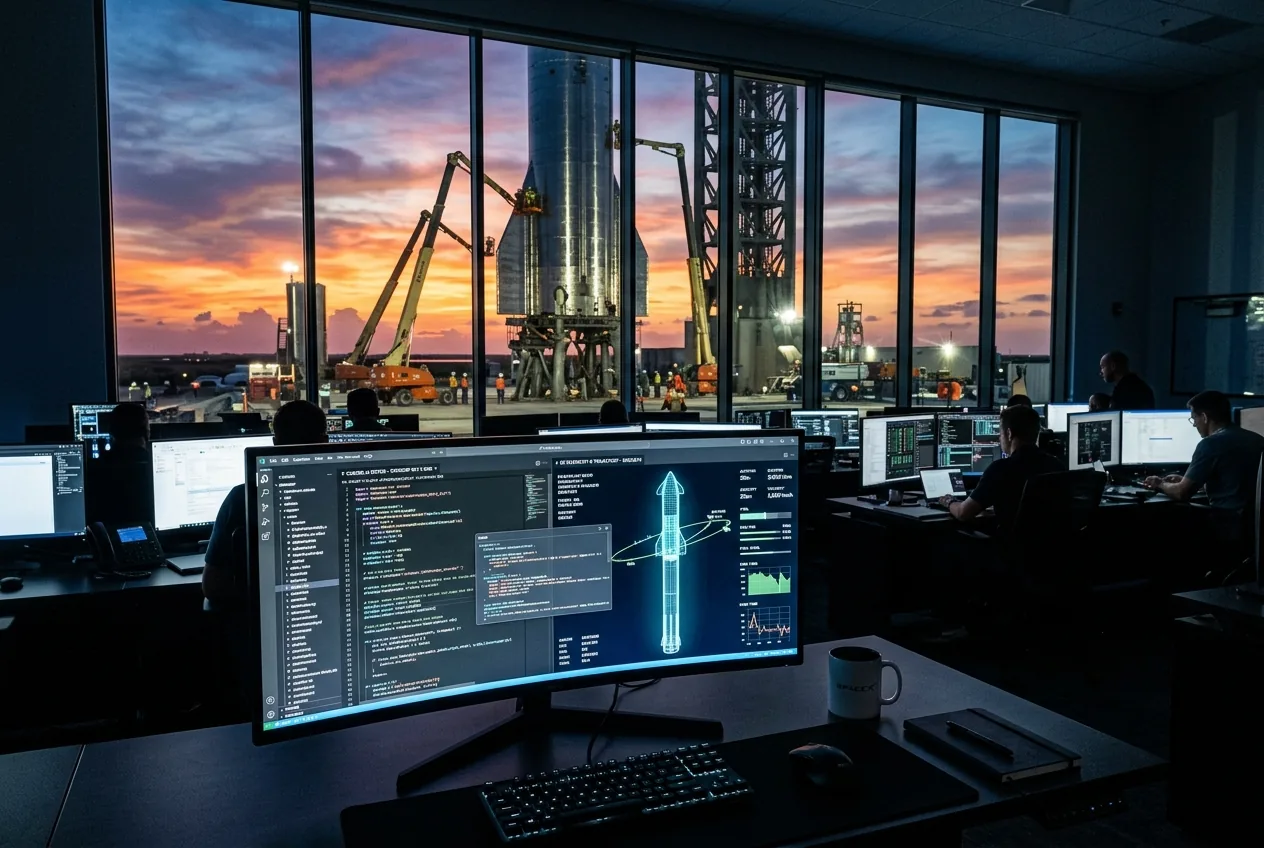
In a move that fundamentally redraws the map of the global technology sector, SpaceX has finalized its acquisition of Cursor, the breakout artificial intelligence startup that revolutionized software development with its context-aware code editor. The deal, valued at a staggering $60 billion, represents one of the largest acquisitions in the history of the technology industry. While the figure might seem astronomical for a firm primarily known for an Integrated Development Environment (IDE), the strategic implications for SpaceX’s aerospace, satellite, and robotics divisions are profound. By absorbing Cursor, SpaceX isn't just buying a tool; it is securing the infrastructure for the next generation of industrial automation and complex system design.
The acquisition brings Cursor’s core team into the fold of SpaceXAI, a specialized unit tasked with integrating advanced machine learning into the company’s hardware programs. For those following the trajectory of Elon Musk’s various ventures, this move bridges the gap between the raw compute power of xAI and the physical engineering challenges of the Starship program. The goal is clear: to accelerate the speed at which humans can write, debug, and deploy the millions of lines of code required to operate a multi-planetary logistics network. This isn't about incremental gains in developer productivity; it is about a wholesale transition to what insiders have termed 'vibe coding,' where the intent of the engineer is translated into functional, mission-critical software by an AI that understands the entire system architecture.
The technical synergy between aerospace hardware and AI-driven code
From a mechanical engineering perspective, the bridge between hardware and software has always been the bottleneck. When a structural engineer at Starbase decides to change the alloy of a liquid oxygen manifold, that change has downstream effects on thermal sensors and pressure regulations. In a traditional environment, software teams would need to manually update the parameters in the flight control software. With the Cursor integration, the AI can theoretically identify every instance where that hardware change impacts the codebase, suggesting or automatically generating the necessary updates. This tight coupling of physical reality and digital simulation is the cornerstone of the SpaceX 'rapid iteration' philosophy.
Can 'vibe coding' survive the rigors of mission-critical environments?
Cursor’s platform is built on the premise that the AI should be a 'partner' in the coding process, rather than a black-box generator. This allows for a 'human-in-the-loop' system where senior engineers can oversee the structural logic while the AI handles the boilerplate and integration. For SpaceX, this means that a smaller team of elite engineers can manage a vastly larger code footprint. As the Starlink constellation grows to include tens of thousands of satellites, and the Starship fleet begins regular lunar and Martian transits, the sheer volume of software maintenance would be impossible for humans to manage alone. The 'vibe coding' approach is not just a luxury; it is a mathematical necessity for the scale SpaceX is targeting.
The economics of a $60 billion bet on developer tools
When news of the $60 billion valuation first leaked, many analysts compared it to Musk’s $44 billion acquisition of Twitter (now X). However, the underlying logic is fundamentally different. While X was a bet on the 'global town square' and data for training LLMs, the Cursor acquisition is an investment in the 'means of production.' In the context of SpaceX’s internal valuation—estimated to be well over $200 billion—spending $60 billion to secure a monopoly on the world’s most advanced AI coding tool makes strategic sense. It ensures that SpaceX maintains a competitive moat that rivals like Blue Origin or traditional aerospace giants like Boeing will find nearly impossible to cross.
Reshaping the workforce of the future
The integration of Cursor into the SpaceX ecosystem also signals a shift in what it means to be a 'developer' in the 2020s. At SpaceX, the boundary between a mechanical engineer and a software developer is blurring. If an engineer can describe a mechanical problem and have the AI generate the simulation code or the control logic, the requirement for deep specialized knowledge in C++ or Rust becomes less of a barrier to entry. This allows for a 'polymath' approach to engineering where a single individual can oversee the design, simulation, and software integration of a rocket component.
This transition will likely have ripple effects across the entire tech industry. As SpaceX demonstrates the viability of AI-first development at the highest levels of engineering, other firms will be forced to follow suit. The demand for 'prompt engineers' or 'AI orchestrators' will rise, while the role of the junior developer tasked with writing basic functions may disappear entirely. For the broader public, this means that the speed of technological progress is about to hit an inflection point. When the friction between an idea and its digital execution is removed, the pace of innovation is limited only by the speed of the physical world.
Why SpaceX became the ultimate home for Cursor
There was significant speculation that other tech titans, such as Microsoft or Google, would attempt to outbid SpaceX for Cursor. However, SpaceX offered something that traditional software firms could not: a real-world testing ground for AGI-level coding. Cursor’s founders have often stated that their goal is to reach a level of AI that can reason about code as well as a human. There is no better way to train that reasoning than by applying it to the laws of physics. Whether it is optimizing the landing sequence of a Falcon 9 booster or managing the life support systems of a Crew Dragon capsule, the problems at SpaceX are grounded in objective reality.




Comments
No comments yet. Be the first!