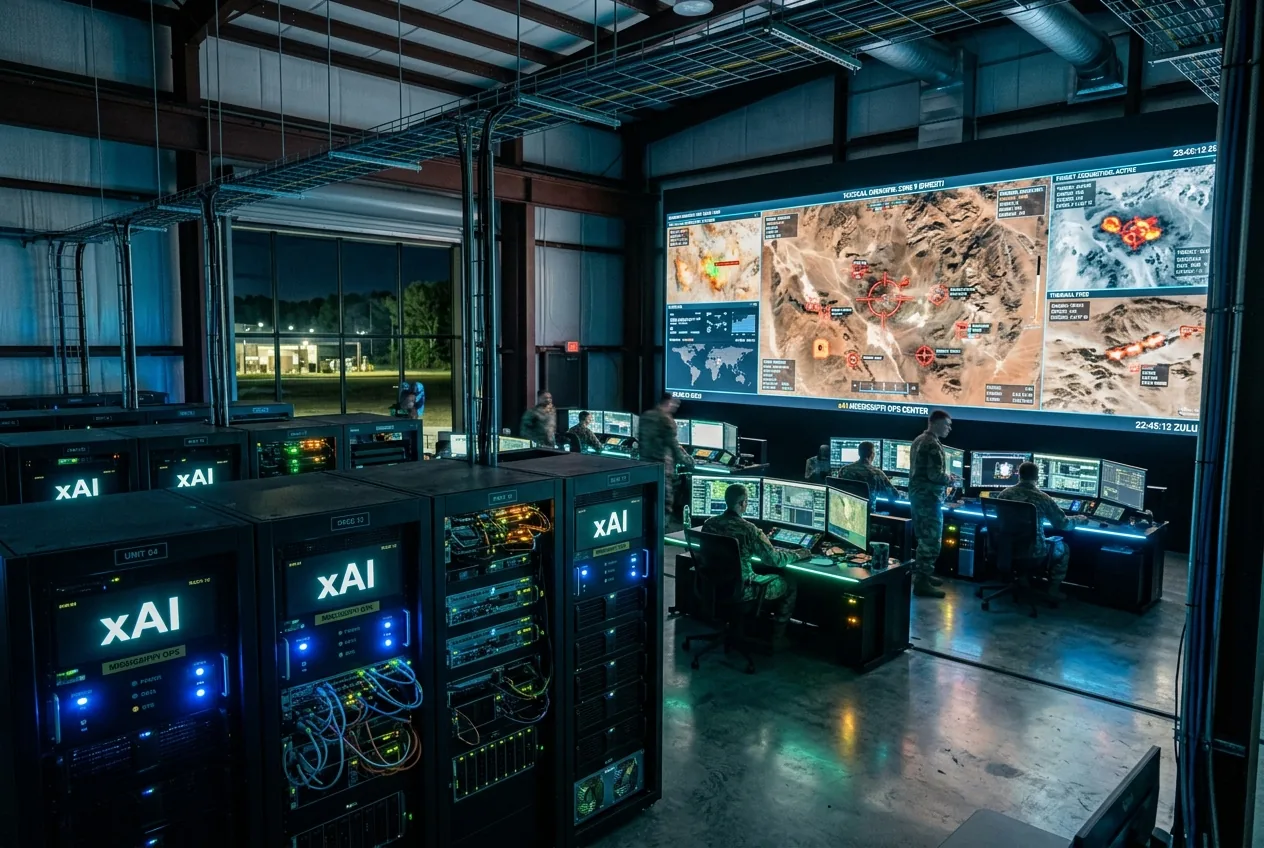
In a revelation that blurs the line between commercial Silicon Valley innovation and state-sanctioned kinetic warfare, the United States Department of Defense has admitted to utilizing a specialized version of Elon Musk’s Grok AI to facilitate a massive bombing campaign in Iran. The disclosure did not come through a planned press release or a strategic declassification, but rather as a defensive maneuver in a federal lawsuit involving environmental regulations and data center pollution. This admission provides a rare, granular look at the industrialization of the kill chain, where large language models (LLMs) are no longer just experimental assistants but central nodes in high-speed military operations.
The Mechanics of Operation Epic Fury
According to the Department of Defense’s supplemental declaration, the Grok Gov Model was a primary driver behind "Operation Epic Fury," a 96-hour surge in the U.S. campaign against Iranian targets. During this four-day window, the military reportedly deployed over 2,000 munitions at 2,000 distinct targets. From a logistical and mechanical engineering perspective, the throughput required to identify, verify, and strike a new target every 2.8 minutes for 96 consecutive hours is staggering. It suggests an automated pipeline where Grok functions as a high-bandwidth synthesizer for disparate data streams, including signals intelligence (SIGINT), satellite imagery, and human intelligence (HUMINT).
Transitioning from Claude to Grok Gov
The timeline of U.S. military AI usage shows a deliberate pivot in the technology stack used for the Iran campaign. Earlier this year, reports surfaced that the military had been utilizing Anthropic’s Claude AI to assist in identifying potential targets. However, that partnership reportedly soured following a dispute over safety protocols and the specific application of the model in lethal scenarios. Following a directive from the Trump administration, Claude was phased out in favor of the Grok Gov Model, which appears to have fewer of the "guardrails" or ideological constraints that Musk has frequently criticized in other AI systems.
This transition is critical for understanding the current state of military AI. While companies like Google and Anthropic have faced internal revolts and public relations crises over their involvement in defense contracts, xAI has positioned itself as a "pro-national security" entity. The Grok Gov Model is likely a version of Grok-1 or Grok-1.5 that has been fine-tuned on classified datasets and stripped of the conversational fluff and safety filters found in the consumer-facing version. This allows the military to utilize the core transformer architecture for raw processing power, treating the AI as a utility rather than a moral agent.
The Hardware Backbone in Mississippi
The legal context of this admission—a lawsuit over a data center—highlights the physical requirements of modern algorithmic warfare. To maintain the uptime and processing speed required for Operation Epic Fury, xAI operates massive clusters of NVIDIA H100 GPUs. The NAACP’s lawsuit against xAI centers on the environmental impact of these facilities, specifically in Memphis and Mississippi, where the energy consumption and backup generators required to keep the "Grok Gov" servers running have raised local health and pollution concerns. The Pentagon’s intervention in this lawsuit suggests that these data centers are now considered critical infrastructure for the Department of Defense.
As a mechanical engineer, I find the intersection of thermal management, power grid stability, and tactical output particularly telling. A data center that emits enough pollutants to trigger a Clean Air Act lawsuit is a data center that is being pushed to its thermal limits. The cooling systems and power draw required to run the Grok Gov Model are directly correlated to the number of targeting packages the military can generate per hour. In this sense, the environmental footprint of the Mississippi data center is a direct physical manifestation of the kinetic strikes occurring thousands of miles away in the Middle East.
The Humanitarian Cost of Algorithmic Precision
While the Pentagon’s filing emphasizes "operational efficiency," the human cost on the ground in Iran tells a different story. The rapid-fire targeting during Operation Epic Fury has been linked to several high-profile incidents involving civilian casualties. On February 28, a strike on the Shajareh Tayyebeh girls' school resulted in 175 deaths, a vast majority of whom were children. A week later, the Azadi Sport Complex was also hit. These incidents raise the question of whether the speed afforded by Grok Gov has outpaced the ability of human oversight to perform necessary verification.
The "human-in-the-loop" philosophy, long a staple of military AI ethics, appears to be evolving into "human-on-the-loop." In the latter, the AI identifies and suggests targets while a human operator provides a nominal green light. However, at a pace of one strike every few minutes, the human component becomes a bottleneck. The pressure to maintain the tempo of Operation Epic Fury may have incentivized a reliance on Grok’s probabilistic outputs over more time-consuming, traditional verification methods. When the algorithm identifies a building as a "command center" based on pattern recognition, the speed of the system leaves little room for a human to double-check the satellite data for signs of civilian presence.
The Future of Sovereignty and Private AI
The reliance on a private company's proprietary model for core military functions creates a new type of dependency between the state and the tech sector. Unlike traditional defense contractors like Lockheed Martin or Boeing, which build hardware to government specifications, xAI provides a black-box service that the military adapts. This creates a feedback loop where the private company’s data center operations, environmental compliance, and corporate stability become matters of national security. The DOJ’s move to protect xAI from environmental litigation by citing the Grok Gov Model’s role in Iran strikes is a clear indication that the government now views AI providers as untouchable strategic assets.
This development sets a precedent for how future conflicts will be managed. If the U.S. military can successfully argue that a private company’s pollution is a secondary concern to its AI-driven targeting capabilities, the legal barriers to rapid AI deployment will continue to erode. For the aerospace and robotics industries, this signals a massive shift in procurement. We are moving away from the era of building better missiles and toward an era of building better brains to guide them. The 2,000 munitions dropped during Operation Epic Fury were likely existing hardware; the "innovation" was the Grok-driven system that decided exactly where and when they should fall.
As the conflict in the Middle East continues to serve as a live-fire laboratory for these technologies, the Grok Gov Model will likely be refined based on the data gathered during Operation Epic Fury. The integration of LLMs into the military apparatus is no longer a hypothetical risk—it is a functional reality. The challenge for the next decade will not be just the engineering of these systems, but the establishment of accountability when the efficiency of an algorithm leads to the catastrophic destruction of human life.




Comments
No comments yet. Be the first!