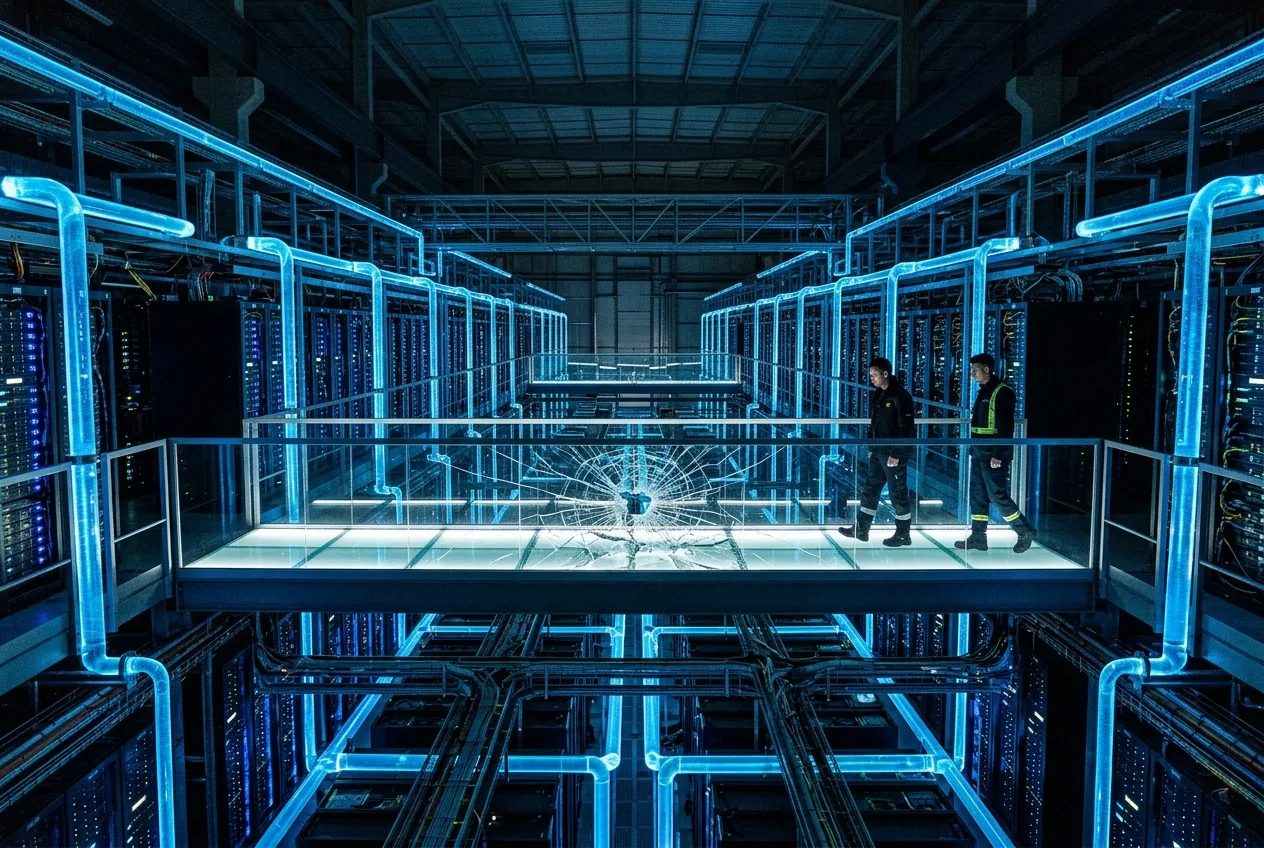
The strategic alliance between Microsoft and OpenAI, once heralded as the most formidable partnership in the history of silicon valley, is entering a period of significant structural instability. While inflammatory headlines suggest an imminent bankruptcy or a scorched-earth divorce, the reality is a far more complex mechanical shift in the underlying economics of generative AI. We are witnessing the beginning of the 'Great Decoupling,' a transition where the symbiotic relationship between the world's largest software provider and the most prominent AI research lab is being tested by the brutal reality of capital expenditure and compute orchestration.
The Architecture of Dependency
The technical cost of 'inference'—the process of a model generating a response—remains the primary financial bottleneck. Unlike traditional software, where marginal costs approach zero after the initial development, every query sent to ChatGPT incurs a tangible cost in electricity and hardware depreciation. For OpenAI to reach profitability, it must decouple its reliance on Microsoft’s standard pricing and build its own infrastructure, or negotiate terms that Microsoft may no longer find palatable as it builds its own internal AI divisions.
The Pivot to a For-Profit Model
The most significant indicator of this shift is OpenAI’s ongoing transition from a non-profit-controlled entity to a for-profit benefit corporation. This is not merely an administrative change; it is a fundamental reconfiguration of the company’s mission and its relationship with investors. The original non-profit structure, designed to ensure that AGI benefits all of humanity, is increasingly seen as a hindrance to the massive capital raises required to compete with Google and Meta. Reports suggest OpenAI is seeking a valuation of $150 billion, a figure that requires a clear, unimpeded path to revenue that doesn't involve siphoning half of its earnings back to Redmond.
From a mechanical engineering and industrial standpoint, this transition reflects a shift from 'research' to 'productization.' When a company moves from laboratory experiments to industrial-scale deployment, the governance must change to support the supply chain of hardware and the long-term maintenance of the stack. Microsoft, meanwhile, has signaled its own desire for independence. By hiring the core team from Inflection AI and establishing Microsoft AI under Mustafa Suleyman, Satya Nadella has effectively built a 'Plan B' that exists entirely within Microsoft’s corporate walls, reducing the catastrophic risk should OpenAI ever fail or choose to seek a different primary cloud provider.
The Financial Burn Rate and the 'Stargate' Reality
The sheer physical scale of Stargate represents the ultimate test of the Microsoft-OpenAI marriage. Building such a facility requires not just software expertise, but massive innovations in power distribution, liquid cooling at scale, and custom silicon. If Microsoft is the one footing the $100 billion bill, it will likely demand a level of control that OpenAI’s leadership, led by Sam Altman, may find restrictive. Conversely, if OpenAI seeks outside funding for such a project, it effectively ends the exclusivity that has defined the partnership thus far. This is the 'divorce' that analysts are tracking: not a sudden break, but a divergence of physical and financial infrastructure.
Why a Total Collapse Is Unlikely
Despite the tensions, the narrative of an imminent bankruptcy that would 'end ChatGPT forever' ignores the industrial utility of the technology. In the world of robotics and automated supply chains, GPT-4 and its successors have become foundational tools for natural language interfaces in industrial settings. The 'weight' of the technology—meaning its integration into third-party software, enterprise workflows, and government systems—is too great for it to simply vanish. Even in a worst-case financial scenario, the assets of OpenAI (the model weights, the data sets, and the engineering talent) represent the most valuable intellectual property in the modern economy.
Furthermore, Microsoft remains OpenAI’s largest shareholder. It is in Microsoft’s fiduciary interest to ensure OpenAI remains solvent, even if the relationship becomes more competitive. We are moving into a 'frenemy' phase of the industry. Microsoft will continue to sell OpenAI’s models through Azure, while simultaneously pushing its own 'Phi' and 'MAI' models to customers who want cheaper, more specialized alternatives. This is a standard evolution in tech ecosystems: the pioneer is eventually joined by the platform provider who helped them get there.
The Mechanical Future of AI Hardware
As an observer focused on the bridge between hardware and software, I find the most interesting aspect of this tension to be the move toward custom chips. OpenAI has reportedly been in talks with chip designers like Broadcom and manufacturers like TSMC to develop its own silicon. This is the ultimate declaration of independence. If OpenAI can design chips optimized specifically for the transformer architecture of LLMs, it can drastically reduce the power-per-inference cost, potentially solving the bankruptcy risk that currently looms over it.
However, the lead time for custom silicon is measured in years, not months. In the interim, OpenAI must navigate a delicate political and financial landscape. It needs Microsoft for its current survival, but it must outgrow Microsoft to achieve its long-term goals. For the industrial sector, this means the 'AI tax'—the cost of implementing these systems—will remain volatile until the infrastructure stabilizes. We are currently in the 'build' phase of a new industrial revolution, and the friction between the architect (OpenAI) and the builder (Microsoft) is a natural part of the process.
Concluding the Decoupling Narrative
The talk of a 'divorce' is perhaps too simplistic. What we are seeing is the maturation of an industry. In the early days of any technological shift, partnerships are tight and exclusive because the risks are high and the resources are scarce. As the technology matures, the players involved seek to verticalize their operations to capture more value. OpenAI is trying to become a platform, and Microsoft is trying to ensure it isn't just a host for someone else’s platform.
While the financial strain on OpenAI is real and the transition to a for-profit model is fraught with legal and ethical hurdles, the underlying technology has already crossed the threshold of industrial necessity. The future of ChatGPT is not one of disappearance, but of diversification. It will likely exist on a wider array of hardware, powered by a more diverse group of investors, and running on a more fragmented but resilient cloud infrastructure. The 'Great Decoupling' is not the end of the story; it is the beginning of the next chapter in the automation of the global economy.




Comments
No comments yet. Be the first!