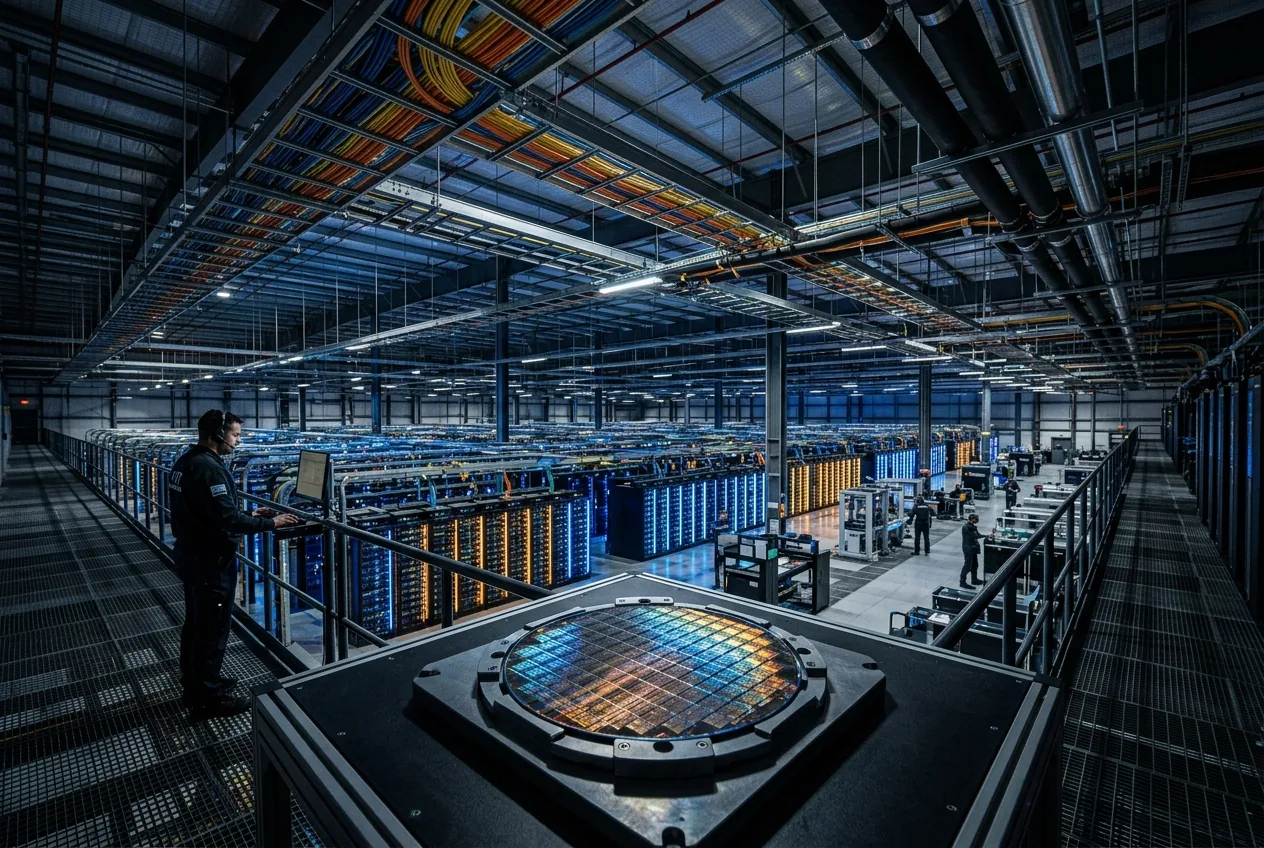
The recent "urgent" market signals surrounding these companies are not accidental. They represent a transition from the experimental phase of generative AI to an industrial-scale deployment phase. When Musk’s xAI brought the "Colossus" supercluster online—featuring 100,000 Nvidia H100 GPUs—it did more than just break records for deployment speed. It signaled to the market that the era of scarcity is being met with a new breed of vertically integrated customer who is willing to bypass traditional procurement timelines to build sovereign compute capabilities.
The Memory Wall: Micron’s Strategic Leverage
To understand why Micron is central to this hardware reshuffle, one must look at the physical limitations of modern GPU architecture. As Nvidia and AMD push the boundaries of floating-point operations per second (FLOPS), they are increasingly hitting what engineers call the "memory wall." A processor, no matter how fast, is limited by the speed at which data can be fed into its cores and moved back to storage. This is where High Bandwidth Memory (HBM) becomes the critical bottleneck.
Micron’s HBM3E (High Bandwidth Memory 3 Extended) is the current gold standard for the industry, offering the thermal efficiency and data transfer rates required for next-generation AI training. The industrial reality is that Micron’s production capacity for HBM3E is reportedly sold out through 2025. For companies like Tesla, which is scaling its Dojo supercomputer, or xAI, which requires massive memory buffers for its Large Language Models (LLMs), Micron is no longer just a component supplier—it is a strategic gatekeeper. The technical necessity of HBM3E in every Nvidia H200 and Blackwell chip means that the semiconductor market is now tethered to the production yields of specialized memory fabs in a way we haven't seen since the early days of the PC revolution.
Nvidia’s Dominance and the Blackwell Transition
When industrial players like Musk demand hardware in "24-hour" timeframes—metaphorically speaking—they are forcing Nvidia to prioritize the largest scale-out customers. This creates a secondary market squeeze. For the smaller players and even mid-sized cloud providers, the availability of Blackwell might be delayed as the biggest clusters get first dibs. From an engineering standpoint, the Blackwell B200 is a marvel, boasting 20 petaflops of FP4 power, but its 700W to 1200W power draw creates a massive infrastructure challenge for the data centers housing them. The market "shake-up" is as much about who can provide the power and cooling for these chips as it is about who can buy them.
AMD’s Pursuit of the Open Ecosystem
While Nvidia focuses on a proprietary stack (CUDA), AMD is positioning its Instinct MI300 and the upcoming MI325X as the pragmatist’s alternative. For a technologist like Musk, who often bristles at vendor lock-in, AMD’s commitment to the ROCm open software ecosystem is a compelling hedge. AMD’s strategy is built on chiplet architecture—a method of stitching together smaller silicon dies to increase yields and lower costs.
The MI300X, for instance, offers more memory capacity and bandwidth than the H100, making it highly effective for inference—the process of running a trained model. As the industry moves from the intensive training phase (where Nvidia dominates) to the massive-scale inference phase (where models are actually used by billions of people), AMD’s hardware becomes economically more viable. If xAI or Tesla decides to diversify even 20% of their compute spend toward AMD, it would represent a multi-billion dollar shift that would indeed shake the current market hierarchy.
The Musk Effect: xAI as a Market Catalyst
Elon Musk’s approach to hardware is distinctly different from the traditional Silicon Valley model. He views compute as a commodity, similar to how he views lithium for batteries or steel for rockets. By building the Colossus cluster in a matter of months rather than years, xAI has proven that the bottleneck in AI isn't just chip design—it's industrial execution. This puts immense pressure on the supply chains of Micron, AMD, and Nvidia.
Musk’s demand for high-speed interconnects and massive power delivery systems has turned the semiconductor market into a subset of the energy and logistics sectors. When Musk tweets about market shifts, he is often referring to the internal consumption needs of his companies. If Tesla’s FSD (Full Self-Driving) version 13 or xAI’s Grok 3 requires a 3x increase in compute, that order alone can move the needle for Micron’s quarterly revenue. The "24-hour" urgency often cited in market circles reflects the rapid pace at which these massive clusters are being approved and funded.
The Pragmatic Reality of the AI Supercycle
Is the market truly on the verge of a massive shake-up? To an engineer, the answer is found in the capital expenditure (CAPEX) reports of the big four: Microsoft, Google, Meta, and the Musk-led entities. We are seeing a historic decoupling of stock market sentiment from physical reality. While traders worry about a "bubble," the physical world is seeing the largest build-out of infrastructure in human history. We are effectively rebuilding the global internet to be an "AI-first" network.
The technical specs of the upcoming year are clear: 1.6T networking, liquid cooling as a standard requirement, and HBM4 on the horizon. Micron, AMD, and Nvidia are the three pillars supporting this new ceiling. For investors and enthusiasts alike, the key is to look past the sensationalist headlines and focus on the bill of materials. A single Blackwell rack can cost upwards of $3 million. At that price point, every percentage of yield improvement from Micron or every software optimization from AMD’s ROCm team translates into hundreds of millions of dollars in saved CAPEX. This is the real mechanism behind the market volatility—it is a race to find the most efficient way to turn electricity into intelligence.




Comments
No comments yet. Be the first!