When Elon Musk recently admitted to wrestling with what he termed "AI psychosis," the phrase ricocheted across Silicon Valley and the industrial technology sector with characteristic velocity. While the phrase carries the rhetorical flourish typical of Musk's public pronouncements, it articulates a very real, acute psychological condition currently permeating the upper echelons of frontier artificial intelligence development. It is an intellectual vertigo produced by confronting the compounding trajectory of machine learning capability curves, massive capital deployment, and the haunting conviction that the technology being built could outpace human oversight faster than the physical infrastructure housing it can cool down.
For Musk, this friction is not theoretical; it is measured in megawatts, silicon yields, and structural supply chains. The entrepreneur sits at the nexus of several conflicting vectors in modern computation. Through xAI, he is racing to deploy unprecedented quantities of enterprise-grade compute to train Grok. Through Tesla, he is attempting to solve embodied artificial intelligence in the physical world via Full Self-Driving neural networks and the Optimus humanoid robotics platform. Yet historically, Musk has been among the most vocal doomsayers regarding artificial general intelligence, repeatedly warning that unconstrained synthetic cognition poses an existential threat to biological life. Navigating that paradox—accelerating the very technology one fundamentally fears—inevitably exacts a cognitive toll.
The Colossus Imperative and Industrial Speed
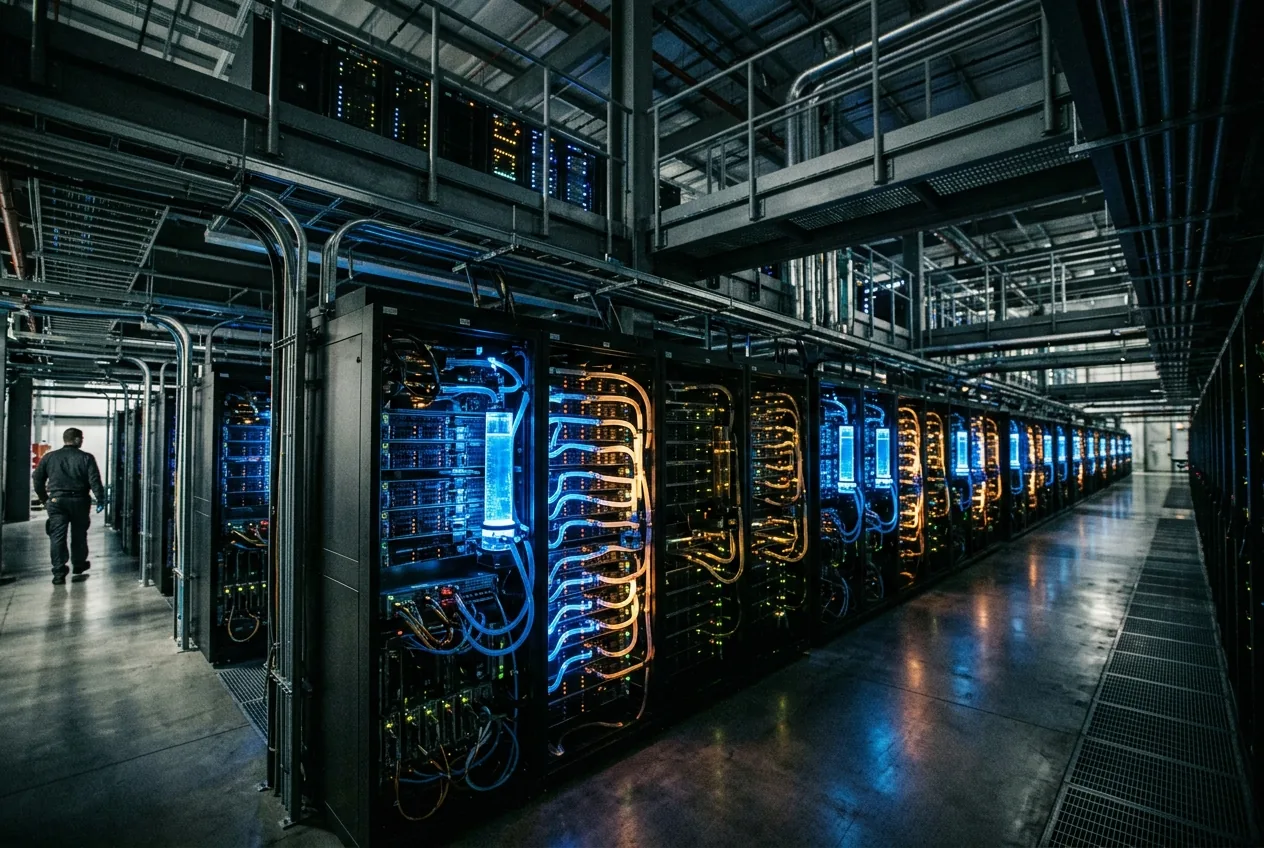
To understand the pressure points informing Musk’s mental state, one must look directly at the hardware floor. In Memphis, Tennessee, xAI constructed the "Colossus" supercluster, a facility housing over 100,000 liquid-cooled Nvidia H100 tensor core GPUs, in a staggering 122 days. In traditional industrial engineering and data center construction, a facility of that magnitude typically requires an execution timeline spanning eighteen months to two years. Compressing that timeline down to four months required round-the-clock physical labor, high-voltage electrical grid reconfigurations, complex civic negotiations for municipal water access, and the continuous management of fragile supply chains.
The physical reality of training modern frontier models like Grok 2 and Grok 3 leaves zero room for margin. Operating at this scale introduces unprecedented mechanical and electrical failure modes. High-bandwidth memory degradation, transceivers failing across optical networks under extreme thermal loads, and localized power drops require relentless active diagnostics. When hundreds of millions of dollars in compute capital are committed to continuous training runs, every microsecond of cluster downtime represents an enormous financial and competitive bleed. The relentless friction of forcing bleeding-edge hardware to run at peak capacity creates an environment of operational siege warfare.
Musk’s description of psychological strain stems directly from this relentless industrial sprint. At this level of technological competition, an organization cannot afford to take a sabbatical or pause training runs while safety architectures catch up. The market dynamics dictate that if xAI slows down, Anthropic, Google DeepMind, or OpenAI will claim the next model inflection point. The builder is thus trapped on an accelerating treadmill where the physical limits of hardware integration define their day-to-day reality.
The Paradox of Accelerated Precaution
Musk's existential angst is deeply tied to a philosophical dilemma he helped popularize over a decade ago. Having co-founded OpenAI in 2015 as a non-profit counterweight to Google's early dominance, his stated goal was to ensure AI development remained open, democratized, and rigorously aligned with human interests. Fast-forward to the present: OpenAI operates as an aggressive commercial enterprise, and Musk is locked in bitter, multi-front litigation against the company and its chief executive, Sam Altman, alleging a betrayal of the original founding charter.
This rupture forced Musk to launch xAI in mid-2023. Rather than stepping back from the brink of what he perceives as catastrophic existential risk, he resolved that the only viable defensive maneuver was to build a rival capability capable of outperforming everyone else. The rationale behind Grok was to engineer a "maximally truth-seeking" intelligence that would theoretically be less prone to algorithmic deceit or ideological hallucination. Yet, building that counterweight requires the very same brute-force scaling dynamics, synthetic data generation methods, and energy-hungry infrastructure that characterize the rest of the industry.
The internal conflict is stark. To safeguard humanity from runaway silicon intelligence, Musk believes he must build it first, build it bigger, and deploy it faster. This is the root of the psychological dissonance: recognizing the extreme catastrophic potential of a technology while simultaneously acting as its most aggressive industrial catalyst. The burden of that logical loop is heavy, forcing an engineer to spend billions of dollars accelerating an outcome they openly fear.
Embodied Intelligence and the Convergence with Robotics
The scope of this challenge extends far beyond conversational software agents and text generation. While xAI captures headlines with Grok, the intellectual baseline Musk is attempting to construct is fundamentally tied to mechanical actuation. Tesla's primary strategic valuation now rests on its ability to transition from an automotive manufacturer into an end-to-end robotics enterprise. The Full Self-Driving fleet acts as an expansive real-world computer vision laboratory, processing petabytes of sensor data daily to train end-to-end neural networks.
Concurrently, the development of the Optimus humanoid robot demands that large multimodal models be adapted to solve complex physical dynamics in real time. Unlike pure software, an embodied AI cannot operate inside an abstract cloud layer with high latency; it must run inference at the edge, interpreting kinodynamic constraints, localized friction coefficients, payload balances, and spatial geometry on millisecond timescales. The complexity of mapping foundational cognitive models into actuators, cycloidal gearboxes, and tactile sensors represents an engineering hurdle several orders of magnitude more challenging than traditional model inference.
This intersection of digital intelligence and mechanical hardware amplifies the psychological pressure. A digital model hallucinating text creates brand liability; an embodied model hallucinating spatial vectors inside a manufacturing plant creates physical catastrophe. Musk’s day-to-day oversight requires bridging the gap between algorithmic safety in the digital realm and kinematic safety on the factory floor, a relentless dual-front discipline where any failure carries immediate real-world consequences.
Is the Industry Reaching a Thermodynamic Wall?
Adding to the existential unease is the growing suspicion across the industry that the traditional paradigm of brute-force scaling may be approaching a phase of diminishing returns. For several years, the prevailing dogma was simple: increase parameter counts, feed more tokens, add more compute, and capability scales linearly. However, frontier research is increasingly encountering limits related to high-quality human data exhaustion, severe power grid bottlenecks, and memory bandwidth constraints.
Data centers are now demanding hundreds of megawatts, pushing utility providers to their absolute limits and prompting tech giants to negotiate dedicated nuclear power agreements. If the scaling laws begin to plateau before artificial general intelligence is achieved, the astronomical capital expenditures poured into facilities like the Memphis supercluster will face brutal economic reckoning. Conversely, if the scaling laws hold and the curve goes vertical, human society will be forced to rapidly adapt to synthetic cognition capable of self-directed recursive improvement. Either outcome brings immense stress to those holding the capital and engineering reins.
Musk’s characterization of this environment as "psychosis-inducing" reflects the impossibility of complacency. If one accepts the premise that synthetic cognitive systems are advancing faster than regulatory, political, or social structures can comprehend, operating at the epicenter of that transformation is necessarily destabilizing. It forces builders to constantly calculate worst-case scenarios while making high-stakes technical bets involving billions of dollars and megawatts of power.
The Burden of Frontier Engineering
As artificial intelligence continues to shift from theoretical research into raw physical infrastructure, the tension between the speed of deployment and the capacity for control will only widen. Musk’s admission may be framed in casual, internet-native vernacular, but it reveals a profound reality: humanity's most ambitious industrial project is running hot, operating near thermal limits, and placing an unbearable cognitive strain on the very architects trying to command it.




Comments
No comments yet. Be the first!