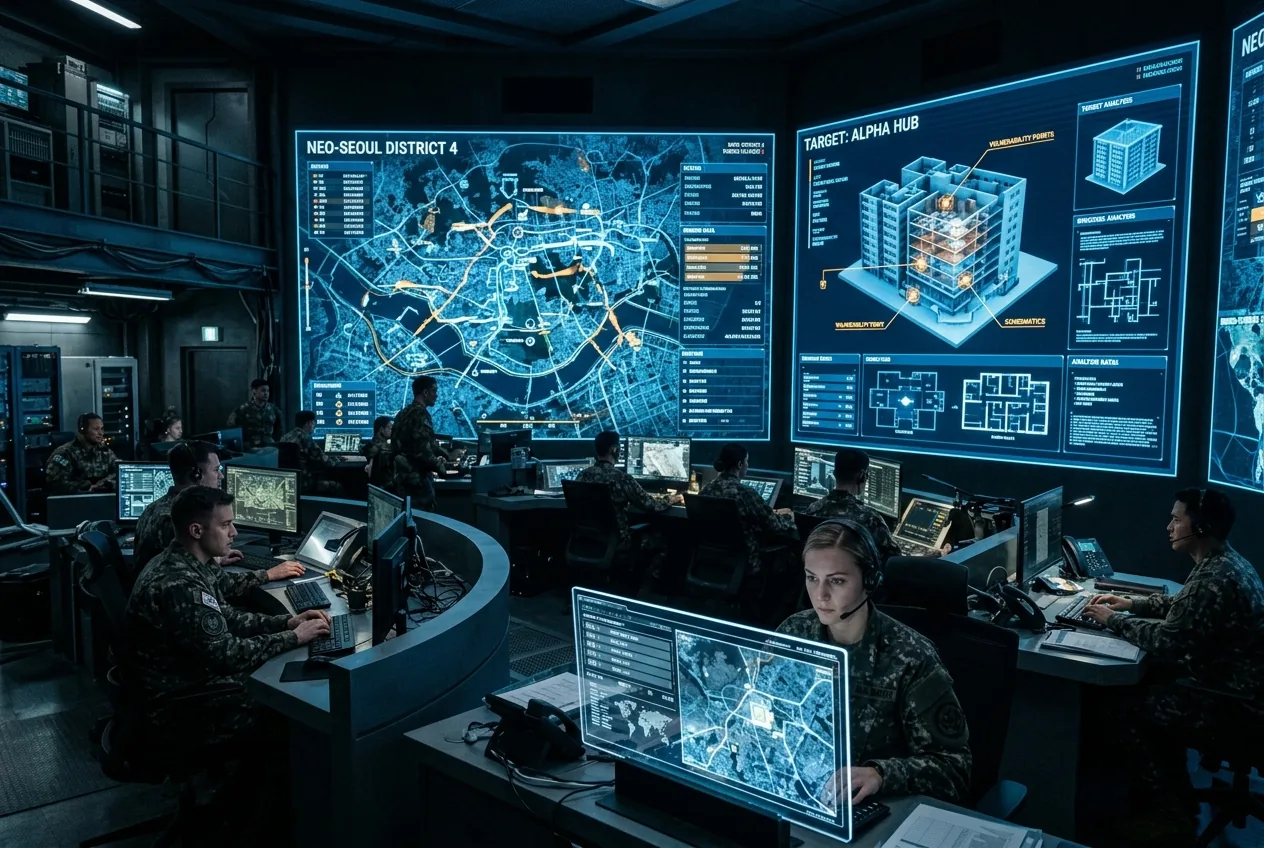
In high-intensity military operations, the most constrained resource is rarely ordnance or fuel. It is cognitive bandwidth. Modern sensor suites—ranging from synthetic aperture radar satellites and synthetic-vision unmanned aerial vehicles to signals intelligence arrays—produce petabytes of raw electromagnetic data every hour. Sorting that data into actionable kinetic targeting packets has historically demanded thousands of human intelligence analysts working across disjointed classified networks. That paradigm is disintegrating as defense planners integrate commercial foundation models into the operational theater.
Recent reporting that modern strike operations have integrated cutting-edge commercial artificial intelligence, specifically models associated with Elon Musk’s xAI ecosystem alongside traditional defense architectures, highlights an inflection point in the digitization of warfare. When reports surface that roughly 2,000 munitions were coordinated, cataloged, or routed with the assistance of commercial-grade large language models and multi-modal architectures during operations in the Middle East, the story is not merely political. It is a story about the structural overhaul of industrial-era command-and-control frameworks.
Deconstructing the Automated Sensor-to-Shooter Loop
To understand how a commercial model like Grok or its enterprise counterparts could interface with kinetic operations, one must look at the mechanics of the military's find-fix-track-target-engage-assess (F2T2EA) kill chain. In decades past, each node of this cycle required distinct computational architectures and manual handoffs. An imagery analyst flagged an anomaly on a runway; a targeteer verified coordinates against a no-strike list; an operations officer checked ordnance inventories; a mission planner calculated fuel burns and ingress vectors.
If an operations cell needs to allocate 2,000 precision-guided munitions—such as GBU-38 Joint Direct Attack Munitions (JDAMs) or AGM-158 Joint Air-to-Surface Standoff Missiles (JASSMs)—the logistical complexity is staggering. Every munition requires a matching hardpoint, an available launch platform with the correct mission software, optimal environmental conditions, and an uncompromised supply line. Generative models and high-parameter reasoning engines are exceptionally adept at solving these dynamic resource-allocation equations at rates that human staff sections simply cannot replicate.
Commercial Compute Meets Theater Logistics
The transition of commercial generative AI into kinetic support environments reflects a broader supply chain reality: national security institutions can no longer out-innovate the private tech sector in compute architecture. For decades, military computing relied on radiation-hardened, bespoke, and proprietary silicon that lagged commercial hardware by half a decade. Today, the foundational infrastructure powering modern warfare belongs to hyperscalers and dedicated AI ventures housing tens of thousands of advanced GPUs.
The integration of systems like Grok, designed initially to crawl the live web and parse massive relational graphs, represents a natural evolution of intelligence processing. Defense networks possess vast troves of unstructured textual, spatial, and acoustic data. A multi-modal model fine-tuned on military ontologies can digest intercept transcripts, drone tracking data, and regional infrastructural schematics simultaneously. The result is a unified threat matrix that delivers probabilistic assessments of target vulnerabilities.
Yet, the bridge between consumer-facing or enterprise API deployments and tactical edge networks is notoriously fragile. Running frontier models within air-gapped, sovereign defense clouds requires extreme model compression, containerized local hosting, and hardened communications links. The software must parse data while operating under strict zero-trust security postures to prevent data leakage back to public training corpuses or foreign adversaries.
The Friction Between Algorithmic Speed and Mechanical Limits
When automated targeting algorithms increase the operational tempo of a strike campaign, they introduce massive strain on the physical supply chain. Ground crews must physically uncrate, assemble, inspect, and load munitions. Ordnance technicians must hand-tighten fuse assemblies and torque lug nuts to precise mechanical tolerances. This creates a dangerous asymmetric tension: the digital target list expands exponentially via algorithmic generation, while the mechanical and human infrastructure tasked with delivery operates linearly.
Furthermore, this disparity introduces profound risks in battle damage assessment (BDA). If an AI system processes initial post-strike overhead imagery, it must distinguish between actual target neutralization and superficial fragmentation damage. Models prone to over-confidence or hallucinations can register a failed detonation as a mission success, or conversely, demand secondary strikes on targets that have already been rendered tactically inert. In an era where precision-guided munitions inventories are critically depleted, algorithmic inefficiencies in target rationing carry geopolitical consequences.
Can Human Verification Keep Up With Machine Reasoning?
The standard defense response to algorithmic targeting concerns is the doctrine of the "human-in-the-loop." According to this mandate, automated systems merely provide recommendations; human officers retain sole authority to authorize kinetic action. However, when an operational tempo scales to hundreds of strikes per day across multiple theaters, the practical definition of "human control" begins to erode.
Human analysts placed in front of hyper-complex operational dashboards face severe cognitive saturation. If a neural network presents a targeting packet complete with visual confirmation, collateral damage estimates, and a designated payload with a 98% confidence score, a human operator rarely has the time or the raw data visibility to verify the algorithmic calculation from scratch. In high-tempo warfare, the human-in-the-loop risks devolving into a human-on-the-rubber-stamp.
This reliance becomes even more dangerous in the face of adversarial counter-measures. State actors possess sophisticated electronic warfare capabilities designed to deceive computer vision models and corrupt the automated ingest pipelines of language systems. Subtle sensor spoofing—such as deploying decoy structures with synthetic thermal signatures or introducing localized electromagnetic noise—can manipulate an AI model into misinterpreting innocent civilian assets as primary military nodes.
The Re-Engineering of the Modern Arsenal
The reported reliance on frontier AI platforms during recent engagements demonstrates that the defense-industrial base is no longer composed strictly of airframe manufacturers, shipyards, and munitions foundries. Frontier AI labs and their underlying compute clusters are now operational centers of gravity in global conflicts.
As these models migrate deeper into the machinery of command and control, the boundaries separating enterprise data science from frontline kinetic action will continue to blur. The primary challenge facing military engineers is no longer simply acquiring more high-explosive ordnance; it is building robust, verifiable, and secure computing architectures that can manage the firehose of tactical data without driving strategic decision-makers into catastrophic, automated errors. When algorithms take the wheel of regional logistics, the physical world has very little margin left for software bugs.




Comments
No comments yet. Be the first!