In late 2008, on a remote coral airstrip in the Marshall Islands, a small team of engineers stood over the charred remnants of three consecutive launch failures. SpaceX had exhausted virtually all of its initial funding, its founder was liquidating personal assets to make payroll, and conventional aerospace contractors viewed the venture as a cautionary tale of Silicon Valley hubris. By the company’s own internal calculations at the time, the probability of ever reaching operational orbit was pegged below ten percent. Today, investment banks, institutional asset managers, and financial analysts regularly model long-term public market trajectories that value the enterprise between one and two trillion dollars. Understanding that shift requires looking past executive rhetoric and examining the fundamental engineering realities, automated supply lines, and industrial manufacturing decisions that turned orbital mechanics into a high-rate production business.
SpaceX’s trajectory is frequently framed through the lens of visionary entrepreneurship or capital market speculation. Yet the real structural break occurred on the factory floor. For decades, the global space industry functioned as an artisanal, cost-plus contracting ecosystem dominated by sprawling tiers of subcontractors, bespoke hand-assembled components, and launch cadences counted in single digits per year. By dismantling that supply chain and treating the launch vehicle as an industrial consumer product rather than a museum-grade prototype, SpaceX altered the unit economics of access to low Earth orbit. The financial valuation now commanded by the firm is a direct mathematical consequence of hardware velocity, manufacturing automation, and vertical integration.
The Thin Margin Between Kwajalein and Insolvency
To appreciate the industrial architecture that supports modern valuations, one must examine the engineering inflection point of Falcon 1. Launches one through three failed due to basic physical phenomena: fuel line corrosion, a stage-separation thrust collision caused by residual engine pressure, and oscillation instabilities. Had the fourth launch in September 2008 failed, SpaceX would have dissolved without producing a single commercial revenue dollar. The mechanical simplicity of the Falcon 1—a single regeneratively cooled Merlin 1C engine burning RP-1 kerosene and liquid oxygen, coupled to an aluminum-lithium monocoque structure—served as an austere testbed for rapid hardware iteration.
When Flight 4 achieved nominal orbital insertion, it proved more than just flight dynamics; it verified that a lean, tightly coupled engineering team could design, mill, program, and fire a launch vehicle for a fraction of the capital expenditure required by traditional defense primes. That survival secured the initial Commercial Orbital Transportation Services contract with NASA, providing the liquidity necessary to scale the design upward into the Falcon 9. Crucially, the company avoided the temptation to disperse manufacturing to specialized subcontractors across multiple congressional districts, a legacy practice designed to capture legislative support at the expense of manufacturing efficiency.
The Industrialization of Orbital Delivery
The operational backbone of SpaceX’s commercial dominance is the Falcon 9 Block 5 architecture. While the general public fixates on the spectacle of booster landings at sea, the deeper technical achievement lies in the operational turnaround and reuse kinetics of the airframe. Legacy rocketry treated first-stage propulsion systems as single-use expendables, amortizing the entire structural, avionics, and turbopump machining costs across a single flight profile. SpaceX engineered the Merlin 1D engine with robust thermal margins, employing a closed-cycle gas generator design that traded peak specific impulse for extreme mechanical durability and throttleable repeatability.
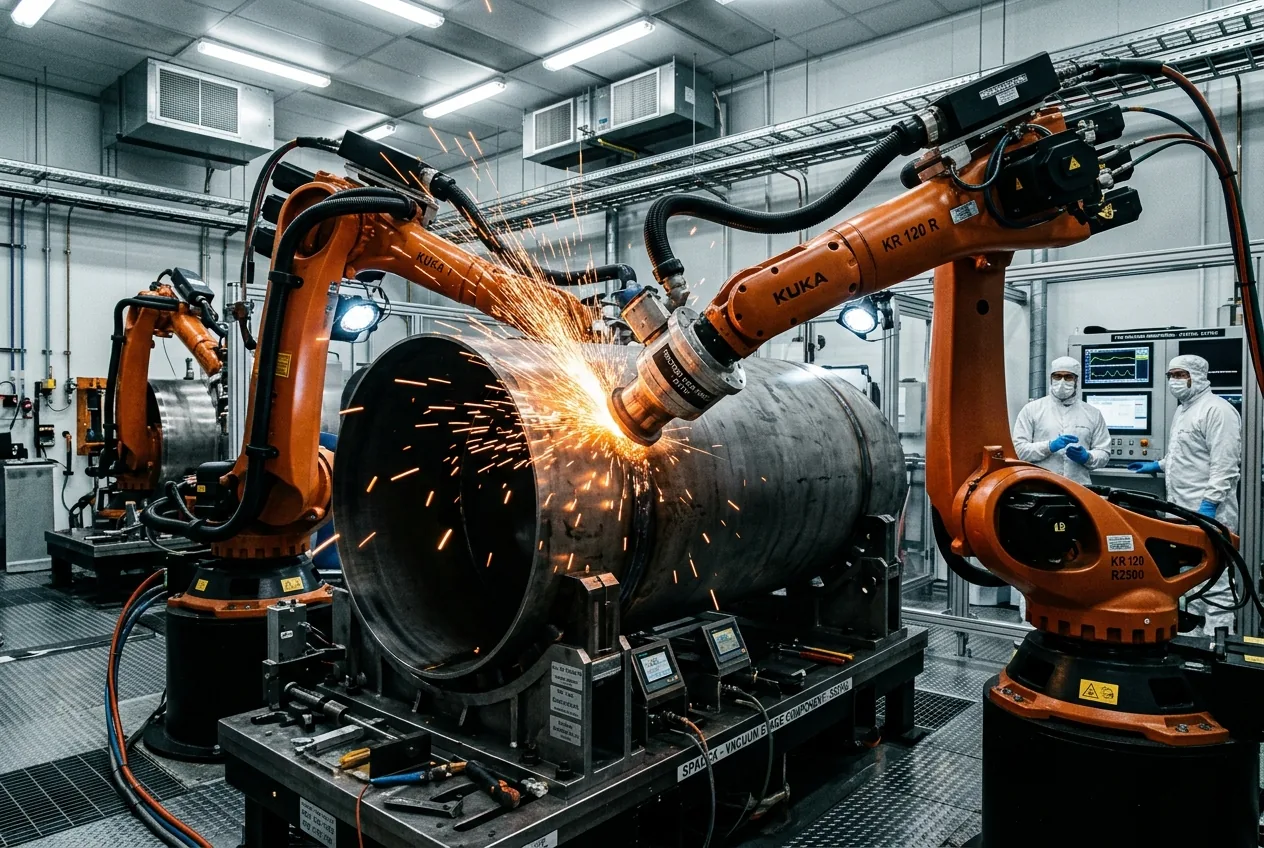
Vertical integration within the Hawthorne, California, production facility allowed the firm to control the tolerances and lead times of critical subassemblies. Instead of waiting eighteen months for third-party forged manifolds, SpaceX deployed high-rate friction-stir welding on lithium-aluminum tanks and manufactured flight computers using modern automotive-grade surface-mount components rather than expensive, decades-old radiation-hardened chips. By using multiple redundant, off-the-shelf microprocessors running custom fault-tolerant software, the avionics bay dropped in cost by orders of magnitude while increasing computational throughput. This industrial velocity depressed marginal launch costs to an estimated sub-$15 million per Falcon 9 flight, enabling a flight cadence that completely crowded out international competition.
Starlink as a Distributed Telecommunications Engine
Launch services alone, regardless of orbital monopoly, do not justify a multi-trillion-dollar enterprise valuation. The global commercial launch market has historically been capped at roughly $10 billion to $15 billion annually. The financial engine that shifts the valuation paradigm into the territory of global tech titans is Starlink, the low Earth orbit broadband megaconstellation. Starlink transforms SpaceX from a freight carrier into a high-margin telecommunications utility with planetary reach.
The engineering challenge of Starlink was not simply designing a phased-array satellite, but producing those satellites at automotive volumes. Prior to Starlink, the global space industry produced fewer than two hundred commercial communication satellites annually. SpaceX built an automated manufacturing line in Redmond, Washington, capable of turning out dozens of flat-panel spacecraft per week. Each chassis integrates krypton- and argon-fed Hall-effect thrusters, optical inter-satellite laser links, and autonomous star trackers into a flat-pack form factor designed to maximize payload fairing volumetric efficiency.
Downstream, the production of user terminals in Bastrop, Texas, represents another masterclass in automated hardware design. The early circular dishes required complex mechanical gimbals and expensive phased-array circuit boards that cost SpaceX over $1,000 to manufacture while selling for $499. Through successive design-for-manufacturing overhauls, the company stripped out mechanical complexity, transitioning to rectangular, passively cooled antennas with integrated system-on-a-chip beamformers that brought unit production costs well below consumer retail pricing. With millions of active subscribers generating high-margin, recurring software-style cash flows, the capital markets began valuing the constellation as a telecommunications disruptor rather than a cyclical aerospace fabricator.
Starship and the Factory-Scale Economics of Reusability
The theoretical ceiling of SpaceX’s long-term valuation ultimately hinges on Starship, the 120-meter fully reusable heavy-lift system currently under testing at Starbase in Boca Chica, Texas. Starship abandons the aerospace industry’s traditional reliance on expensive carbon fiber composites and specialized aluminum alloys in favor of 300-series cold-rolled stainless steel. From a mechanical engineering standpoint, this decision trades structural weight for dramatic manufacturing advantages: steel is inexpensive, requires no multi-million-dollar cleanrooms or autoclaves, exhibits remarkable thermal characteristics at cryogenic temperatures, and retains structural integrity at the elevated temperatures experienced during orbital reentry.
If Starship achieves its target operational cadence, the cost to deliver mass to orbit is projected to collapse from thousands of dollars per kilogram down to double digits. This metric fundamentally alters the global logistics chain. It enables unprecedented economic activity in orbit: commercial space stations, high-yield off-world manufacturing, planetary defense infrastructure, and lunar logistics under NASA's Artemis program. The market capitalization of such a platform is not merely evaluated against existing satellite launch demand, but against the creation of an entirely new industrial domain.
The Mechanical Bridge to Capital Markets
Financial institutions arriving at multi-trillion-dollar projections are not pricing in speculative science fiction; they are pricing in the structural capture of low Earth orbit and the infrastructure that sustains it. By reconciling the unforgiving physical constraints of rocketry with high-rate industrial manufacturing, SpaceX demonstrated that hardware iterations executed at speed can yield software-like economic scaling. The transition from a 10 percent survival probability to the upper stratosphere of global capital markets is, at its core, a triumph of mechanical engineering applied to the economics of mass manufacturing.




Comments
No comments yet. Be the first!