Sensational headlines from Middle Eastern wire services and digital outlets recently ignited a storm across defense technology circles with claims that the United States administration had authorized xAI’s flagship model, Grok, for kinetic targeting and strike planning against regional targets in Iran. The assertion paints a sci-fi portrait of warfare: an eccentric commercial chatbot selecting coordinates and launching ordnance from thousands of miles away. Yet, strip away the speculative geopolitical rhetoric, and the underlying reality presents an entirely different technical and structural challenge for defense engineers and military command structures.
While modern militaries are aggressively procuring artificial intelligence capabilities, the gap between an interactive frontier large language model (LLM) and an operational targeting pipeline is vast. Understanding how commercial systems enter defense workflows requires examining the rigorous protocols of the Department of Defense, the architectural realities of sensor-to-shooter loops, and the severe physical and deterministic constraints governing kinetic strikes.
The Anatomy of Modern Algorithmic Targeting
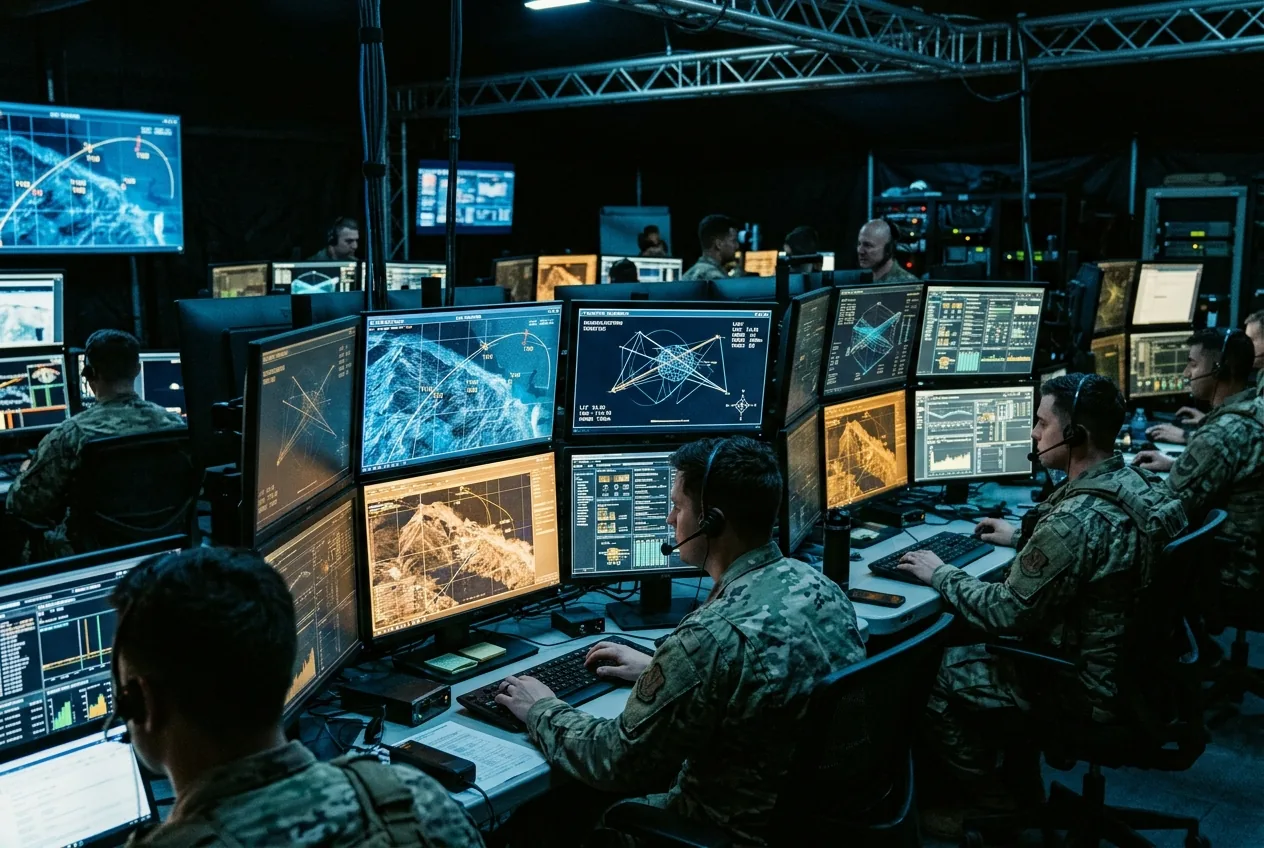
Modern military strike planning does not hinge on conversational chatbots issuing firing commands. Instead, algorithmic warfare operates through highly structured, multi-echelon architectures designed to process petabytes of sensor data under extreme security classifications. The backbone of American algorithmic targeting has long been anchored in programs like Project Maven, now transitioned under the Chief Digital and Artificial Intelligence Office (CDAO) and integrated into the Combined Joint All-Domain Command and Control (CJADC2) framework.
Generative models and LLMs, when deployed in these intelligence architectures, do not generate coordinates for strike packages in isolation. Rather, they serve as specialized semantic processing engines. An intelligence analyst tasked with reviewing vast troves of intercepted radio transmissions, foreign-language open-source intelligence, and legacy targeting folders might utilize a conversational interface to query historical patterns or summarize complex operational logs. The output is strictly preparatory; it serves to reduce cognitive load on the human operator rather than dictate tactical execution.
The Engineering Divide Between Commercial Weights and Tactical Enclaves
Military operational data, particularly target folders and dynamic kinetic plans, cannot traverse public internet pipelines or unvetted commercial cloud architectures. Any artificial intelligence model utilized in operational targeting must be deployed within secure, air-gapped environments that meet stringent Department of Defense Cloud Computing Security Requirements Guide standards, typically Impact Level 6 (IL6) for classified secret data, or higher for Special Access Programs.
Deploying a frontier model into these tactical enclaves requires significant engineering modifications. The model must be containerized, audited for backdoors and training data leakage, stripped of dynamic internet connectivity, and fine-tuned on classified technical manuals, weapons engagement zones, and rules of engagement (ROE). xAI, like competitors such as Anthropic, Google, and OpenAI, has explored avenues to license model weights to defense integrators. However, porting a system like Grok into an operational battle management system involves substantial software refactoring, turning a general-purpose conversationalist into an enterprise retrieval-augmented generation (RAG) tool that strictly cites verified military databases.
Why Stochastic Systems Cannot Actuate Kinetic Strikes
From a mechanical and systems engineering standpoint, large language models possess a fundamental vulnerability that precludes them from acting as final firing authorities: stochastic non-determinism. LLMs are probabilistic token predictors. When given identical inputs under varying system temperatures or context windows, they can produce divergent outputs. In precision strike operations, non-determinism represents a catastrophic failure mode.
Precision strikes require deterministic mathematical solutions. Ballistic trajectories, blast radiuses, collateral damage estimations (CDE), and weapon-target pairing (WTP) rely on hard physics engines and empirical blast modeling. Defense engineers calculate the precise kinematic capabilities of a Joint Direct Attack Munition (JDAM) or a Tomahawk cruise missile against the structural density of a reinforced concrete bunker. Replacing these deterministic physics computations with the probabilistic guessing of an LLM would introduce unacceptable risks of catastrophic failure or collateral devastation.
Furthermore, Department of Defense Directive 3000.09, which governs autonomy in weapon systems, legally mandates rigorous human-in-the-loop and human-on-the-loop protocols for any kinetic application. Even as autonomous navigation and automated target recognition (ATR) mature at the platform level, the legal and tactical threshold for weapons release requires positive human identification and approval. A model like Grok cannot legally or technically be given an “authorization to strike”; it can merely present processed intelligence to a human targeteer who cross-references the data with independent tactical sensors.
The Vector of Hallucination in Intelligence Synthesis
The primary technical hurdle preventing conversational AI from dominating intelligence preparation is the phenomenon of hallucination. When frontier models encounter ambiguous, low-resolution, or contradictory inputs, they default to plausible-sounding fabulation. In an intelligence context involving hostile state actors like Iran, raw data is routinely incomplete, actively spoofed by electronic warfare, or camouflaged through deliberate denial and deception operations.
To counteract this, defense contractors and military software labs employ strict retrieval-augmented generation (RAG) guardrails. In these architectures, the generative model is forbidden from answering using its latent parametric memory. Instead, it is constrained strictly to extracting and reformatting text from pre-verified intelligence documents provided in its context window. This functional reality strips away the flamboyant persona of chatbots like Grok, reducing the software to an advanced semantic search and formatting utility.
Information Operations and the Allure of AI Legends
Why do unverified reports regarding commercial AI systems and kinetic strikes proliferate so rapidly across international media? The intersection of high-profile Silicon Valley technology, geopolitical brinkmanship, and modern warfare creates a fertile ground for narrative inflation. Attributing automated omnipotence to an adversary or framing ordinary military software procurement as a leap toward fully automated assassination serves distinct psychological warfare objectives.
For domestic and international audiences, invoking high-profile commercial artificial intelligence systems projects a veneer of hyper-advanced, infallible technological dominance. Conversely, for adversaries, such reports justify heightened security postures, retaliatory cyber operations, or diplomatic appeals against asymmetric algorithmic threats. The reality remains far more mundane: military workflows evolve through iterative, bureaucratic software acquisitions, standardized API integrations, and cautious field trials where legacy hardware interfaces dictate the pace of adoption far more than Silicon Valley product release cycles.
The integration of advanced computation into defense operations is accelerating, but the pipeline remains anchored in rigorous hardware design, deterministic guidance systems, and human accountability. Frontier models will continue to find utility in parsing paperwork, transcribing voice intercepts, and organizing log files for tactical commanders. But the myth of a consumer-facing AI orchestrating kinetic warfare over sovereign territory remains a technological impossibility, detached from the unforgiving physical laws of modern weapons systems.




Comments
No comments yet. Be the first!