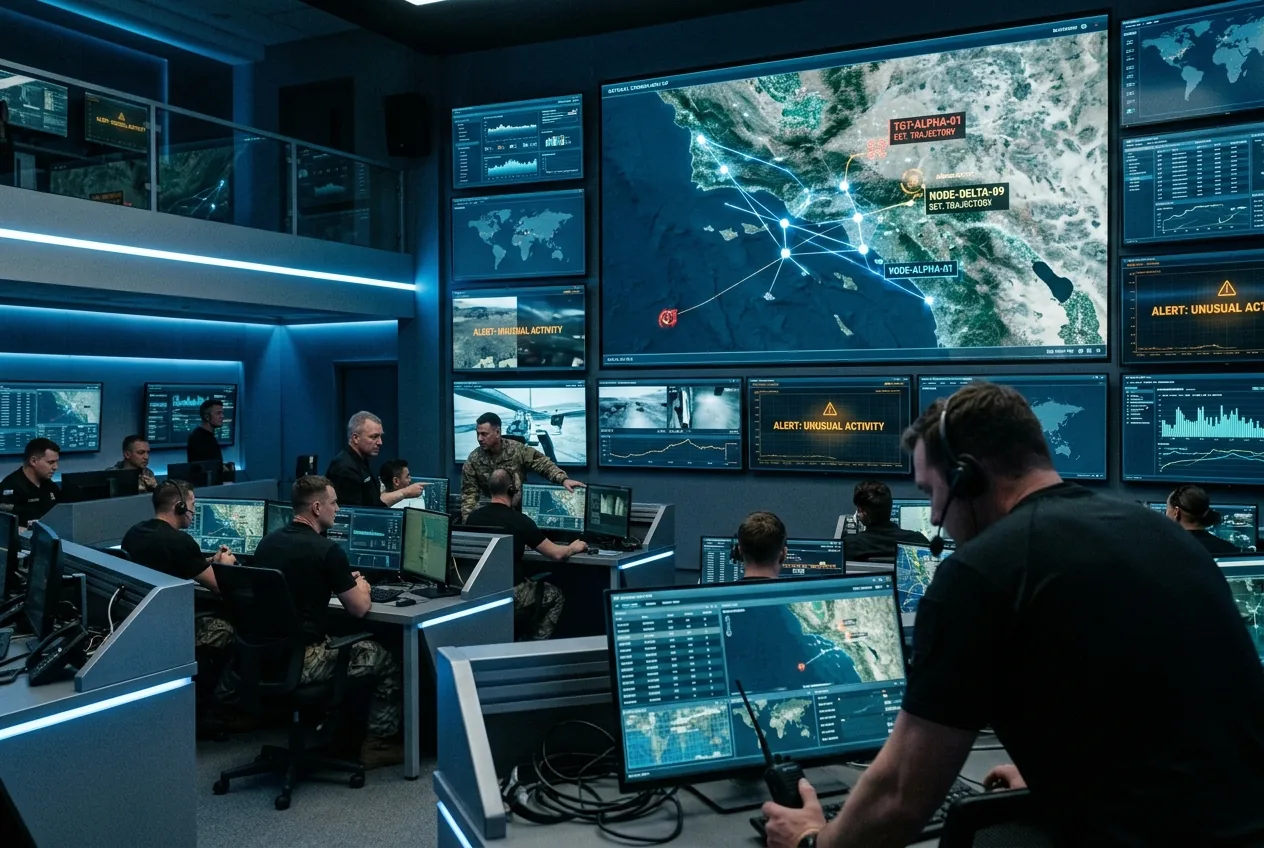
Recent reports alleging that the Pentagon leveraged Elon Musk’s xAI platform, Grok, to designate and process upwards of 2,000 targets in the Middle East within a ninety-six-hour window have sent shockwaves across both the defense and technology sectors. First circulating through Middle Eastern geopolitical news outlets, including reports highlighted by The Cradle, the assertion details an unprecedented level of real-time commercial artificial intelligence integration within active kinetic combat operations. While the precise contractual mechanisms and technical execution remain heavily classified, the core question is no longer whether modern militaries are attempting to deploy commercial generative models into the kill chain, but rather how these neural architectures are mechanically fitted into the machinery of rapid targeting.
Military automation has quietly transitioned from an experimental research initiative into the operational backbone of United States Central Command (CENTCOM). For decades, processing satellite imagery, signals intelligence, and drone video feeds required thousands of human analytical hours. Today, modern strike packages are governed by algorithmic orchestration platforms designed to condense the time between target identification and weapon release from hours to minutes. Understanding the credibility and implications of Grok’s reported participation requires stripping away the geopolitical hyperbole and examining the physical reality of automated sensor-to-shooter data pipelines.
The Architecture of Algorithmic Targeting
To evaluate claims of mass algorithmic target generation, one must first look at the foundational infrastructure the Department of Defense has spent years constructing. The modern standard for automated warfare was pioneered under Project Maven, officially designated the Algorithmic Warfare Cross-Functional Team, launched in 2017. Project Maven’s initial mandate focused squarely on computer vision: training deep convolutional neural networks to ingest millions of hours of full-motion video from tactical unmanned aerial vehicles and automatically classify trucks, personnel, radar arrays, and weapons caches. Over time, that computer-vision engine was integrated into sophisticated battle-management suites such as the Maven Smart System and Palantir’s visual command ecosystems.
However, computer vision only identifies that a shape exists; it does not analyze the context, origin, or broader tactical significance of an installation. That is where large language models and reasoning engines enter the operational envelope. Over the past eighteen months, the Pentagon’s Chief Digital and Artificial Intelligence Office (CDAO) established Task Force Lima to evaluate how generative AI models—including systems engineered by OpenAI, Anthropic, Google, and xAI—could be securely plugged into military hardware systems. The objective is not to allow an AI to independently fire a cruise missile, but to automate target systems analysis, synthesize intercepted electronic chatter, cross-reference satellite telemetry, and compile standardized joint target folders at machine speed.
If a commercial model like Grok was indeed integrated into recent CENTCOM operations, its architectural utility would reside specifically in this synthesis layer. When offensive campaigns scale to hundreds of strikes per day, the logistical bottleneck is human cognitive bandwidth. An advanced foundation model fine-tuned for tactical data can rapidly ingest multi-source intelligence, cross-verify it against doctrine parameters such as collateral damage estimation methodologies, and generate action-ready firing coordinates for human review in a fraction of a second. This mechanical efficiency is the only mathematical explanation for how any military could credibly process thousands of discrete target nodes across a theater in a matter of days.
Commercial Foundation Models in Defense Operations
The emergence of xAI within national security discussions marks a stark philosophical shift from the Silicon Valley dynamics of the prior decade. In 2018, thousands of Google engineers signed internal petitions that forced the company to let its Project Maven contract expire, sparking widespread speculation that American tech giants would refuse to build weapons-adjacent software. That boundary has effectively collapsed. Today, enterprise tech firms compete aggressively for multi-billion-dollar enterprise cloud contracts, and the CDAO regularly conducts Global Information Dominance Experiments (GIDE) that openly feature commercial generative models inside defense logistics networks.
Elon Musk’s commercial empire has maintained a deep, symbiotic relationship with the national security apparatus for years, primarily through SpaceX’s launch capabilities and the Starshield tactical satellite communications network. Grok, developed by xAI, was trained on colossal compute clusters designed to parse vast streams of unstructured text, contextual trends, and multimodal inputs with high analytical throughput. For the Pentagon, tapping into frontier models through secure, air-gapped sovereign instances offers access to commercial breakthroughs that internal military labs cannot duplicate without billions in software engineering overhead.
Yet, deploying a model developed for public discourse into a kinetic targeting environment creates unique engineering hazards. General-purpose models are fundamentally optimized for human fluency and creative reasoning, not deterministic physical precision. In ballistic calculations and target verification, a software hallucination is not a harmless conversational quirk; it is a fatal systemic failure. If defense contractors or combatant commands are hooking Grok or similar foundation models into operational APIs, strict programmatic scaffolding must be enforced around the model, treating the neural net as an advisory data parser rather than an authoritative decision-maker.
The Fragility of the Sensor-to-Shooter Loop
From an engineering perspective, accelerating the kill chain introduces severe feedback-loop risks. The doctrine of modern targeting revolves around the classic cycle known as D3A: Decide, Detect, Deliver, and Assess. Historically, the friction inherent in human coordination between tactical commanders, intelligence analysts, and legal advisors acted as a biological buffer against catastrophic misidentification. By compressing the Detect and Deliver phases into near-instantaneous automated sequences, that buffer is thinned to a nominal sign-off from an exhausted human-in-the-loop.
When an algorithmic system processes 2,000 targets over a ninety-six-hour campaign, human operators are presented with standardized interfaces confirming coordinates, target type, and projected collateral estimates. At that operational velocity, human review risks becoming entirely performative—a psychological phenomenon known as automation bias, where human supervisors routinely defer to the machine’s output because they lack the time and raw data to independently contest the algorithm’s findings. If Grok or any comparable architecture is synthesizing intelligence at that scale, the moral and legal responsibility remains anchored to the human command chain, but the kinetic trajectory is dictated by the algorithm’s internal weights.
Furthermore, adversarial nations and regional actors are fully aware that Western forces are transitioning to algorithmic battle networks. This awareness inevitably leads to algorithmic counter-warfare: physical deception, thermal decoys, adversarial camouflage, and deliberate digital poisoning designed to trick computer vision and confuse LLM parsers. If a targeting model is trained to interpret specific behavioral signatures as imminent threats, an adversary can manipulate those variables to trigger automated strikes against strategically worthless or politically disastrous locations, turning the system’s speed against itself.
The Inevitable Trajectory of Machine-Speed War
Whether Grok played a direct, specialized role or the reports reflect an amalgam of various proprietary commercial tools running beneath the Maven umbrella, the operational trajectory of the Department of Defense is unmistakable. Industrial-scale algorithmic warfare is no longer an aspirational concept confined to DARPA white papers; it is operating in active combat corridors across the globe. As defense pipelines ingest increasingly massive telemetry streams from orbiting sensors, autonomous surveillance drones, and intercepted telecommunications, the requirement for automated synthesis platforms will only intensify.
The integration of foundation models into military workflows represents a profound structural inflection point in human conflict. It bridges the gap between raw data collection and kinetic force, turning code into an industrial component of warfare. As these technologies mature, the commercial developers building consumer-facing chatbots will face an unavoidable reality: cutting-edge intelligence architectures are dual-use systems by default. In modern automated warfare, the code deployed to organize human language is the very same architecture shaping the battlefield.




Comments
No comments yet. Be the first!