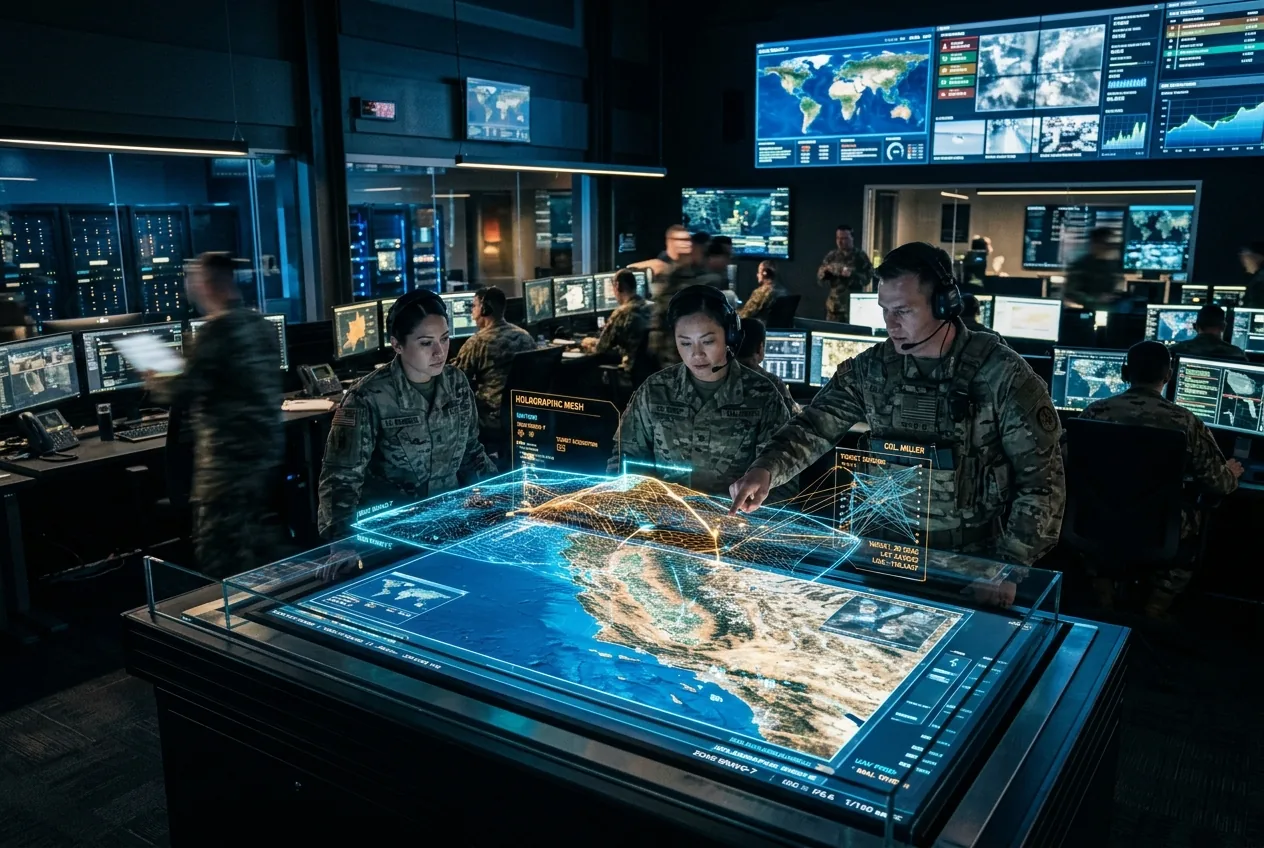
Recent reports detailing the integration of advanced commercial artificial intelligence into kinetic operations have ignited a critical examination of modern fire-control architectures. Assertions that frontier models, including xAI's Grok, were leveraged in tactical workflows to coordinate and deploy upwards of two thousand munitions against Iranian-backed logistics hubs and command nodes highlight an accelerating paradigm shift. Defense planners are no longer treating artificial intelligence as an experimental sandbox for back-office paperwork; they are embedding algorithmic synthesis directly into operational battle rhythms.
Understanding this development requires moving past science-fiction hyperbole and dissecting the engineering reality of automated warfare. Modern precision-strike complexes do not hand autonomy to a chatbot to fire a cruise missile or release a satellite-guided bomb. Instead, large language models and multi-modal neural networks are being evaluated as cognitive middleware, stitching together fragmented telemetry, intelligence intercepts, and geospatial sensor feeds to compress the military kill chain from hours to seconds.
The Anatomy of Algorithmic Target Identification
Modern military strike packages rely on an interconnected ecosystem commonly known as the sensor-to-shooter loop. For decades, the primary bottleneck in this loop was human cognition: intelligence analysts had to manually scrub through thousands of hours of high-definition full-motion video captured by uncrewed aerial systems, correlate those feeds with synthetic aperture radar scans, and verify geographic coordinates against static collateral-damage databases. The introduction of deep convolutional neural networks under initiatives like the Pentagon's Project Maven solved the initial tier of computer vision processing, allowing algorithms to automatically tag vehicles, radar installations, and bunker entrances.
Where generative foundation models alter the operational equation is in situational aggregation. Modern strike complexes generate petabytes of heterogeneous data that human mission planning cells struggle to synthesize under time constraints. When an operations center coordinates the expenditure of thousands of precision munitions across a distributed theater, the logistical and tactical overhead is staggering. Generative systems trained to query massive, disparate relational databases allow tactical action officers to query complex operational pictures using conversational syntax, asking for viable weapon-target pairings based on real-time ordnance inventories, weather forecasts, and dynamic anti-air threats.
Dissecting the Machine Architecture Behind Kinetic Strikes
To understand the claims surrounding large-scale munition deployments, one must analyze the physical infrastructure required to support algorithmic targeting in a combat theater. Tactical cloud environments, operated under umbrella frameworks such as the Pentagon's Joint Warfighting Cloud Capability, deploy secure edge-compute nodes to regional operating bases. These hardware stacks host containerized instances of multi-modal models, isolated from external public networks to prevent data exfiltration and ensure deterministic performance.
When an algorithmic workflow assists in planning the deployment of thousands of ordnance units, it functions within a layered stack. Palantir's Artificial Intelligence Platform and the Maven Smart System serve as operational interfaces, pulling in the model’s analytical outputs and presenting them to human targeting officers. The model does not calculate the terminal guidance telemetry for a Joint Direct Attack Munition or a Tomahawk cruise missile; specialized digital flight control systems handle the kinematic guidance. The generative model’s contribution lies entirely in the cognitive preparation of the battlefield, structuring the chaotic influx of operational inputs so human decision-makers can approve strikes at machine speed.
Why Commercial Tech Giants Are Piercing the Defense Barrier
The reported utilization of architectures associated with private labs like xAI marks the culmination of a broader industry pivot. For years, leading Silicon Valley technology companies maintained strict self-imposed bans on defense contracts, often driven by internal employee pushback regarding kinetic applications. That ideological boundary has largely dissolved over the past twenty-four months, replaced by an aggressive race to secure massive federal national-security contracts.
The economic and strategic drivers behind this shift are absolute. Frontier artificial intelligence models require capital expenditure on a scale unprecedented in software engineering, demanding billions of dollars in specialized GPU clusters, custom silicon, and dedicated power generation. The Department of Defense represents one of the few institutional customers with both the strategic imperative and the non-dilutive capital necessary to sustain long-term compute acquisitions. From specialized data-mining platforms to generative intelligence synthesis, commercial tech firms are repositioning their models as dual-use assets essential to state deterrence.
Furthermore, operational deployment in complex, contested environments provides tech developers with the ultimate validation dataset. Operating in environments subjected to intense electronic warfare, GPS spoofing, and deliberate data poisoning forces software architectures to achieve a level of hardware reliability, low-latency processing, and cyber resilience that cannot be simulated in commercial enterprise software suites. The lessons learned from coordinating massive munition stockpiles directly inform subsequent generations of enterprise automation and robotics software.
The Structural Dilemma of Algorithmic Escalation
The integration of ultra-fast automated analysis into theater-wide strike planning permanently shifts the nature of escalation control. Historically, the friction of human bureaucracy and operational logistics acted as an accidental buffer in military crises. Compiling battle damage assessments, verifying secondary target libraries, and distributing target tasking orders required hours or days, affording political leaders a window to assess adversary responses and modulate diplomatic leverage.
When algorithms reduce the targeting cycle to minutes, that deliberate buffer disappears. If targeting nodes process satellite imagery and automated signals intercepts to produce valid firing solutions for thousands of targets simultaneously, the institutional pressure to execute those solutions before the tactical window closes becomes intense. Human oversight risks becoming a rubber-stamping formality—a phenomenon known in engineering as automation bias—where commanders, overwhelmed by the volume and velocity of machine-generated recommendations, default to approving automated targeting plans.
This dynamic introduces acute systemic fragility. In high-stakes confrontations involving near-peer actors or regional powers with distributed ballistic capabilities, the speed of algorithmic decision-making creates an escalatory ratchet. If an opposing force recognizes that an adversary’s targeting apparatus operates at algorithmic speed, it faces an acute 'use it or lose it' dilemma regarding its own strategic assets, dramatically lowering the threshold for preemptive conventional strikes.
The Long-Term Trajectory of the Algorithmic Battlefield
Whether specific commercial models are directly involved or operating as part of broader multi-vendor defense software layers, the operational direction of global militaries is fixed. The future of kinetic power projection will not be defined solely by the stealth profiles of airframes or the kinematic velocity of hypersonic glide vehicles, but by the computational throughput of the software networks directing those munitions. The industrial base that manufactures munitions must now integrate tightly with the digital infrastructure that identifies their destinations.
As these targeting architectures mature, the divide between specialized military software and commercial foundation models will continue to blur. The challenge facing systems engineers and strategic analysts alike is no longer proving whether artificial intelligence can organize a massive, theater-wide air campaign. That capability has arrived. The challenge now lies in building the mechanical, institutional, and operational safeguards required to keep human intentionality in control of an automated war machine.




Comments
No comments yet. Be the first!