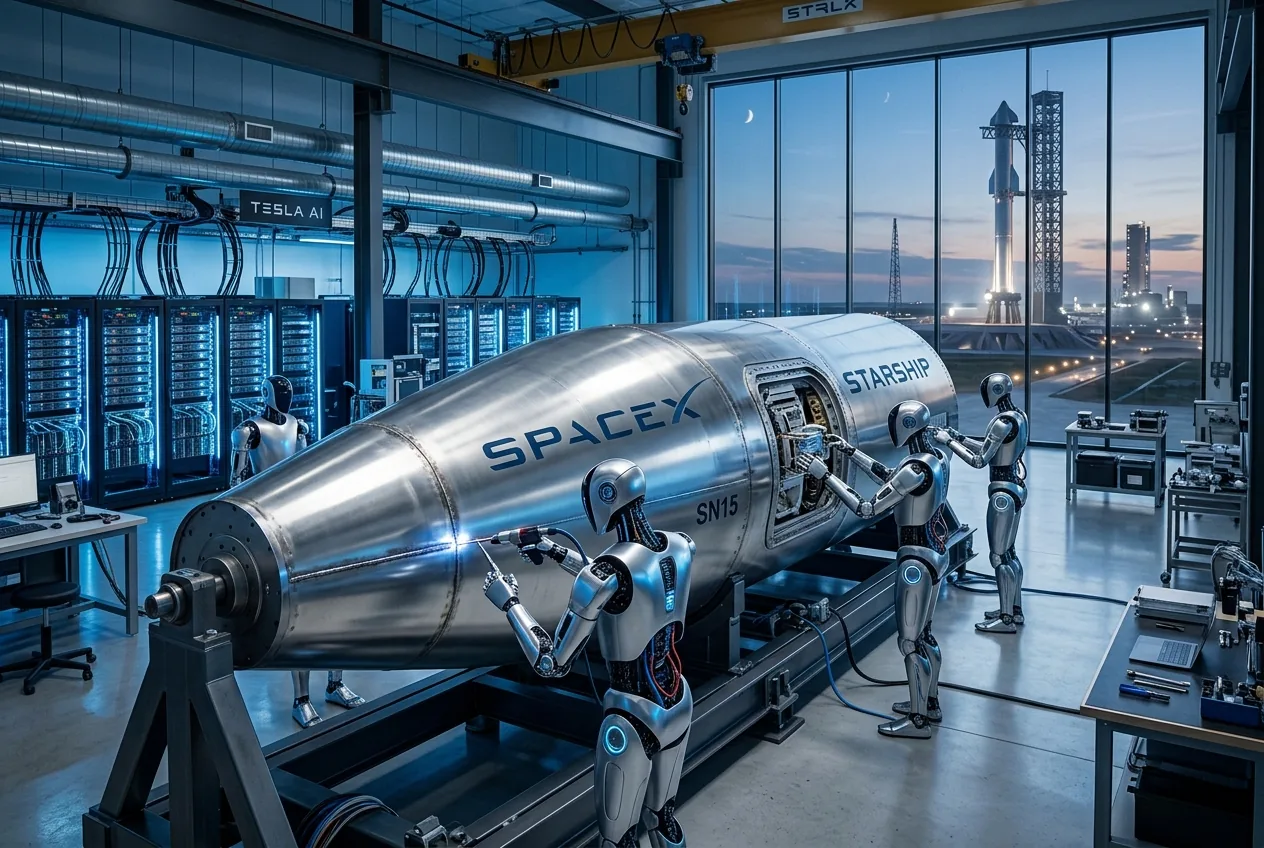
In the lead-up to what is projected to be the largest initial public offering in history, Elon Musk has reportedly intensified internal discussions regarding a potential merger between Tesla and SpaceX. This strategic pivot, occurring just weeks before SpaceX’s planned debut on the Nasdaq, suggests a broader ambition to consolidate Musk’s sprawling industrial empire into a single, vertically integrated powerhouse focused on artificial intelligence, robotics, and space-based infrastructure. While the financial world watches the June 12 IPO date with bated breath, the underlying technical and operational overlaps between the two companies provide a pragmatic rationale for such a move, even as governance experts raise alarms over the concentration of power.
The scale of the proposed SpaceX IPO is unprecedented. Targeting a $1.75 trillion valuation, the company seeks to raise approximately $75 billion, a figure that would eclipse the record-setting debut of Saudi Aramco. This valuation is not merely based on launch services or satellite internet; rather, SpaceX’s S-1 filing reframes the company as an AI infrastructure giant. The filing outlines a staggering $28.5 trillion total addressable market (TAM), with a remarkable 93% of that figure—roughly $26.5 trillion—allocated to AI-driven opportunities. This shift in narrative indicates that the future of SpaceX is as much about data and computation as it is about rocketry.
The Convergence of AI and Hardware
The technical synergy between Tesla and SpaceX has grown increasingly tangible over the last twenty-four months. Tesla’s advancements in autonomous systems, specifically its Full Self-Driving (FSD) stack and the development of the Optimus humanoid robot, require massive computational power and sophisticated sensor fusion. Conversely, SpaceX’s Starlink constellation and the upcoming Starship missions necessitate radiation-hardened, power-efficient computing that can operate in the harsh environment of low Earth orbit and beyond. By merging, the two entities could leverage a unified R&D pipeline, sharing breakthroughs in battery chemistry, thermal management, and edge computing.
Economic Viability and the 'Algorithm'
From a mechanical and industrial engineering perspective, the merger aligns with Musk’s well-documented "Algorithm"—a five-step process that emphasizes questioning every requirement, simplifying processes, and accelerating production. At Tesla, this resulted in the Giga Press and the structural battery pack. At SpaceX, it led to the rapid iteration of the Starship architecture. Unifying the two companies would allow for a shared manufacturing philosophy, where the high-volume production techniques perfected at Tesla’s Gigafactories could be applied to the mass production of Starship components and Starlink satellites.
There is also a clear economic incentive in the pooling of capital. SpaceX’s 2025 capital expenditures are projected to reach $20.7 billion, a significant portion of which is directed toward the Terafab chip facility and high-performance computing clusters. Tesla, with its robust cash flow from automotive sales and energy storage, could serve as the financial engine to sustain these high-CAPEX projects. Analysts at Wedbush, led by Dan Ives, estimate the probability of a merger as high as 80% to 90% by early 2027, citing the "inevitable gravitational pull" of their shared technical goals.
Are Governance Concerns a Dealbreaker?
Despite the technical logic, the financial structures revealed in the IPO filings have drawn scrutiny. One of the most controversial revelations is the existence of nearly $20 billion in AI hardware leases with Valor Equity Partners. Valor is led by Antonio Gracias, a longtime Musk associate and SpaceX board member. PwC has reportedly classified these arrangements as debt rather than simple leases, adding $9 billion in related-party obligations to SpaceX’s balance sheet. Governance experts argue that such "non-arm’s-length" transactions raise questions about whether the terms are truly in the best interest of minority shareholders or simply a method for Musk to shuffle capital between his inner circle.
Moreover, Musk’s retention of roughly 85% of SpaceX’s voting power ensures that he will have near-total control over the company post-IPO. This status as a "controlled company" grants exemptions from certain Nasdaq rules regarding board independence. For Tesla shareholders, who have already witnessed Musk divert engineering talent to his other ventures like X (formerly Twitter) and xAI, a merger could be seen as either a masterstroke of integration or a dilutive event that complicates Tesla’s primary mission as an automaker. The legal path to a merger would likely involve complex stock swaps and could trigger significant litigation from institutional investors concerned about valuation transparency.
Digital Assets and the New Treasury
Adding another layer of complexity to the SpaceX balance sheet is the disclosure of significant Bitcoin holdings. The IPO filing reveals that SpaceX holds 18,712 BTC, valued at approximately $1.45 billion. This exceeds Tesla’s own Bitcoin stash, positioning SpaceX as one of the largest corporate holders of digital assets in the world. While some see this as a hedge against fiat volatility, others view it as a strategic component of a future space-based economy, where decentralized ledgers could facilitate autonomous transactions between satellites, lunar bases, and terrestrial users.
The integration of digital assets aligns with the vision of orbital edge computing. If SpaceX succeeds in deploying a network of in-space servers, the ability to process and monetize data in orbit becomes a new revenue stream. This "space cloud" would serve not only Musk’s companies but also government agencies and private enterprises, providing a secure alternative to ground-based data centers that are vulnerable to geopolitical instability and environmental disasters.
The Road to Mars and the Moon
Ultimately, the merger of Tesla and SpaceX would represent the culmination of Musk’s career-long effort to bridge the gap between Earth and the stars. From a technical standpoint, the two companies are already breathing the same air; they share engineers, board members, and a singular focus on solving the most difficult physics problems of our time. Whether the market can stomach the governance risks and the sheer scale of a $2 trillion-plus conglomerate remains the primary question. As the June 12 IPO approaches, the industry is not just looking at a rocket launch, but the potential launch of a new era in industrial history, where the boundary between a car company and a space agency finally disappears.




Comments
No comments yet. Be the first!