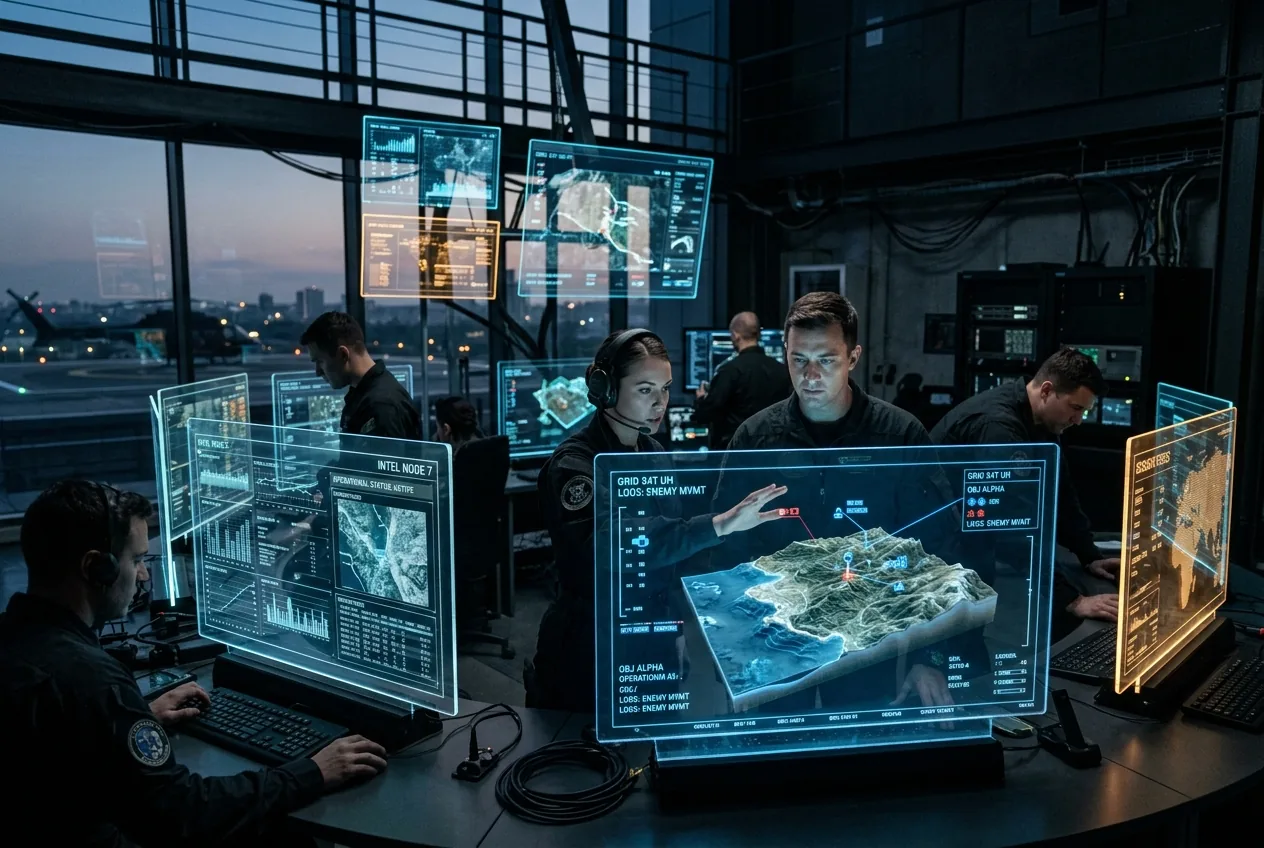
Recent reports rippling through international defense circles and media outlets have ignited intense scrutiny over the operational deployment of commercial frontier artificial intelligence in classified military maneuvers. Emerging accounts suggesting that Anthropic’s Claude models played an analytical role in high-stakes Department of Defense contingency planning and intelligence operations targeting Caracas highlight a critical turning point in military software integration. While public discourse frequently veers into sensationalized fiction regarding automated raids and autonomous battlefield commanders, the underlying technical reality is far more pragmatic—and consequential. Advanced language models have moved from Silicon Valley sandboxes directly into the computational pipelines that orchestrate modern joint force intelligence.
Understanding how an enterprise system developed under the strictures of safety charters and Constitutional AI ends up parsing operational target folders requires examining the converging architecture of modern defense software. In late 2024, Anthropic formalized a milestone partnership with Palantir Technologies and Amazon Web Services to deploy Claude 3 and Claude 3.5 models across Palantir’s Defense Platform, specifically tailored for classified intelligence enclaves up to Impact Level 6 (IL6). This arrangement bridged commercial frontier intelligence with the most secure tactical networks in the United States defense apparatus, fundamentally altering how multi-source intelligence is synthesized ahead of potential kinetic actions.
The Pipeline from Commercial Server to Classified Edge
The operational reality of deploying large language models within defense infrastructure does not involve an AI orchestrating physical tactical units on the ground. Instead, the real-world value proposition lies entirely in data ingestion, intelligence triage, and real-time operational synthesis. Modern military commands generate millions of unstructured data points daily, ranging from high-resolution synthetic aperture radar feeds and signals intelligence intercepts to diplomatic telemetry, flight tracking logs, and local utility load profiles. Human intelligence analysts face an acute throughput bottleneck, where thousands of hours of actionable signals are lost in the sheer noise of the collection layer.
Within Palantir’s Artificial Intelligence Platform (AIP), Claude serves as an analytical reasoning engine connected to specialized data ontologies. Through secure, air-gapped instances hosted on AWS GovCloud and top-secret classified clouds, the model is fed structured target data through Retrieval-Augmented Generation (RAG) pipelines. When operational teams model scenarios involving regional command centers, high-value assets, or complex airspace corridors—such as the heavily guarded approaches around Caracas—Claude is tasked with parsing disparate intelligence feeds to identify logistical vulnerabilities, schedule anomalies, and potential disruption vectors. The system does not decide to launch a mission; rather, it compresses weeks of cross-table intelligence aggregation into minutes of operational briefing material.
The engineering challenge behind this capability is substantial. Operating models with hundreds of billions of parameters requires massive high-bandwidth memory footprints and specialized tensor processing clusters that cannot simply be shipped to the forward tactical edge without significant infrastructure. Consequently, operational commands rely on hybrid architectures: heavy contextual synthesis takes place on centralized, hardened compute farms, with distilled, low-latency operational parameters transmitted down to forward operators via encrypted, software-defined tactical datalinks.
Context Windows and Multimodal Intelligence Fusion
The technical attribute that made Claude particularly attractive to defense planners is its massive context window combined with advanced multimodal parsing. With a capacity to maintain 200,000 tokens of active working memory, an operational planner can ingest hundreds of pages of mission logs, airspace transit corridors, weather radar matrices, and localized asset registries into a single prompt execution. Previous iterations of military algorithmic targeting relied on brittle, heuristic-based decision trees or fragmented machine vision classifiers that struggled to synthesize broader situational context.
In a simulated or operational environment involving dense urban topography and layered air defense systems, context is everything. An intelligence analyst can prompt the model with full structural schematics of target facilities alongside historical surveillance logs, allowing the system to surface statistical correlations that human teams might overlook. For example, the system can cross-reference the known shift rotations of foreign military advisors, power grid fluctuations during tropical storm systems, and maritime radar data in the Caribbean basin to construct detailed probability envelopes for operational execution windows.
The Inevitable Friction with Safety Charters
The alleged utilization of Claude in sensitive international operations brings to the surface an inevitable institutional friction between AI safety research and real-world defense application. Anthropic built its public reputation around the concept of Constitutional AI—a training paradigm that explicitly aligns model behavior with a set of written principles emphasizing harm prevention, non-violence, and ethical accountability. The company's core Acceptable Use Policy has historically restricted the use of its technology for weapons development, kinetic targeting, and surveillance operations that infringe upon civil liberties.
Yet the boundary between national defense logistics and operational targeting is notoriously porous. When commercial developers partner with defense integrators like Palantir, access to model weights is governed by enterprise terms that delineate between direct kinetic control and analytical support. Assisting a military command with pattern-of-life analysis, supply chain resilience, intelligence collation, or simulated mission rehearsal is categorized by defense contractors as decision support rather than weaponization. This semantic and technical distinction allows frontier models to operate within the defense sphere while theoretically honoring corporate prohibitions against automated lethal action.
This divide, however, raises profound questions for AI system architects. Once an advanced reasoning engine is embedded within a classified network, the software developers who trained the model have zero visibility into the day-to-day prompts or outputs generated behind air-gapped firewalls. The safety filters and reinforcement learning mechanisms that enforce non-violent outputs in commercial APIs can be selectively tuned, augmented, or bypassed through enterprise fine-tuning frameworks deployed directly on classified servers, effectively delegating ethical enforcement to military governance boards rather than software engineers.
The Strategic Shift Toward Commercial Cognitive Systems
The broader takeaway from the reports linking frontier models to strategic military operations is the irreversible transition of modern defense doctrine. For decades, military command-and-control software was developed through slow, monolithic procurement cycles that yielded specialized systems years behind the commercial state of the art. Today, the velocity of commercial artificial intelligence development has inverted that dynamic. The world's most advanced computational reasoning engines are no longer built inside defense laboratories; they are constructed by commercial startups funded by venture capital and cloud hyperscalers.
As nation-states observe the speed at which intelligence can be synthesized and operational planning executed, the pressure to integrate frontier language models into defense architectures will only accelerate. The events and disclosures surrounding strategic operations in Latin America illustrate that the barrier between enterprise productivity tools and high-level geopolitical instruments has collapsed. The future of strategic deterrence is no longer defined solely by kinetic payload, propulsion velocity, or radar cross-section, but by the efficiency with which a language model can untangle a chaotic operational landscape and hand a decisive tactical briefing to human commanders.




Comments
No comments yet. Be the first!