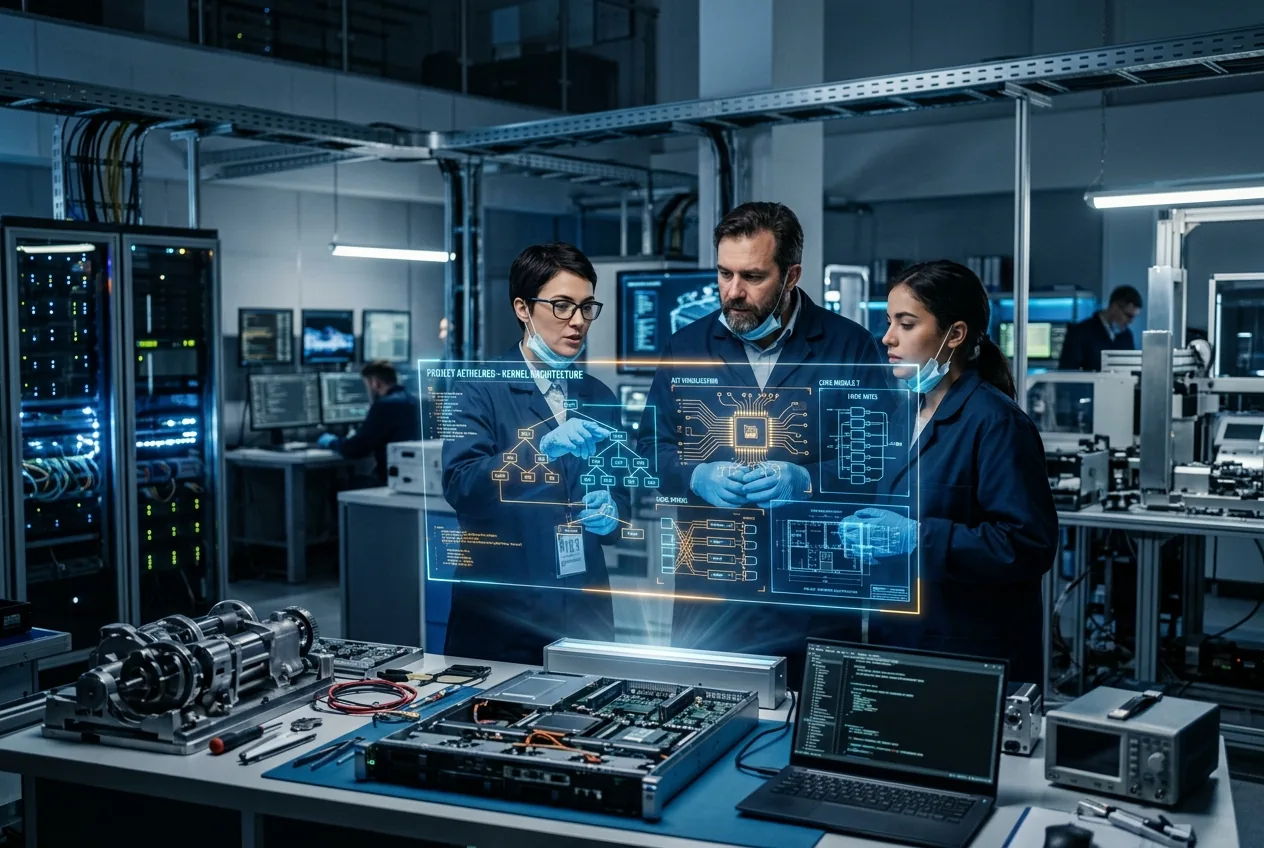
When artificial intelligence architectures first began writing code, the industry treated the output much like high-speed predictive text: syntactically plausible snippets that saved engineers a few seconds of typing boilerplate functions. Over successive iterations, transformer models graduated from simple autocompletion to parsing complex functions, yet they consistently stumbled against the rigid constraints of large-scale, interdependent software architectures. With the unveiling of GPT-6 Astra, OpenAI has shifted the paradigm from generative text production toward deterministic systems engineering. Rather than simply scaling parameter counts to chase conversational polish, the Astra release is explicitly architected around multi-step reasoning, closed-loop compiler execution, and the autonomous management of industrial-grade codebases.
For hardware engineers, software developers, and industrial system designers, this shift marks an essential inflection point. High-level language modeling has historically suffered from hallucinations and subtle logical drift—flaws that are merely irritating in a chatbot, but catastrophic in an embedded control system or a financial ledger. GPT-6 Astra addresses this gap by decoupling raw generative inference from deterministic code synthesis, weaving formal verification routines and autonomous execution environments directly into the foundation model's operational pipeline.
The Architectural Departure from Pure Autoregression
At the mechanical core of GPT-6 Astra is a departure from standard next-token autoregression during complex technical tasks. While foundational transformer layers still handle semantic comprehension and abstract intent mapping, Astra routes programming and logical tasks into an integrated reasoning engine that operates on dynamic execution graphs. Instead of guessing the next likely sequence of syntax, the model generates structured abstract syntax trees (ASTs), executes candidate branches within isolated software containers, and evaluates runtime telemetry before committing an output to the user. This inference-time search strategy transforms coding from a probabilistic gamble into an iterative, verifiable engineering process.
This closed-loop feedback mechanism bridges a historical gap in machine intelligence: the lack of empirical ground truth during generation. When tasked with debugging a memory leak or refactoring a concurrent pipeline, Astra formulates a hypothesis, writes localized unit tests, executes them against instrumented virtual environments, and measures performance metrics such as memory allocation and CPU cycle consumption. If an exception is thrown or a thread lock is encountered, the system parses the stack trace, adjusts its internal tree of thought, and recompiles. This iterative capability mirrors the workflow of a senior systems engineer operating within a continuous integration and continuous deployment (CI/CD) framework, dramatically reducing the human intervention traditionally required to catch silent failures.
Furthermore, Astra introduces significant upgrades to context handling through what OpenAI terms structural state persistence. Rather than treating an entire repository as a flat sequence of hundreds of thousands of tokens, Astra constructs a topological graph of code dependencies, interfaces, and shared state variables. This enables the model to retain contextual coherence across legacy software suites that span millions of lines of code without exhausting physical memory bandwidth or suffering from mid-context attention degradation.
Moving from Autocomplete to Autonomous Systems
The practical implication of this architectural overhaul is most evident in benchmarks measuring end-to-end task completion rather than isolated code completion. On extended software engineering benchmarks, which measure an AI agent's ability to pull an issue ticket from a repository, reproduce the bug, edit multiple interdependent files, and pass existing regression suites, GPT-6 Astra demonstrates unprecedented autonomy. Where earlier systems frequently broke auxiliary dependencies while patching a localized error, Astra maintains structural awareness across diverse modules, recognizing how a change in a low-level data structure ripples outward to user-facing APIs.
Crucially, Astra tackles the persistent challenge of legacy code refactoring. Modern industrial infrastructure—ranging from automated manufacturing lines to air traffic telemetry—runs on billions of lines of brittle, poorly documented C, Fortran, and older C++ codebases. Refactoring these systems to modern standards like Rust or modern C++ has long been bottlenecked by human labor costs and the terrifying risk of introducing unmapped regressions. Astra’s ability to map functional dependencies and verify deterministic input-output equivalence provides organizations with an automated pathway to modernize mission-critical systems without halting operations.
This capability extends beyond standard web and enterprise application development into low-level hardware abstraction layers. Astra demonstrates an acute fluency in hardware description languages (HDLs) such as Verilog and VHDL, alongside bare-metal C for microcontroller programming. By parsing timing diagrams, memory maps, and register specifications from raw technical datasheets, the model can synthesize driver code and firmware that accurately respects hardware interrupts, clock domains, and bus constraints. For industrial automation teams, this compresses hardware bring-up times from months of oscilloscope probing to weeks of targeted validation.
The Compute Economics and Infrastructure Realities
Achieving this level of autonomy carries an immense physical footprint, bringing compute economics directly into focus. Running extensive inference-time rollouts, continuous code compilation, and sandbox execution environments consumes substantially more kilowatt-hours per prompt than standard conversational inference. The trade-off is stark: organizations are exchanging the high recurring payroll cost of human engineering hours for dense, capital-intensive data center compute cycles.
From a data center infrastructure perspective, deploying GPT-6 Astra at scale demands significant mechanical and electrical adaptation. The compute clusters powering this model rely on dense accelerators linked by ultra-high-bandwidth optical interconnects, designed to minimize latency during distributed tree-search operations. The thermal design power (TDP) of these server racks routinely pushes the limits of conventional air-cooling systems, necessitating advanced direct-to-chip liquid cooling loops and localized closed-loop heat exchangers. The computational cost of generating a verified, fully tested software module is non-trivial, meaning enterprise adoption will be governed strictly by return on investment: does the automated output reduce technical debt and accelerate time-to-market enough to justify the elevated cost per query?
For many industrial sectors, the answer appears to be affirmative. When measuring the true cost of software defects—which include post-deployment outages, security vulnerabilities, and prolonged testing cycles—front-loading verification into high-cost inference compute proves economically viable. The enterprise calculation is no longer centered on token generation speed, but on the verified reliability of the final artifact delivered to the production environment.
Bridging Software Logic to Physical Automation
Perhaps the most transformative consequence of GPT-6 Astra lies at the intersection of pure software engineering and physical machinery. Modern robotics and automated supply chain facilities do not suffer from a lack of physical actuators or sensors; they suffer from the software bottlenecks required to orchestrate them. Programmable Logic Controllers (PLCs), Industrial Internet of Things (IIoT) edge nodes, and Robot Operating System (ROS 2) nodes require precise, deterministic code that must run without memory leaks or race conditions under harsh operating conditions.
Astra allows automation engineers to describe high-level kinematic objectives or material handling sequences in natural language, which the model translates into validated PLC ladder logic, structured text, or deterministic C++ control loops. Because the system can simulate kinematics and physical dynamics within its internal testing loops, it validates that generated motion profiles do not exceed torque limits, introduce mechanical resonance, or violate safety interlocks before the code is ever flashed to physical hardware on the factory floor. This tight coupling between abstract semantic reasoning and physical constraints marks a significant leap forward for industrial automation.
In warehouse automation, for instance, reconfiguring a robotic sorting cell for a new product form factor typically requires days of robotic programming, calibration, and edge-case tuning. With Astra-driven pipelines, edge cameras capture the physical workspace parameters, feed spatial geometries to the model, and allow the system to synthesize and verify localized path-planning algorithms in real time. The factory floor becomes a dynamic, software-defined environment where hardware capabilities are rapidly unlocked by autonomic software synthesis.
Navigating the New Realities of Software Maintenance
As OpenAI integrates GPT-6 Astra into enterprise workflows, the day-to-day discipline of software engineering will face a profound reorientation. The traditional role of the junior and mid-level software engineer—centered on translating functional requirements into written code, authoring boilerplate tests, and triaging bug trackers—is rapidly migrating toward systems architecture, specification verification, and physical hardware validation. Human engineers will increasingly act as systems auditors, defining the objective constraints, performance boundaries, and safety protocols under which autonomous models operate.
This shift does not eliminate the necessity of deep technical understanding; rather, it amplifies it. When an AI generates hundreds of files of highly optimized, verified code, an engineer without a rigorous grasp of systems architecture, memory models, and networking physics will be wholly incapable of assessing the systemic risk of deploying that code into production environments. The challenge of the coming decade will not be writing code, but verifying intent—ensuring that the complex, autonomous software engines driving modern infrastructure faithfully reflect human engineering ethics, physical realities, and operational safety.




Comments
No comments yet. Be the first!