For hardware engineers and systems architects, the claim demands rigorous deconstruction. In the tech industry, "AGI" has long operated as a moving target, migrating from classic Turing test metrics to high-dimensional mathematics, board games, and standardized professional exams. Huang’s operational definition, however, is decidedly pragmatic. Rather than chasing a philosophical definition of synthetic sentience, his view anchors itself in task completion, perceptual latency, and multimodal comprehension. When a system can process high-resolution video streams, ingest acoustic intonation, reason across disparate knowledge domains, and reply within human conversational latency of less than 300 milliseconds, it functions, for all intents and purposes, as an intelligent peer. Yet between conversational fluency and actual industrial autonomy lies a massive chasm of compute, mechanical physics, and deterministic reliability.
The Latency Threshold and the Physics of Perception
To understand why Huang views modern real-time agents as an inflection point, one must look at the hardware engineering required to sustain them. For years, generative large language models suffered from the latency stack: automatic speech recognition transcribed audio to text, an inference engine processed the prompt and generated tokens, and a text-to-speech engine synthesized the final acoustic waveform. This cascading architecture introduced latencies ranging between 1.5 to 4 seconds, destroying any illusion of fluid human collaboration.
Nvidia’s commercial interest in this definition is self-evident, but that does not make the technical observation incorrect. Sustaining a high-frame-rate, continuous video-in, voice-out inference pipeline for hundreds of millions of users simultaneously represents an exponential increase in compute intensity compared to static text generation. A text prompt consumes tokens intermittently; a live video stream consumes high-dimensional tensor data continuously. From an infrastructure perspective, this shift demands an entirely new topology of data centers, transitioning from batch-oriented training clusters to massive, low-jitter inference fabrics built on architectures like Nvidia's Blackwell GB200 NVL72 liquid-cooled racks.
Benchmark Completion Versus Deterministic Reasoning
Huang’s assertion that AGI has arrived rests heavily on functional benchmarking. If you define AGI as an algorithm capable of scoring in the top percentile of legal bar exams, medical licensing boards, software engineering assessments, and multimodal spatial puzzles, then modern frontier networks have unquestionably fulfilled that requirement. In many formal cognitive tests, modern deep neural networks do not merely match the average human; they outpace the median professional.
However, from the vantage point of mechanical and systems engineering, benchmarking reveals a profound vulnerability: the absence of deterministic physical grounding. Passing a written structural mechanics exam does not make a neural network capable of diagnosing real-world metal fatigue on a vibration-heavy gantry crane. Large models excel at linguistic synthesis and pattern recognition within structured latent spaces, but they remain prone to stochastic hallucinations when pushed into edge-case scenarios that fall outside their training distributions.
In safety-critical applications—such as chemical plant automation, nuclear reactor telemetry monitoring, or automated flight control—an accuracy rate of 95% is effectively indistinguishable from total failure. Traditional control theory relies on mathematically provable stability margins, deterministic loops, and fail-safe feedback mechanisms. Current neural architectures, even those exhibiting real-time multimodal agility, operate as statistical approximators. Declaring AGI "here" based on conversational fluidity conflates interactive human mimicry with verifiable, deterministic general reasoning.
The Reality Gap: Why Software AGI Stalls at the Factory Floor
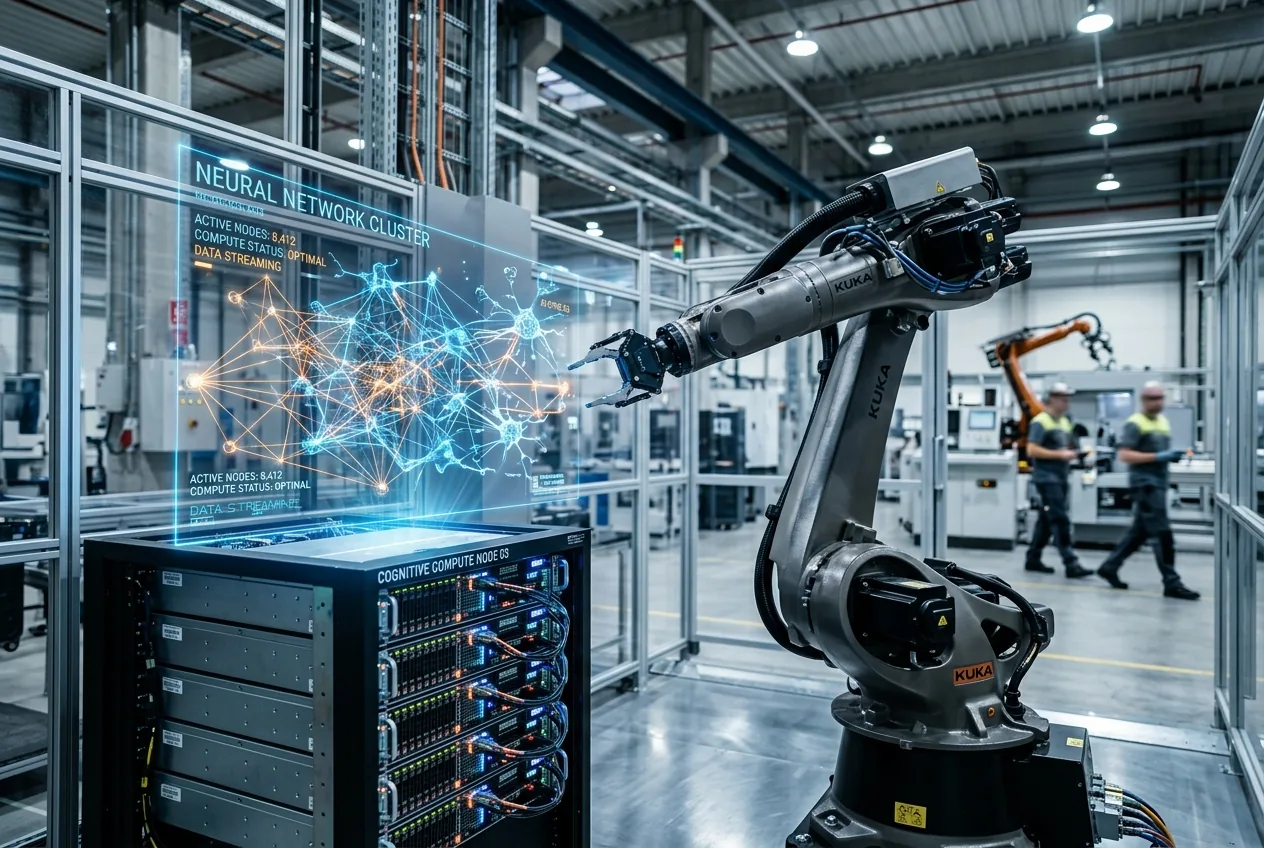
The most substantial critique of Huang's declaration emerges when we attempt to bridge digital agents to physical actuators. As software engineers celebrate the dawn of AGI within virtual sandboxes, robotics engineers are still fighting fundamental mechanical bottlenecks: actuator power density, sensor drift, thermal degradation, and tactile feedback.
Consider an industrial warehouse or a complex assembly line. A multimodal assistant can easily "see" an unsorted pile of flexible rubber gaskets through a high-definition stereo camera and describe their material composition. It can dictate the optimal sorting sequence in natural English, Korean, or Mandarin. But translating that visual understanding into a robotic end-effector that can grasp a deformable, non-rigid object without crushing it or slipping requires physical dexterity that AI models cannot infer from internet-scale text and video corpora alone.
Physical interaction requires an understanding of mass, friction, inertia, and non-linear material mechanics under dynamic conditions. While foundation models for robotics—often termed Vision-Language-Action (VLA) models—are making strides, they consume enormous compute just to achieve modest manipulation success rates. If AGI has arrived, it remains trapped behind glass, possessing universal knowledge of the world while remaining unable to tighten a loose M8 bolt with appropriate torque. For automation engineers, true general intelligence cannot be divorced from embodiment; the physical world is the ultimate validation ground.
The Economic Engine Behind the Declaration
Behind the technical debate lies a brutal economic reality. The capital expenditure pouring into artificial intelligence infrastructure has reached unprecedented heights. Hyperscalers such as Microsoft, Alphabet, Meta, and Amazon are pouring tens of billions of dollars per quarter into specialized silicon, cooling infrastructure, and power generation. For this capital cycle to maintain momentum, the commercial narrative must continuously advance from assistive software toward universal labor replacement.
A Working Definition for the Next Decade
Whether one accepts Huang's proclamation depends almost entirely on how one frames the term. If artificial general intelligence requires an autonomous machine possessing an internal model of self, continuous lifelong learning, and physical mastery over the kinetic environment, then we remain far from the finish line. We do not yet possess machines that can repair a damaged pipeline in sub-zero Arctic conditions or redesign a robotic gearbox from first principles without human guidance.
If, however, AGI is defined as a machine intelligence capable of perceiving human reality across multiple sensory streams, translating thought to spoken logic within human biological reaction times, and executing complex white-collar tasks across thousands of specialized domains, then Huang's assessment is difficult to dismiss. We have built systems that listen, see, calculate, and reply faster than we do. The challenge now shifts from building the brain to engineering the hands, the power grids, and the mathematical guardrails necessary to make that intelligence safe, affordable, and mechanically useful in the real world.




Comments
No comments yet. Be the first!