When Nvidia Chief Executive Jensen Huang steps onstage in his trademark leather jacket, he is not merely pitching silicon; he is selling a metaphysical inflection point. In recent industry addresses and commentary swirling around frontier models—including speculative architectures like OpenAI's theoretical next iterations—Huang has repeatedly doubled down on a contentious proposition: that Artificial General Intelligence (AGI) is no longer a distant theoretical construct, but an engineering milestone effectively arriving within the lifecycle of current and upcoming silicon roadmaps. By calibrating the benchmark of human-level intelligence to standardized test performance, multi-modal synthesis, and algorithmic reasoning across diverse human domains, Huang has framed systems on the horizon of GPT-6 as functional AGI.
Yet, peel away the enterprise marketing and the euphoric valuation multiples of the AI infrastructure sector, and a far more grounded reality emerges. For industrial engineers, roboticists, and systems designers, intelligence cannot be isolated within a benchmark suite of competitive examinations or conversational fluidness. True autonomy demands robust interaction with unstructured physical environments, deterministic reliability, and an economic model that survives outside venture-subsidized data centers. Huang's pronouncements reveal less about the philosophical emergence of machine consciousness and far more about the capital imperatives driving the most expensive hardware buildout in human history.
The Semantic Re-Engineering of General Intelligence
The core friction in Huang’s claim lies in how one chooses to define AGI. Historically, computational theorists framed general intelligence as the ability of an autonomous agent to set its own goals, reason causally, adapt to novel environments without retraining, and transfer conceptual knowledge across completely unrelated physical and theoretical paradigms. Over the past twenty-four months, that definition has undergone a convenient corporate revision. As frontier models absorb trillions of tokens, enterprise executives have increasingly redefined AGI as a probabilistic system capable of passing virtually any human-designed cognitive test at or above the 90th percentile.
Under this narrowed, pragmatic rubric, Huang’s assessment appears mechanically plausible. If AGI simply denotes a software framework that excels at medical board examinations, writes functional code in dozens of languages, analyzes legal discovery documents, and synthesizes cross-domain technical literature in seconds, then the progression from GPT-4 to multimodal architectures and beyond clearly approaches that threshold. Compute scaling laws have proven surprisingly durable in squeezing out emergent conversational and analytical competence. But equating cognitive retrieval and pattern interpolation with generalized autonomy ignores the foundational boundaries of transformer architectures.
In practice, next-token prediction—regardless of whether it operates across text, audio, or spatial point clouds—remains tethered to statistical probability distributions derived from historical data. It does not construct an internal, causal model of the physical world that can self-correct when faced with events outside its training distribution. When an algorithmic system encounters a structural edge case, it does not invent an underlying physical hypothesis; it calculates the highest-probability continuation of its existing weights. Calling this mechanism AGI may satisfy Wall Street quarterly calls, but on the factory floor and in automated supply chains, the semantic leap falls apart.
The Multi-Gigawatt Substation Behind the Illusion
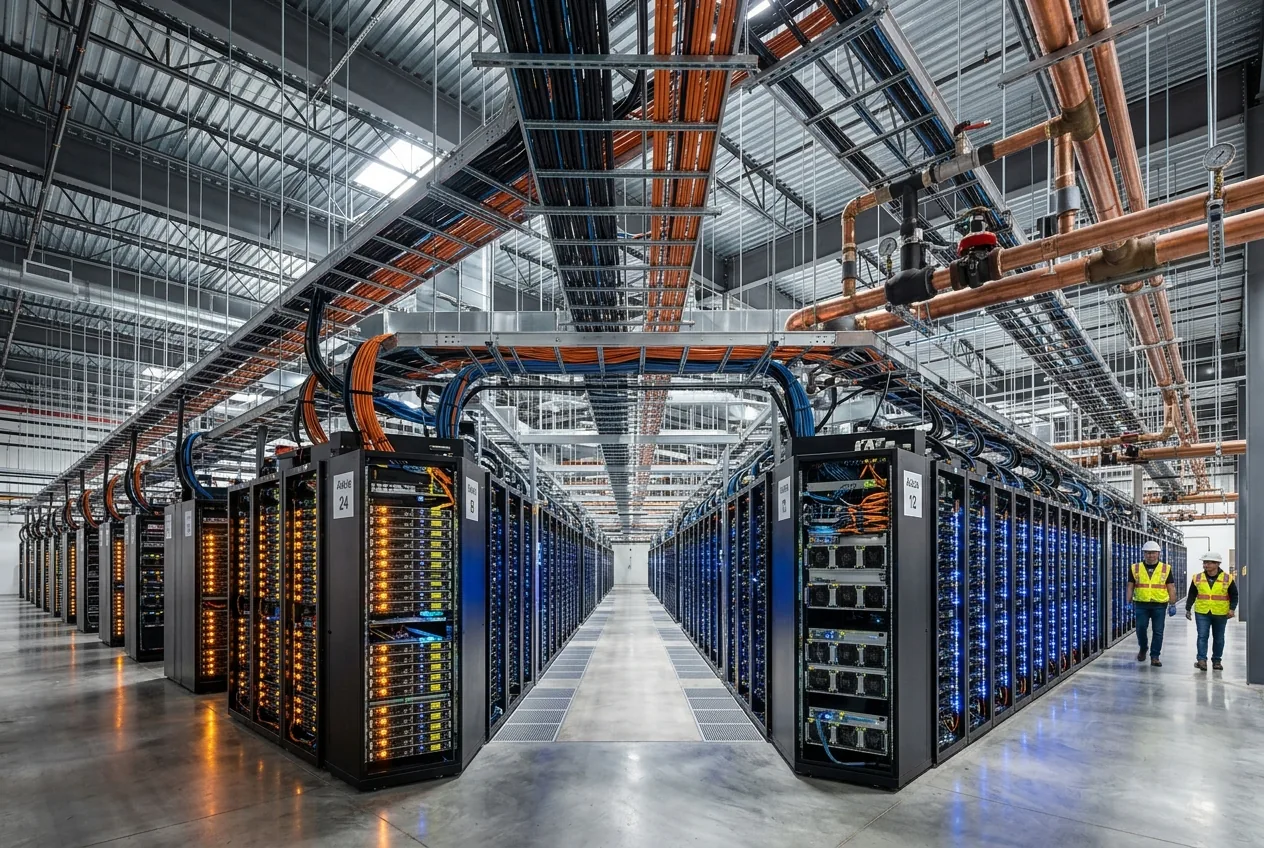
Nvidia’s institutional confidence in the arrival of frontier intelligence is directly proportional to its control over the compute supply chain. To train and execute models approaching the theoretical scale of a GPT-6 tier system, the engineering requirements have ceased to be purely algorithmic; they have become civil, electrical, and thermal engineering crises. The shift from Hopper to Blackwell, and toward the upcoming Rubin architecture, demonstrates that raw performance gains are increasingly achieved through extreme physical packaging and power density.
The Blackwell GB200 NVL72 rack, for instance, consumes upwards of 120 kilowatts per cabinet, requiring direct-to-chip liquid cooling systems and complex multi-node NVLink mesh interconnects running at 1.8 terabytes per second bidirectional bandwidth per GPU. Moving petabytes of weights across thousands of synchronized chips requires an unprecedented mobilization of capital. Utility companies across North America and Europe are now fielding interconnection requests for single data center campuses demanding between 500 megawatts and two gigawatts of continuous power. That is equivalent to the output of an entire commercial nuclear reactor dedicated entirely to matrix multiplication.
This massive physical overhead introduces an economic calculation that technology executives rarely highlight. As the parameters of frontier models expand into the multi-trillion realm, the cost per inference query scales dramatically unless aggressive quantization and distillation techniques are employed. If an alleged AGI requires billions of dollars in capital expenditure, hundreds of megawatts of grid capacity, and an army of thermal engineers to sustain its operational readiness, its utility across human industry is fundamentally constrained. True general intelligence in biological organisms operates within a 20-watt power envelope and learns complex navigation from a handful of physical interactions. The current brute-force trajectory relies on an energy-intensity profile that borders on industrial brute force.
Why Robotics Exposes the Limits of the Model
The ultimate stress test for any claim of general intelligence is not a legal certification exam; it is physical embodiment. In industrial automation, logistics, and precision robotics, the gap between multi-modal language models and physical reality becomes painfully obvious. Language and static images represent highly structured, symbolic representations of human knowledge. The real world, by contrast, operates on continuous mechanics, non-linear contact dynamics, friction coefficients, microsecond latency requirements, and physical degradation.
When technology leaders speak of generalized agents operating in the world, they often overlook the fundamental sensorimotor divide. In a robotic workcell, an autonomous manipulator must grip an unmodeled, deformable object, gauge the tactile feedback through high-frequency force sensors, adjust its joint torque in milliseconds, and maintain stability without destroying the workpiece or damaging nearby machinery. A pure foundation model, regardless of how advanced its contextual reasoning, possesses no innate sense of gravity, inertia, or material fatigue. It must be paired with deterministic control theory, kinematics solvers, and localized closed-loop state estimation.
The Strategic Motive of Imminent Superintelligence
Understanding Jensen Huang’s rhetoric requires recognizing Nvidia’s structural position in the global economy. As the dominant supplier of the computational picks and shovels for the generative AI boom, Nvidia’s commercial interests are optimized when hyperscalers—Microsoft, Google, Meta, and Amazon—fear obsolescence. If the engineering horizon between standard enterprise software and transformative AGI is perceived to be narrow, every cloud provider must secure sovereign AI infrastructure and purchase tens of thousands of next-generation accelerators simply to remain competitive.
Yet within mechanical engineering, precision manufacturing, and infrastructure management, the real work of AI is proceeding without the hyperbole. Industrial automation is benefiting immensely from small, specialized, deterministic models that execute computer vision quality control, predictive vibration analysis, and localized route planning on low-power edge silicon. These systems do not claim to possess general intelligence, nor do they need it. They deliver measurable return on investment by decreasing scrap rates, optimizing cycle times, and protecting mechanical assets from catastrophic failure.
The arrival of models capable of sweeping synthetic benchmarks will undoubtedly reshape enterprise software, digital productivity, and automated code generation. But until these systems can step outside the protective envelope of clean digital tokens, manage physical mass, master thermodynamic limits, and operate with deterministic guarantees under unpredictable real-world stresses, the proclamation of AGI remains a compelling marketing narrative rather than an accomplished engineering fact.




Comments
No comments yet. Be the first!