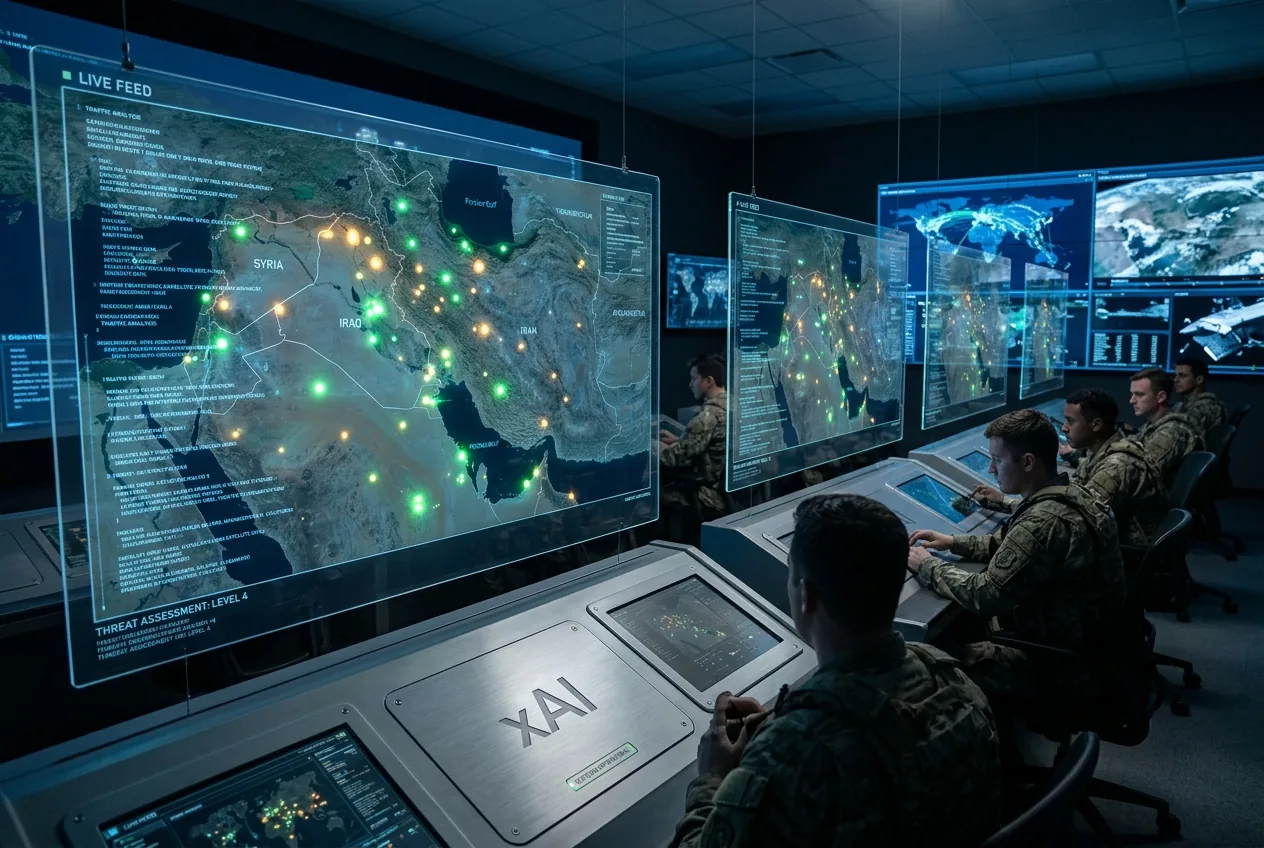
The integration of artificial intelligence into the kinetic "kill chain" has long been a goal of the Department of Defense, but the recent reports suggesting that Elon Musk’s Grok AI played a role in guiding U.S. strikes against targets in Iran mark a significant, if controversial, milestone. According to emerging reports cited by regional outlets in Azerbaijan, the Pentagon has allegedly leveraged the real-time processing capabilities of xAI’s flagship model to refine targeting data and assess battle damage in high-stakes environments. While the official narrative often focuses on the ethical guardrails of AI, the mechanical reality of this integration speaks to a massive shift in how industrial-scale data is converted into tactical action.
For those of us tracking the intersection of robotics and industrial automation, the leap from a conversational LLM (Large Language Model) to a military-grade guidance assistant is not as vast as it might appear. At its core, Grok is an engine designed to ingest, process, and synthesize massive streams of unstructured data with lower latency than almost any other commercial model. By utilizing the live data stream from the X platform, Grok possesses a unique temporal advantage. In the context of military operations, where the shelf-life of intelligence is measured in seconds, this "real-time" access transforms a social media aggregator into a potent Open Source Intelligence (OSINT) tool.
The Mechanics of Real-Time Intelligence Synthesis
To understand why the Pentagon would look toward a commercial entity like xAI, one must look at the bottleneck of modern military intelligence. Traditional satellite reconnaissance and signals intelligence (SIGINT) are incredibly precise but often require time-consuming processing and analysis by human operators. In a fast-moving theater like the Middle East, the gap between detecting a mobile missile launcher and authorizing a strike can be the difference between success and failure. Grok’s architecture, which is optimized for high-speed inference on massive NVIDIA H100 clusters, allows it to scan millions of data points—from ground-level social media posts to localized sensor telemetry—to provide a composite view of the battlefield.
The reported involvement of Grok in strikes against Iranian-backed infrastructure suggests that the AI was used to filter the "noise" of the digital landscape. During kinetic events, local populations often upload imagery, video, and text descriptions of movement long before official channels can confirm them. Grok’s ability to parse this information, verify geographical markers against known maps, and provide a probability-based assessment of target location is a textbook example of high-utility automation. It isn't necessarily pulling the trigger; it is narrowing the search window for the humans who do.
The Azerbaijan Connection and Regional Proximity
The fact that these reports originated or gained significant traction through Azerbaijani news cycles is no coincidence. Azerbaijan occupies a critical geopolitical position, bordering both Iran and Russia, and has increasingly become a hub for high-tech military cooperation. The region serves as a laboratory for modern drone warfare and electronic surveillance. For the Pentagon to test or deploy AI-driven targeting protocols in this corridor makes logistical sense. The proximity allows for a dense network of ground sensors and communication nodes that can feed data back into the Grok training and inference loops.
Furthermore, the industrial infrastructure of Azerbaijan—specifically its investments in satellite ground stations and fiber-optic backbones—makes it an ideal staging ground for the digital side of modern conflict. If Grok is being used to guide strikes, the data must travel through reliable, low-latency channels. The synergy between Musk’s Starlink satellite constellation and the xAI software suite provides a vertically integrated stack that can bypass traditional, slower military communications infrastructure. This is the "hardware-software bridge" that defines the current era of industrial technology.
Can a Chatbot Handle Military Precision?
A primary concern among skeptics is the issue of "hallucination"—the tendency of LLMs to generate plausible-sounding but factually incorrect information. In a civilian context, a hallucination is a nuisance; in a military context, it is a catastrophic failure. However, the Pentagon’s use of AI is rarely a closed loop. Instead, these systems are used for "augmentation." Grok likely functions as a high-speed triage system, flagging potential targets or identifying anomalies in movement patterns that are then verified by human analysts using classified assets.
From a mechanical engineering perspective, we view this as a multi-stage filtering process. The first stage is the wide-aperture intake of data (Grok), and the final stage is the precision verification. By automating the first stage, the military can handle an exponentially larger volume of data than was previously possible. The efficiency of the H100 GPUs powering xAI allows for these computations to happen in a fraction of the time required by previous-generation algorithmic systems. This isn't just about "chatting" with an AI; it is about utilizing the underlying compute power to run complex geospatial simulations in real-time.
Economic and Industrial Implications of Private AI in Defense
The economic viability of using commercial AI for defense purposes is undeniable. Building a proprietary, government-exclusive AI with the same capabilities as Grok would cost billions of dollars and take years of development. By tapping into the existing infrastructure of xAI, the Department of Defense is adopting a "SaaS" (Software as a Service) model for warfare. This shift has massive implications for the defense industry, as it moves away from traditional hardware manufacturers like Lockheed Martin and Boeing toward Silicon Valley software firms.
This transition also highlights the importance of the global supply chain for semiconductors. The ability of the U.S. to conduct these AI-enhanced operations is directly tied to its access to the most advanced chips. If Grok is indeed providing the tactical edge in the Middle East, it reinforces the strategic necessity of the domestic chip industry and the logistical chains that support massive data centers. We are seeing a convergence where the factory floor, the data center, and the battlefield are all governed by the same principles of throughput and latency optimization.
The Future of Autonomous Targeting
As we move forward, the question isn't whether AI will be used in combat, but how deeply it will be integrated into the physical hardware of robotics. If Grok can guide a strike based on digital data, the next logical step is for it to directly interface with autonomous drones and unmanned ground vehicles (UGVs). We are looking at a future where the AI identifies the target, calculates the optimal flight path for a drone swarm, and manages the logistics of the entire operation with minimal human intervention.
While the Pentagon and xAI have been cautious in their public statements regarding the specific parameters of this collaboration, the technical evidence points toward an irreversible trend. The "kill chain" is becoming a "compute chain." As the processing power of models like Grok continues to grow, and as the data they ingest becomes more granular, the boundary between the digital world and the physical battlefield will continue to dissolve. This is the reality of modern industrial warfare: it is fast, it is data-driven, and it is increasingly managed by the same algorithms that suggest what we should read on our social feeds.




Comments
No comments yet. Be the first!