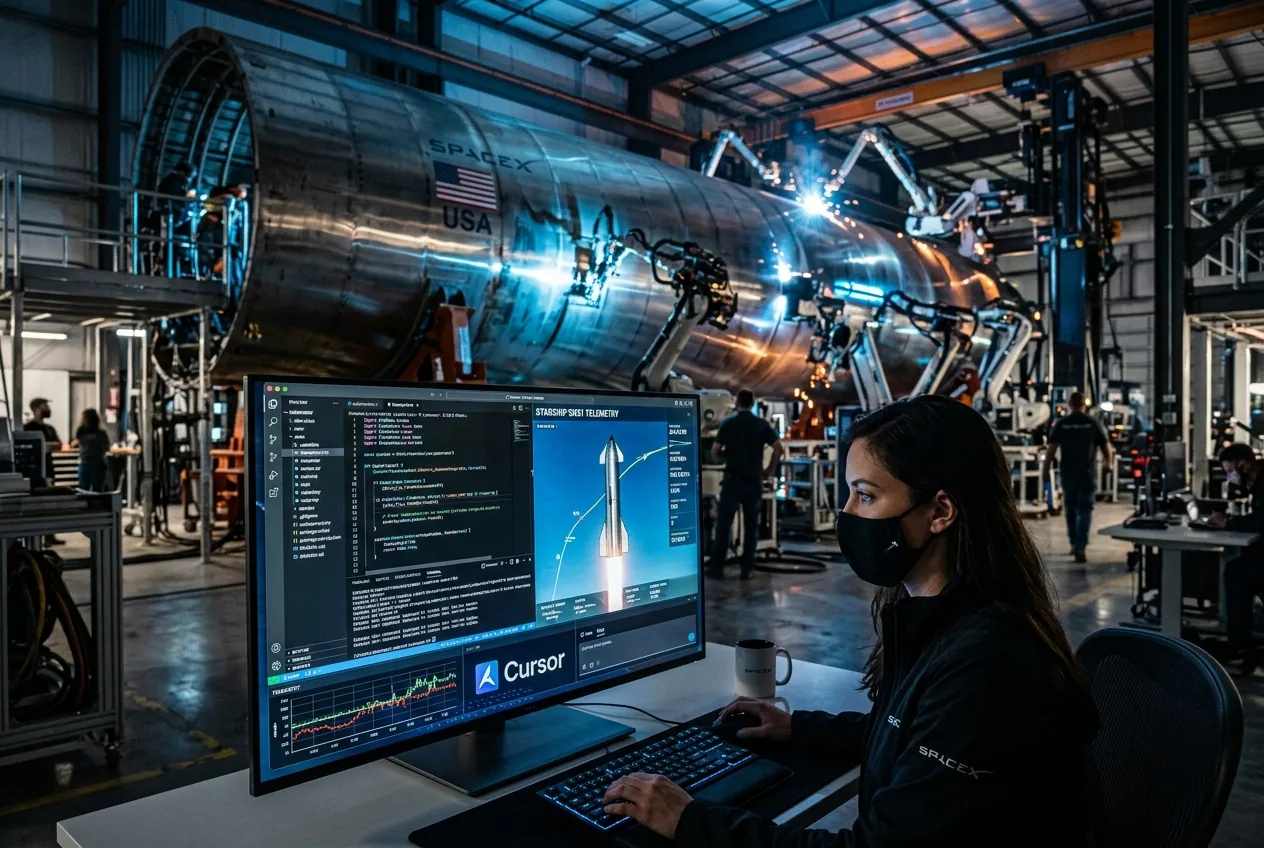
In a move that redefines the intersection of aerospace engineering and artificial intelligence, SpaceX has officially announced the acquisition of Anysphere, the startup behind the AI-powered code editor Cursor, for a staggering $60 billion. The deal, which represents one of the largest software acquisitions in history, marks a pivot for the Hawthorne-based launch provider as it seeks to integrate deep-learning capabilities directly into the hardware design and flight control pipeline.
The acquisition price—nearly eight times what Microsoft paid for GitHub in 2018—reflects a high-stakes bet on the future of autonomous engineering. While Cursor has primarily been viewed as a high-performance integrated development environment (IDE) for software engineers, SpaceX leadership views it as the foundational interface for the next generation of Starship development and Starlink network management. By bringing Cursor into the fold, SpaceX is effectively vertically integrating the very tools used to write the code that powers its rockets.
The Architecture of Software-Defined Aerospace
From a mechanical engineering perspective, the modern rocket is less a vehicle and more a flying distributed sensor network. The Falcon 9 and Starship platforms rely on millions of lines of C++ and Rust code to manage real-time telemetry, engine gimballing, and thermal protection systems. Historically, the feedback loop between a mechanical failure during a static fire test and a software patch could take days or weeks. SpaceX intends to use Cursor’s AI-native architecture to shrink this cycle to hours.
The technical synergy here is clear: SpaceX needs a way to manage the exponential growth of its codebase as it prepares for Mars missions. The complexity of a multi-planetary life support system and the autonomous navigation required for deep space travel exceeds the capacity of traditional manual coding. By utilizing Cursor’s ability to map and modify massive codebases, SpaceX is moving toward a model where engineers act as high-level architects, while the AI handles the routine implementation of redundant safety protocols and sensor data processing.
The xAI Integration and Latent Space Engineering
The deal also clarifies the relationship between Musk’s various ventures, specifically xAI. While SpaceX is the purchasing entity, the technical backbone of the new "Cursor Space Edition" will reportedly be powered by xAI’s Grok models. This integration allows for a closed-loop system where the AI is trained on proprietary SpaceX flight data, telemetry logs, and mechanical schematics. This is not just about writing code; it is about "latent space engineering," where the AI understands the physical properties of the rocket hardware through the software that controls it.
For example, if a valve on a Raptor engine exhibits a specific vibration pattern during a test, Cursor’s integrated AI could theoretically suggest real-time modifications to the valve-controller software to dampen those harmonics. By feeding physical sensor data back into the code editor, SpaceX is attempting to bridge the gap between digital simulation and physical reality. This creates a proprietary advantage that no other aerospace company—including legacy giants like Boeing or Lockheed Martin—currently possesses.
Economic Viability and the $60 Billion Question
Critics have been quick to question the $60 billion valuation, particularly for a company that was recently valued in the hundreds of millions. However, the economic logic of SpaceX is rarely tied to traditional SaaS metrics. Instead, the value is derived from the acceleration of the Starship program. If the integration of AI-native coding tools allows SpaceX to reach orbit more frequently or reduces the time to build a Martian colony by even 10%, the ROI transcends the initial purchase price.
Can AI Safely Code for Safety-Critical Systems?
One of the primary concerns among industry veterans is the reliability of AI-generated code in environments where lives are at stake. Traditional aerospace software follows a rigorous process of verification and validation (V&V). The introduction of an AI that proactively writes and modifies code raises questions about how these safety standards will be maintained. SpaceX has signaled that it will implement a new "AI-to-Hardware" validation layer that uses Cursor to not only write code but also to automatically generate test cases and formal proofs of correctness.
This approach shifts the burden of proof from the human engineer to an automated system. In this framework, Cursor would be tasked with proving that a code change cannot lead to a specific failure state, such as an engine shutdown during Max-Q. If successful, this would revolutionize the field of formal methods in computer science, making it possible to build more complex systems with higher confidence than manual testing could ever provide.
The Impact on the Global IDE Market
If Cursor is pulled behind the SpaceX firewall, it could trigger a frantic development cycle at Microsoft, Google, and Meta to produce a comparable tool. However, the advantage SpaceX has is the specific, high-stakes data it can provide to the AI. A code editor trained on the telemetry of a landing rocket is fundamentally different from one trained on web development frameworks. This specialized training is what makes Cursor uniquely valuable to the future of robotics and industrial automation.
A New Era of Industrial Automation
As SpaceX integrates Cursor into its manufacturing floor at Starbase, we are likely to see the rise of "Copilots for Hardware." This is not just about the code running on the rocket; it is about the code running the robots that build the rocket. The automation of the factory line requires complex logic for robotic arms, laser welders, and quality control cameras. Cursor provides the platform to manage this complexity at scale.
The acquisition represents the final acknowledgment that the boundary between mechanical engineering and software engineering has permanently dissolved. In the 20th century, a rocket was a feat of metallurgy and chemistry. In the 21st century, it is a feat of computation. By spending $60 billion on Cursor, SpaceX has declared that the most important component of their next rocket isn't the engine or the fuel tank—it's the editor where the code is born.
The long-term implications for the supply chain and global robotics market are profound. If SpaceX succeeds in using Cursor to radically accelerate its development cycles, every other industrial company will be forced to follow suit. We are entering an era where the speed of innovation is limited only by the context window of the AI assisting the engineer. For SpaceX, that window just became $60 billion wider.




Comments
No comments yet. Be the first!