The Industrial Foundation of a Trillion-Dollar Asset
To understand the valuation of SpaceX, one must look past the spectacle of rocket launches and focus on the unit economics of orbital delivery. SpaceX is no longer a venture-backed underdog; it is the primary logistical provider for the modern space economy. The company’s valuation, recently hovering near $180 billion in private secondary markets, is predicated on its ability to drive down the cost per kilogram to orbit. This is achieved through a level of mechanical reusability that was deemed physically impossible by industry incumbents only a decade ago.
The Falcon 9 program has effectively commoditized Low Earth Orbit (LEO). However, the real driver of the trillion-dollar projection is Starship. From a mechanical engineering perspective, Starship represents a paradigm shift in industrial automation. It is a fully reusable, stainless-steel heavy-lift vehicle designed for rapid turnaround. If SpaceX successfully scales Starship operations, the cost of space access will drop by orders of magnitude. This doesn't just create a new market; it creates a monopoly on the infrastructure required for satellite internet, orbital manufacturing, and lunar logistics. When an IPO eventually occurs—likely starting with the spin-off of Starlink—the resulting liquidity is expected to propel Musk’s personal equity into the stratosphere.
Why xAI is the Intelligence Layer for Heavy Hardware
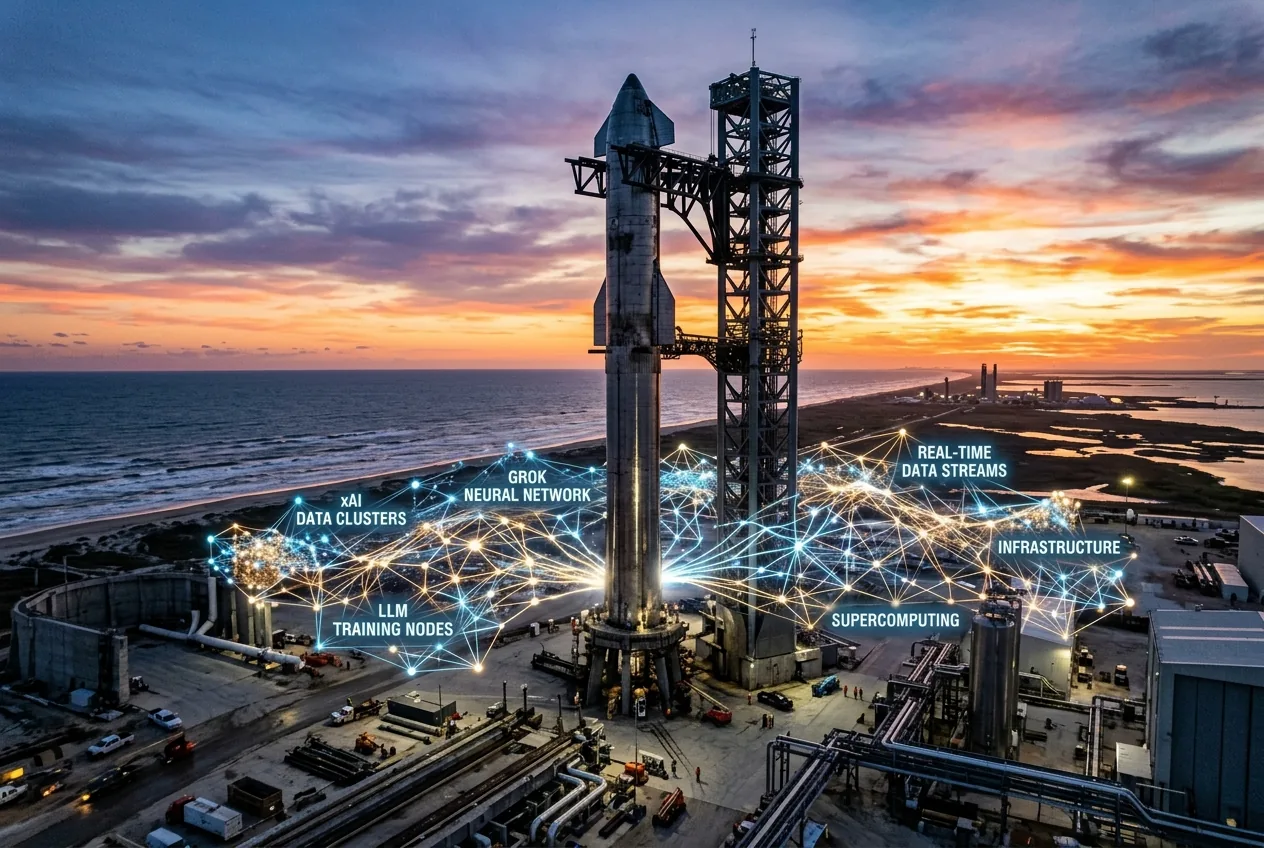
While SpaceX handles the physical movement of matter, xAI is being built as the cognitive layer that optimizes these systems. The recent capital raises for xAI, valuing the startup at upwards of $24 billion, indicate a market appetite for AI that is grounded in physical reality rather than just chatbot interfaces. As a journalist focused on robotics and automation, I see xAI’s Colossus supercluster—built in record time in Memphis—as more than just a training ground for the Grok large language model. It is a massive computational engine designed to solve complex physics and engineering problems.
The synergy between xAI and Musk’s other ventures is the true catalyst for his wealth. In industrial settings, AI is used for predictive maintenance, supply chain optimization, and the autonomous operation of robotic systems. By integrating xAI’s capabilities with SpaceX’s manufacturing data, the feedback loop for design iterations becomes significantly tighter. This reduces the time-to-market for new aerospace components and optimizes the telemetry data coming from the thousands of Starlink satellites currently in orbit. The market recognizes that an AI company with direct access to massive industrial hardware datasets is exponentially more valuable than one relying on scraped internet text.
The Mathematics of the First Trillionaire
For SpaceX, the revenue stream from Starlink acts as a stabilizing force for the more volatile R&D required for Mars exploration. Starlink is currently the world’s largest satellite constellation, providing high-speed internet to remote regions and maritime industries. This is a recurring revenue model that justifies a high valuation multiple. When analyzed alongside the growth of xAI, which seeks to provide the compute power and algorithmic precision for the next generation of industrial robotics, the path to a trillion dollars becomes a logical extension of current industrial trends. We are witnessing the birth of a new kind of conglomerate: one that owns both the machines and the intelligence that governs them.
Is an IPO the Final Step for Starlink?
The question of a SpaceX or Starlink IPO is a frequent topic of debate in financial circles. From an engineering and operational standpoint, remaining private has allowed SpaceX to take risks that a quarterly-earnings-focused public market would likely penalize. However, the scale of Starship’s ambitions—requiring billions in infrastructure for launch sites and propellant production—may eventually necessitate the massive capital infusion that only a public offering can provide. Analysts suggest that a Starlink IPO would be one of the most significant financial events in history, potentially valuing the satellite division alone at over $100 billion.
Such a move would provide the final surge needed to push Musk over the trillion-dollar threshold. But for the engineers and technicians on the ground, the IPO is secondary to the technical milestones. The goal is a high-cadence launch schedule that turns space into a predictable industrial corridor. The wealth generated is a byproduct of solving the fundamental mechanical problem of reusability. If you can use a rocket 20 times instead of once, you have disrupted the economics of an entire planet.
The Global Utility of Vertical Integration
The integration of SpaceX, Tesla, and xAI creates a closed-loop system of innovation. Tesla provides the battery technology and autonomous driving hardware; xAI provides the software brains; and SpaceX provides the transport mechanism. This vertical integration is the reason Musk is outpacing his contemporaries. While other billionaires are diversified across retail or traditional finance, Musk’s wealth is concentrated in the foundational technologies of the next century: energy, intelligence, and transportation.
From a pragmatic perspective, the rise of the first trillionaire is a signal that the market is placing a premium on hard tech. It is a move away from the 'app economy' and back toward the 'atom economy.' For industry observers, the focus should not be on the number of zeros in a net worth, but on the massive industrial capacity being built in the process. The trillion-dollar valuation of an individual is a metric of the scale at which private enterprise is now capable of operating—levels of infrastructure development that were previously the sole domain of superpowers.
The Real-World Impact of Autonomous Infrastructure
As we look toward 2027 and the potential trillionaire milestone, the real-world utility of these companies will be the ultimate measure of success. The deployment of xAI’s models into the manufacturing floors of SpaceX and Tesla will likely set new benchmarks for industrial efficiency. We are moving toward a period where supply chains are not just managed by humans with spreadsheets, but by autonomous agents capable of predicting disruptions and adjusting mechanical workflows in real-time.
The convergence of SpaceX’s launch capability and xAI’s computational power represents a significant consolidation of industrial might. Whether or not Musk hits the trillion-dollar mark exactly on schedule is less important than the underlying reality: the bridge between complex hardware and the global market is being fortified by AI. For those of us in the field of mechanical engineering and robotics, this is the most exciting era of industrial history, where the limits of wealth are being redefined by the limits of what we can build and automate.




Comments
No comments yet. Be the first!