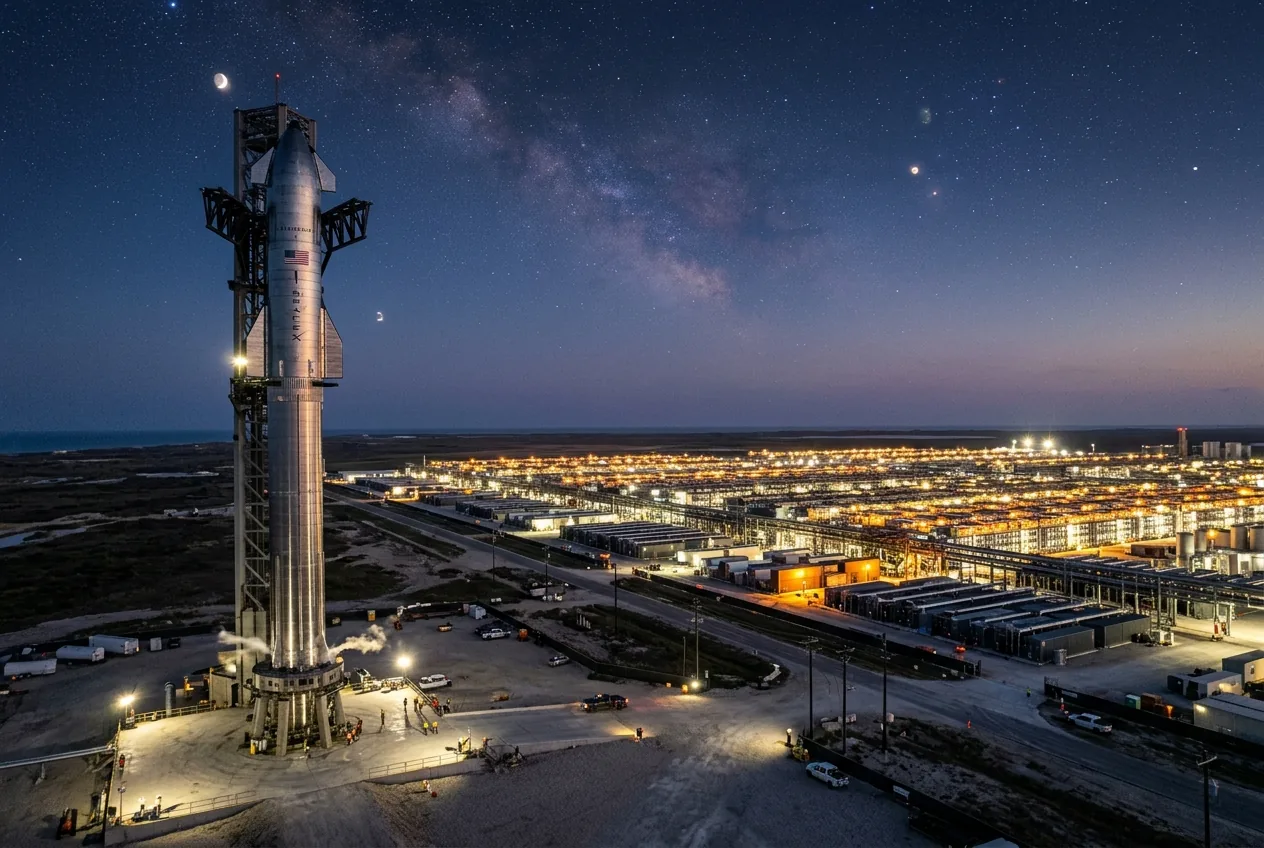
The financial milestone of the world’s first trillionaire has long been a subject of speculative economics, but the recent valuation surge following the strategic maneuvers of Elon Musk’s portfolio suggests that the threshold has finally been crossed. While much of the public discourse focuses on the sheer magnitude of the number, a technical analysis reveals that this wealth is not merely a product of speculative trading. Instead, it is the result of an unprecedented vertical integration of physical infrastructure, orbital logistics, and massive-scale computational power. The cornerstone of this valuation rests on the successful industrialization of low-earth orbit via SpaceX and the rapid deployment of sovereign AI capabilities through xAI.
To understand the mechanics of this trillion-dollar valuation, one must look past the stock tickers and into the engineering realities of Starship and the Colossus supercomputer cluster. SpaceX is no longer just a launch provider; it has evolved into the primary gatekeeper for the burgeoning space economy. With the Starship launch system moving toward operational maturity, the cost per kilogram to orbit is projected to drop by orders of magnitude. This technical efficiency creates a moat that traditional aerospace firms, burdened by legacy manufacturing processes and non-reusable architectures, simply cannot bridge. The financial markets are now pricing in SpaceX as a utility—the foundational layer for all future off-planet industry.
The Economic Engine of Orbital Reusability
Starlink, the satellite internet constellation, serves as the immediate cash-flow engine that justifies these multi-billion dollar valuations. Unlike traditional telecommunications, which require extensive terrestrial infrastructure and right-of-way negotiations, Starlink leverages the vacuum of space to provide global low-latency connectivity. From a purely industrial standpoint, the ability to manufacture satellites in-house and launch them on proprietary rockets creates a feedback loop of capital efficiency. As of the latest reports, the subscriber growth and enterprise adoption of Starlink have reached a tipping point where the service is not only self-sustaining but is funding the development of the more ambitious Mars-oriented hardware.
xAI and the Compute Moat
While SpaceX provides the physical delivery mechanism, xAI provides the cognitive framework that is increasingly necessary to manage complex industrial systems. The categorization of this financial milestone under xAI is particularly relevant because of the synergy between artificial intelligence and heavy industry. In Memphis, xAI has deployed the 'Colossus' supercomputer, an H100 GPU cluster of unprecedented scale. This is not merely a research tool for generating text; it is a high-density computational fabric designed to process vast amounts of telemetry data from Tesla’s fleet and SpaceX’s flight tests. The integration of xAI into the broader ecosystem suggests a move toward autonomous industrial management.
The synergy between these companies is often overlooked in traditional financial reporting. SpaceX provides the communication layer (Starlink) and the logistics layer (Starship), while xAI provides the intelligence layer. When these components are synthesized, they create a closed-loop system for industrial automation. For example, the deployment of Starlink terminals in remote mining or agricultural sites provides the data streams necessary for xAI to optimize autonomous machinery. This is the 'how' behind the wealth: the creation of a unified technological stack that services the most basic requirements of modern civilization—energy, transport, and intelligence.
The Risks of Technical Monopolies
The emergence of a trillionaire on the back of such critical infrastructure raises significant questions about the centralization of industrial power. From a mechanical engineering perspective, the reliance on a single architecture—Starship—for the majority of the world’s heavy-lift capacity creates a single point of failure for the space industry. If a design flaw were to ground the Starship fleet, the global progress in orbital infrastructure would stall. Furthermore, the concentration of massive compute power within a private entity like xAI places immense leverage in the hands of a single individual, outside the purview of traditional regulatory frameworks designed for the 20th-century economy.
The economic viability of these ventures also depends on the continued growth of the private space sector. While SpaceX has successfully commoditized the launch market, the demand side—companies actually using space for manufacturing or research—is still in its infancy. For Musk’s trillion-dollar valuation to hold, there must be a corresponding rise in orbital economic activity. This requires not just rockets, but a legal and regulatory environment that supports property rights in space and the long-term habitation of low-earth orbit. The technical hurdles of life support and radiation shielding remain significant, and the capital required to solve these problems is immense, even for a trillionaire.
However, the pragmatic reality is that the competitors in this space are currently years, if not decades, behind. The 'Old Space' firms are struggling to move past the expendable rocket model, and other AI startups are heavily dependent on third-party cloud infrastructure. By controlling the means of production and the means of delivery, Musk has effectively insulated his wealth from the standard ebbs and flows of the consumer market. His net worth is tied to the physical laws of orbital mechanics and the mathematical limits of compute scaling. This transition from consumer electronics and social media toward hard-tech infrastructure is what ultimately pushed the valuation into the thirteen-figure range.
Redefining Global Industrial Policy
Musk reaching the trillionaire status is an indicator that the most valuable commodity in the 21st century is no longer data alone, but the ability to manifest data into physical action. The combination of xAI’s algorithms and SpaceX’s hardware represents a new form of industrial power. National governments are beginning to recognize this, as seen in the increasing reliance of NASA and the Department of Defense on SpaceX for critical missions. The 'SpaceX IPO' isn't just a liquidity event; it is a signal to the global market that the future of heavy industry is off-planet and autonomous.
As we look at the 'how' behind this historic wealth, it becomes clear that it was built on a series of calculated engineering risks. The decision to use stainless steel for Starship instead of carbon fiber, the choice to develop the Raptor as a full-flow staged combustion engine, and the rapid build-out of the Colossus cluster were all high-risk technical gambles that paid off. These engineering decisions have direct financial consequences. They reduced the cost of capital and increased the speed of iteration, allowing Musk’s companies to outpace both governmental and corporate rivals. In this context, the trillion-dollar figure is less a reflection of personal consumption and more a measure of the industrial capacity currently under the control of a single technical vision.
In the coming years, the challenge will be to see if this concentrated capital can solve the remaining hurdles of deep-space transit and artificial general intelligence. The infrastructure is now in place; the rockets are flying, and the servers are humming. The milestone of the first trillionaire may be the headline, but the real story is the unprecedented consolidation of the tools required to build the future. For the global audience watching this unfold, the focus should remain on the hardware. As long as the engines continue to fire and the clusters continue to compute, the trajectory of this wealth—and the industrial shift it represents—appears set to continue its ascent.




Comments
No comments yet. Be the first!