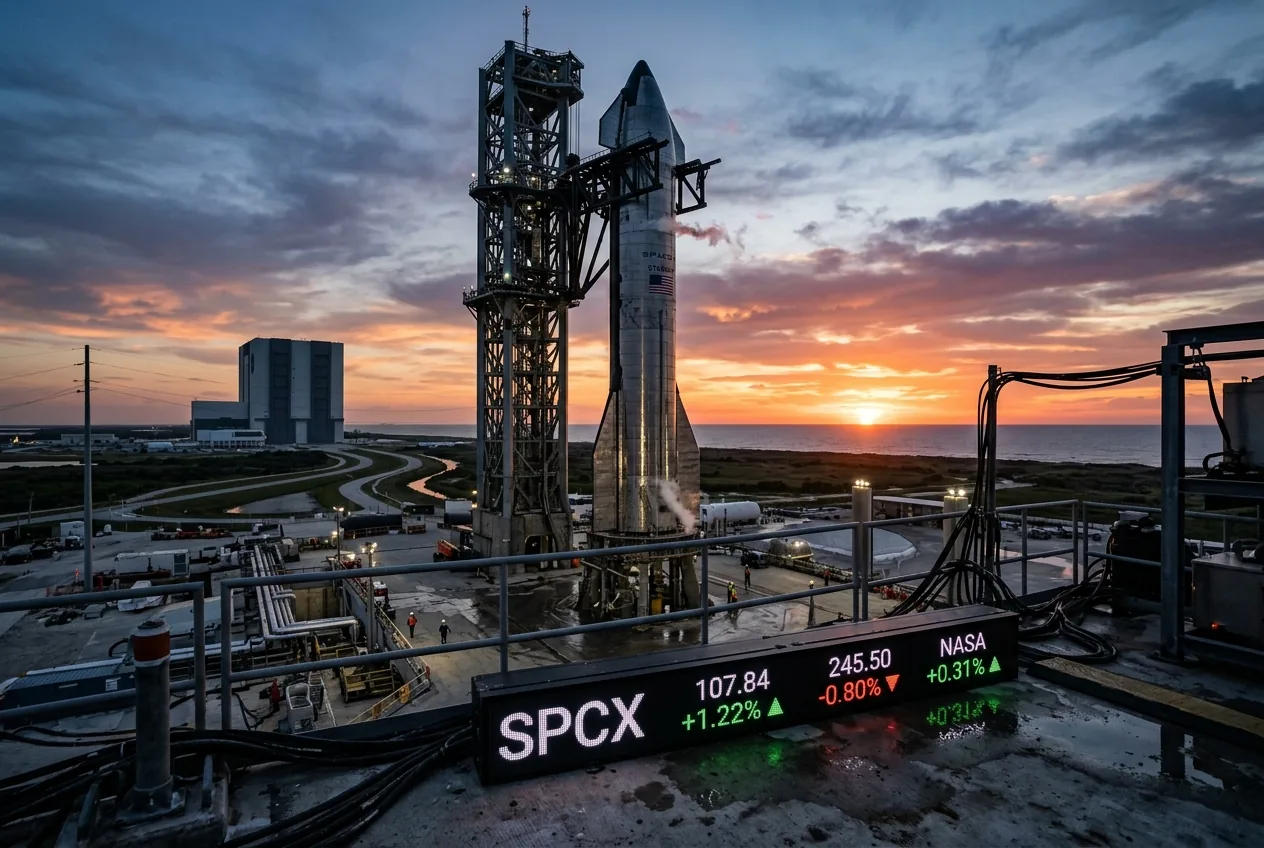
The aerospace industry is on the cusp of its most significant financial transformation since the dawn of the Jet Age. SpaceX, the private enterprise that effectively broke the government monopoly on orbital delivery, has officially filed for an initial public offering (IPO) on the Nasdaq. Seeking the ticker symbol SPCX, the company is aiming for a valuation of $1.25 trillion. If successful, this listing will not only be the largest in Wall Street history—eclipsing Saudi Aramco’s 2019 debut—but will also serve as the catalyst to propel Elon Musk to the status of the world’s first trillionaire. This is not merely a wealth milestone; it is a fundamental restructuring of how the world’s most ambitious engineering projects are funded and governed.
The Mechanics of a Trillion-Dollar Valuation
To understand the $1.25 trillion figure, one must look past the headlines and into the hard assets and revenue streams detailed in the SpaceX prospectus. The company reported roughly $18.6 billion in revenue for 2025. While this was accompanied by a net loss of $4.3 billion, the valuation is driven by a massive asset base and the dominance of the Starlink subsidiary. SpaceX currently holds approximately $102 billion in physical assets, including its fleet of reusable Falcon 9 rockets, the growing Starship infrastructure in South Texas, and the thousands of Low Earth Orbit (LEO) satellites that comprise the Starlink constellation. This industrial footprint provides a level of vertical integration that is unprecedented in the private sector.
The financial architecture of the deal suggests that SpaceX is looking to raise between $40 billion and $80 billion in fresh capital. This influx of liquidity is strategically timed. The Starship program, which aims to provide a fully reusable, heavy-lift launch vehicle capable of reaching Mars, requires billions in continued research and development and manufacturing scaling. By transitioning from a private entity to a public one, SpaceX is essentially betting that the public markets have the depth to sustain its long-term vision of multi-planetary habitation. It is a move away from the venture capital and private equity cycles that have fueled its growth thus far, toward a more permanent, institutional capital base.
For Elon Musk, the IPO represents a culmination of decades of equity accumulation. Holding a majority stake in a trillion-dollar entity will push his personal net worth—already hovering around $600 billion—into ten-figure territory. Despite the public offering, Musk is not relinquishing control. The filing reveals a dual-class share structure that ensures he retains approximately 85% of the voting power. This allows him to maintain his role as CEO, Chairman, and Chief Technology Officer, effectively insulating the company’s engineering priorities from the short-term pressures often associated with quarterly earnings reports on Wall Street.
How Starlink and xAI Anchor the Balance Sheet
While the rocket business provides the brand prestige, Starlink is the primary engine of the company's current economic viability. According to the IPO filing, Starlink generated $3.2 billion in revenue in the first quarter of 2026 alone, yielding an operating profit of $1.2 billion. It is projected to account for more than 70% of the company's total revenue by the end of the year. Unlike the capital-intensive and high-risk nature of individual rocket launches, the satellite internet business offers a recurring revenue model that is highly attractive to institutional investors. The scalability of the LEO constellation provides a high-margin utility that differentiates SpaceX from traditional aerospace defense contractors.
The integration of xAI into the SpaceX corporate umbrella is another critical, albeit more volatile, component of the filing. Earlier this year, SpaceX acquired xAI, Musk’s artificial intelligence venture. While xAI recorded a loss of $6.4 billion in 2025, the IPO prospectus reveals a strategic partnership with Anthropic that could stabilize these losses. Anthropic has reportedly agreed to pay $15 billion annually to access data centers managed under the xAI venture. This suggests that Musk is leveraging the physical infrastructure of SpaceX—specifically its power and cooling capabilities at launch sites and data hubs—to support high-compute AI workloads.
The Engineering Challenges of Scale
From a mechanical engineering perspective, the IPO is a response to the logistical realities of the Starship program. The transition from the Falcon 9 to Starship is not just a change in scale; it is a change in the philosophy of spaceflight. Starship is designed for rapid reusability, aiming for turnaround times measured in hours rather than weeks. To achieve this, SpaceX must build a production line capable of churning out Raptor engines and stainless-steel hulls at a scale more akin to automotive manufacturing than traditional aerospace. The capital raised in the IPO is likely earmarked for the expansion of "Starbase" in Texas and the construction of offshore launch platforms.
The technical specs of the Raptor 3 engines and the thermal protection systems required for Starship’s atmospheric reentry remain the primary hurdles. These are not just theoretical challenges; they are expensive, hardware-intensive problems that require a massive workforce of specialized engineers. The IPO filing lists $60.5 billion in debt, much of which has been used to fund the iterative testing phases of the Starship prototypes. For investors, the risk lies in the timeline. If Starship achieves reliable operational status within the next 24 months, SpaceX could effectively monopolize the global launch market, leaving competitors like Blue Origin and Arianespace to fight for the scraps of the small-satellite market.
Furthermore, the environmental and regulatory landscape remains a constant variable. The IPO document explicitly lists various legal challenges as risk factors for potential shareholders. SpaceX has set aside more than $500 million for expected legal costs, including patent infringement claims and investigations into content moderation for its digital subsidiaries. These are the growing pains of a company that is no longer a nimble startup but a global infrastructure provider. The engineering precision required to land a rocket must now be matched by the legal and financial precision required to navigate the SEC and international regulators.
Will the Elon Musk Effect Stabilize or Destabilize?
The prospectus makes it clear that SpaceX is a "Musk-centric" entity. His 85% voting control means that shareholders are essentially buying into his vision with limited recourse to influence corporate direction. This lack of traditional board oversight is a point of contention for some institutional analysts, who worry about the concentration of power. However, supporters argue that it is precisely this lack of bureaucratic friction that has allowed SpaceX to outpace legacy contractors like Boeing and Lockheed Martin, who are often bogged down by committees and cost-plus contracts.
The economic viability of the IPO also hinges on the continued expansion of the global space economy. As more nations and private corporations seek to establish presence in LEO and beyond, the demand for SpaceX’s services is likely to grow. The company is betting that it can lower the cost per kilogram to orbit to a level that makes entirely new industries—such as space-based manufacturing and asteroid mining—economically feasible. If SpaceX becomes the primary toll-road for the final frontier, a $1.25 trillion valuation might actually be conservative in the long run. For now, the world watches as the most expensive rocket ever built prepares for its most critical launch yet: the transition to the public market.




Comments
No comments yet. Be the first!