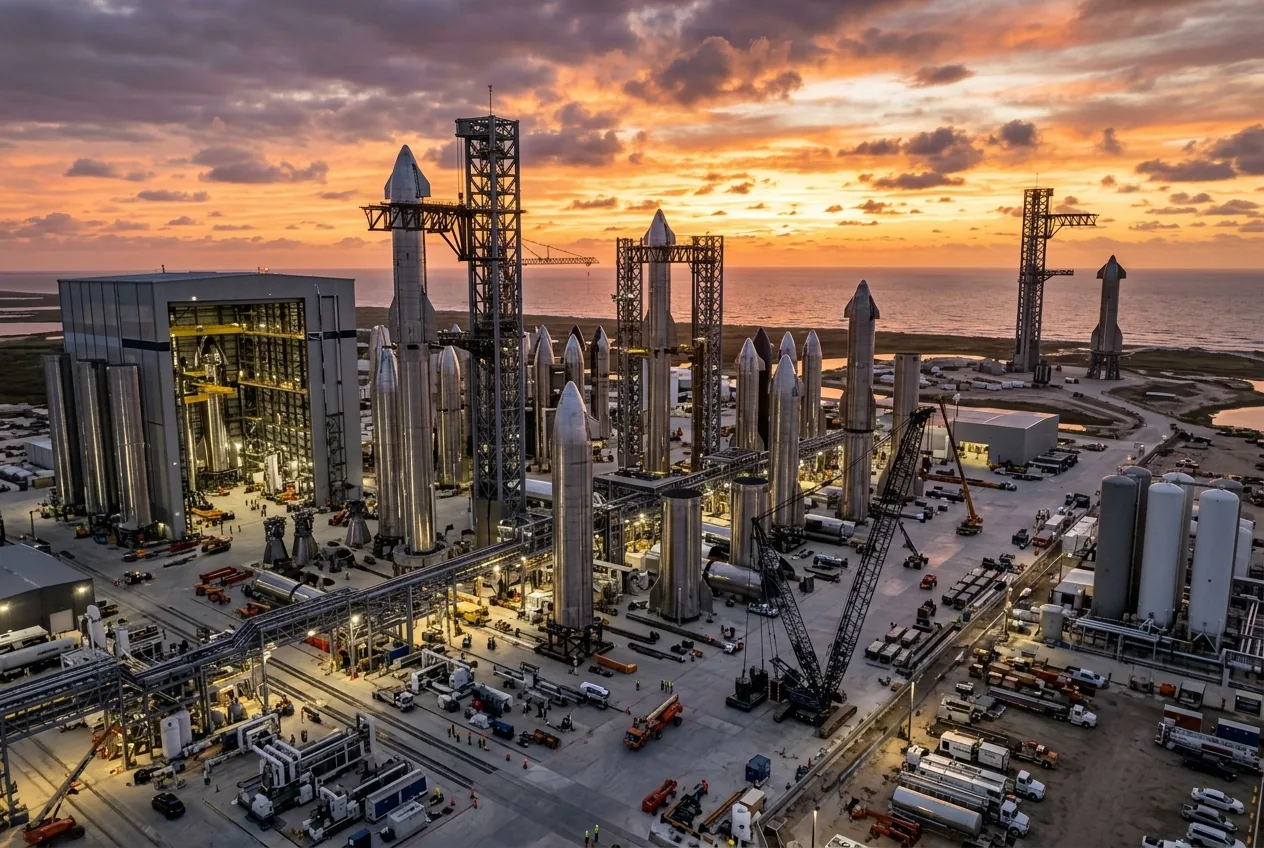
In the history of industrial capitalism, few figures have ever approached the scale of what is now being proposed at Starbase, Texas. SpaceX, the aerospace manufacturer that has effectively monopolized the global launch market, is reportedly internalizing a strategy for a public offering valued at an unprecedented $1.75 trillion. This is not merely a financial milestone; it is a calculated engineering pivot. For a company that has spent two decades perfecting the vertical integration of rocket manufacturing, the move toward a trillion-dollar valuation signals the transition from an experimental aerospace firm to a foundational utility for the solar system.
From the perspective of mechanical engineering and industrial automation, this capital infusion is a prerequisite for the mass production of the Starship launch system. To achieve the stated goal of making life multiplanetary, SpaceX must move beyond the artisanal production of spacecraft. They require a manufacturing throughput comparable to the automotive industry but with the precision of high-vacuum aerospace standards. The $1.75 trillion target reflects the sheer cost of building a fleet of thousands of reusable ships, the infrastructure for orbital propellant depots, and the localized manufacturing hubs required on the lunar and Martian surfaces.
The Engineering Logic of Starship Mass Production
To understand the necessity of this valuation, one must look at the Raptor engine production line. The Raptor 3, SpaceX’s latest iteration of its methane-fueled powerhouse, represents a triumph of additive manufacturing and parts consolidation. By reducing the complexity of the engine's external plumbing and integrating cooling channels directly into the printed structures, SpaceX has shortened the assembly time significantly. However, scaling this from a few dozen engines a year to the thousands required for a Martian flotilla demands a level of industrial automation that the aerospace sector has never witnessed.
The assembly of the Starship airframe itself relies on a highly specialized series of robotic welding stations and longitudinal seamers. Unlike traditional aerospace manufacturing, which relies on heavy tooling and jigs that are difficult to iterate, SpaceX utilizes a modular ring-segment approach. This allows them to swap out designs for the payload bay or header tanks without halting the entire line. A $1.75 trillion injection allows for the expansion of these 'Mega-Bays,' turning Starbase into a high-output factory where a full Starship stack could, in theory, roll off the line every few days. This throughput is the only way to drive down the cost per kilogram to orbit to the double-digit levels necessary for sustainable off-world colonization.
Starlink as the Economic Foundation
While Starship is the vehicle for expansion, the Starlink satellite constellation is the economic engine that justifies a trillion-dollar valuation to investors. Starlink has transitioned from a risky beta program to a dominant global telecommunications provider. By controlling the entire stack—from the satellite bus design to the launch vehicle and the ground user terminals—SpaceX has achieved a level of vertical integration that traditional telecommunications companies cannot match. The recurring revenue from millions of global subscribers provides the steady cash flow needed to offset the high R&D costs of the Starship program.
Technically, Starlink's success hinges on the deployment of V2 Mini and eventually the full-sized V2 satellites. These units feature significantly increased data throughput and direct-to-cell capabilities, but their mass requires the increased lift capacity of Starship. The symbiotic relationship between the two programs is clear: Starlink provides the capital, and Starship provides the logistical capacity to maintain and expand the constellation. For the public market, this represents a rare combination of a high-growth tech platform and a heavy industrial infrastructure play, explaining the massive valuation premium over traditional aerospace competitors like Boeing or Lockheed Martin.
Why the Orbital Propellant Depot is the Critical Variable
The most significant technical hurdle to the multiplanetary vision is not the launch itself, but what happens once the vehicle reaches Low Earth Orbit (LEO). Starship is a massive vehicle, and to reach the Moon or Mars with a meaningful payload, it must be refilled with liquid oxygen and liquid methane in space. This requires the development of orbital propellant depots—essentially massive thermos flasks in vacuum that can manage cryogenic fluids without significant boil-off. This is an engineering challenge of the highest order, involving complex fluid dynamics in microgravity and advanced thermal shielding.
A public offering of this magnitude provides the 'patient capital' required to master cryogenic fluid management (CFM). Automated docking and fluid transfer between two Starships is a maneuver SpaceX intends to demonstrate frequently in the coming years. The infrastructure for these depots will require a dedicated fleet of 'Tanker' Starships, which perform repetitive launches to ferry fuel to the depot. This 'tugboat' model of space logistics is capital-intensive but fundamentally changes the math of space exploration. By decoupling the launch from the trans-planetary injection, SpaceX can send 100-ton payloads to the lunar surface, a feat that would be impossible for any single-launch architecture.
The Risk Profile of Interplanetary Logistics
Investors entering at a $1.75 trillion valuation are not just betting on a rocket company; they are betting on the emergence of a new sector of the global economy. However, the technical risks remain non-trivial. The long-term reliability of the Raptor engine during the months-long transit to Mars, the efficacy of heat shields during high-velocity atmospheric entry, and the biological challenges of deep-space radiation are variables that cannot be fully solved by capital alone. SpaceX’s approach has always been iterative—'test fast, fail fast'—but with public shareholders, the tolerance for spectacular launchpad explosions may diminish.
Furthermore, the industrialization of Mars requires more than just transport. It requires the development of In-Situ Resource Utilization (ISRU) technologies. To return from Mars, SpaceX must manufacture propellant on the Martian surface using the Sabatier reaction, extracting CO2 from the atmosphere and hydrogen from ice to create methane and oxygen. This is a chemical engineering plant that must operate autonomously millions of miles from the nearest technician. The $1.75 trillion valuation accounts for this expanded scope, positioning SpaceX as the primary contractor for the infrastructure of a second civilization. It is a bold, perhaps even audacious, financial move, but one that is perfectly aligned with the mechanical reality of what it takes to move a species beyond its home planet.
Is the Market Ready for a Trillion-Dollar Space Utility?
The shift toward a public offering suggests that SpaceX has reached a point of maturity where its internal systems are stable enough for external scrutiny. For years, the company operated with the agility of a startup, funded by private equity and the personal wealth of its founder. But the scale of the Mars mission—estimated to require tens of billions of dollars annually for several decades—exceeds what private markets can typically sustain. By tapping into the public markets, SpaceX accesses a deeper pool of liquidity, allowing it to build out the 'Starbase' infrastructure globally, possibly expanding to offshore launch platforms and international spaceports.
From a mechanical engineering perspective, the transition to a public company may also enforce a more rigorous standardization of hardware. To satisfy the demands of large-scale industrial operations, the 'Starship' must become a commodity. We are seeing the beginning of this with the standardized 'PEZ' dispenser for Starlink satellites and the universal docking adapters. The $1.75 trillion valuation is a bet that SpaceX can successfully move from the era of 'experimental flights' to the era of 'scheduled logistics,' where the movement of mass into orbit is as routine and reliable as the movement of freight across the oceans. If they succeed, the return on investment won't just be measured in dollars, but in the permanent expansion of the human industrial footprint into the solar system.




Comments
No comments yet. Be the first!