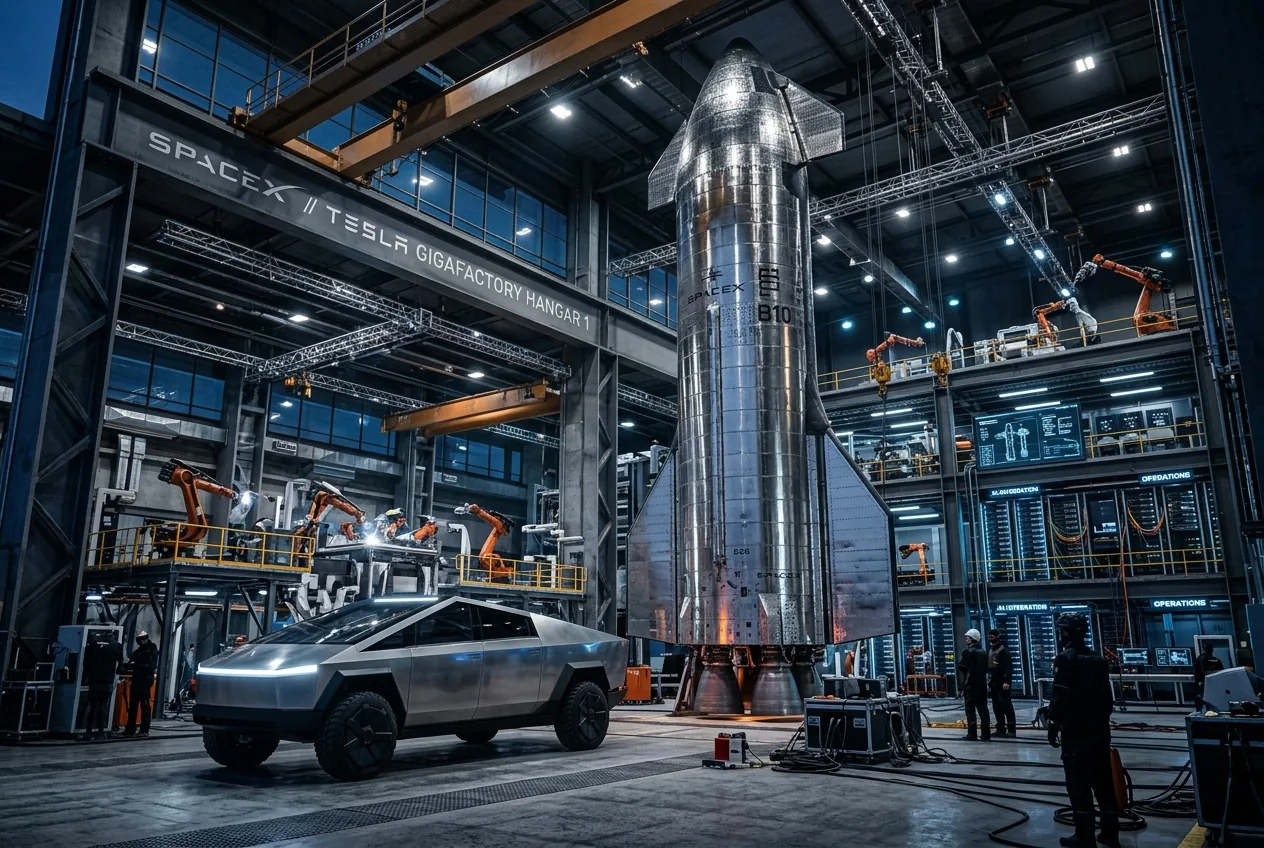
In the high-stakes world of industrial engineering and aerospace, the silos between seemingly disparate industries are beginning to dissolve. Reports have surfaced that Elon Musk is actively exploring a merger between Tesla and SpaceX, a move that would consolidate two of the most influential technology firms in history under a single corporate banner. This potential union comes at a pivotal moment, as SpaceX prepares for an initial public offering (IPO) that could value the aerospace giant at upwards of $2 trillion. If the merger proceeds, the resulting entity would command a market valuation exceeding $3.4 trillion, effectively creating what some analysts are calling the "Berkshire Hathaway of AI and Robotics."
From a mechanical engineering perspective, the logic behind such a consolidation extends far beyond simple balance sheet optimization. While the financial markets focus on the record-breaking IPO targeted for mid-June, the underlying technical synergies suggest that Tesla and SpaceX are already functioning as two divisions of the same machine. The exchange of materials science expertise, high-performance computing resources, and manufacturing protocols has created a deep, albeit unofficial, integration that a formal merger would merely codify. As someone who has spent years tracking the bridge between hardware and global markets, the engineering inevitability of this merger is perhaps its most compelling feature.
The Financial Architecture of a Multi-Trillion Dollar Giant
The immediate catalyst for these discussions is the imminent Nasdaq debut of SpaceX. Targeted for June 12, the IPO is expected to be the largest in history, with a valuation range between $1.75 trillion and $2 trillion. This massive influx of liquidity presents both an opportunity and a risk for Musk’s existing empire. Gary Black, managing partner of The Future Fund, has warned that a standalone SpaceX IPO could inadvertently cannibalize Tesla’s investor base. Shareholders may be tempted to liquidate Tesla positions to secure a stake in the burgeoning space economy, particularly as Tesla faces a more mature and competitive electric vehicle (EV) market. A merger would solve this problem by tying the fortunes of the two companies together, ensuring that investors remain exposed to the full spectrum of Musk’s technological ambitions.
The proposed structure of the merger remains a subject of intense debate among legal and financial experts. One likely scenario involves SpaceX completing its IPO and then utilizing its high-valuation stock to absorb Tesla through a stock swap. This would be particularly advantageous for Musk, who maintains roughly 85% voting control at SpaceX thanks to a super-voting share structure. Tesla, by contrast, operates under a standard one-share-one-vote system. By merging the two, Musk could potentially solidify his control over the combined entity, shielding the broader mission from the whims of short-term institutional investors and activist shareholders who have occasionally challenged his leadership at Tesla.
Technical Synergies in AI and Robotics
Beyond the financial maneuvers, the most significant driver of this merger is the shared technical stack between the two companies. Tesla is no longer just an automotive company; it is a robotics and AI firm that happens to sell cars. SpaceX, similarly, has evolved from a launch provider into a global telecommunications and data powerhouse via Starlink. Both companies are currently converging on the same critical problem: the development of autonomous systems capable of operating in unstructured environments. Whether it is a humanoid robot navigating a factory floor or a Starship landing on a lunar surface, the fundamental AI requirements—computer vision, real-time path planning, and sensor fusion—are remarkably similar.
Furthermore, the crossover in materials science cannot be overstated. The cold-rolled stainless steel alloy developed for the Tesla Cybertruck was a direct descendant of the material research conducted for the Starship program. This type of cross-pollination is efficient, but it also creates legal and intellectual property (IP) headaches in a world where the companies remain separate entities. A merger would eliminate these friction points, allowing engineers to move freely between projects without the need for complex inter-company service agreements or the risk of IP leakage. For a mechanical engineer, the ability to use a single proprietary alloy or a unified software kernel across land, sea, and space assets is an incredible force multiplier.
Governance and the Challenge of Integration
While the technical and economic benefits are clear, the governance of such a gargantuan entity presents a unique set of challenges. Critics argue that a merger would grant Musk unprecedented and perhaps dangerous levels of control over critical global infrastructure. SpaceX is a vital partner to NASA and the Department of Defense, while Tesla is a cornerstone of the American transition to renewable energy. Combining these assets under a single board of directors, largely influenced by a single individual, raises significant questions about oversight and accountability. If the merger proceeds, it will likely be the most scrutinized corporate action of the decade.
There is also the question of operational focus. Skeptics suggest that Tesla is already suffering from "CEO dilution," with Musk’s attention divided between his various ventures. A formal merger could either streamline this by providing a unified corporate structure or exacerbate it by creating a conglomerate so large it becomes unmanageable. However, the counter-argument is that the companies are already so intertwined—evidenced by the $131 million in Cybertruck orders placed by SpaceX and the shared use of engineering talent—that formalizing the relationship would actually reduce administrative overhead. It would transition the relationship from a series of "related party transactions" to internal departmental transfers.
Looking ahead, the potential Tesla-SpaceX merger represents the logical conclusion of Musk's career-long effort to vertically integrate the most difficult aspects of modern industry. From mining the raw materials for batteries to launching the satellites that provide the data for autonomous driving, the goal is total control over the supply chain and the technology stack. As the IPO approaches, the market is beginning to realize that the value of these companies may not lie in their individual products, but in their collective ability to function as a single, multi-planetary industrial engine. Whether the merger happens in 2026 or 2027, the technical foundation has already been laid, and the economic gravity of the SpaceX IPO may finally pull these two giants into a single orbit.




Comments
No comments yet. Be the first!