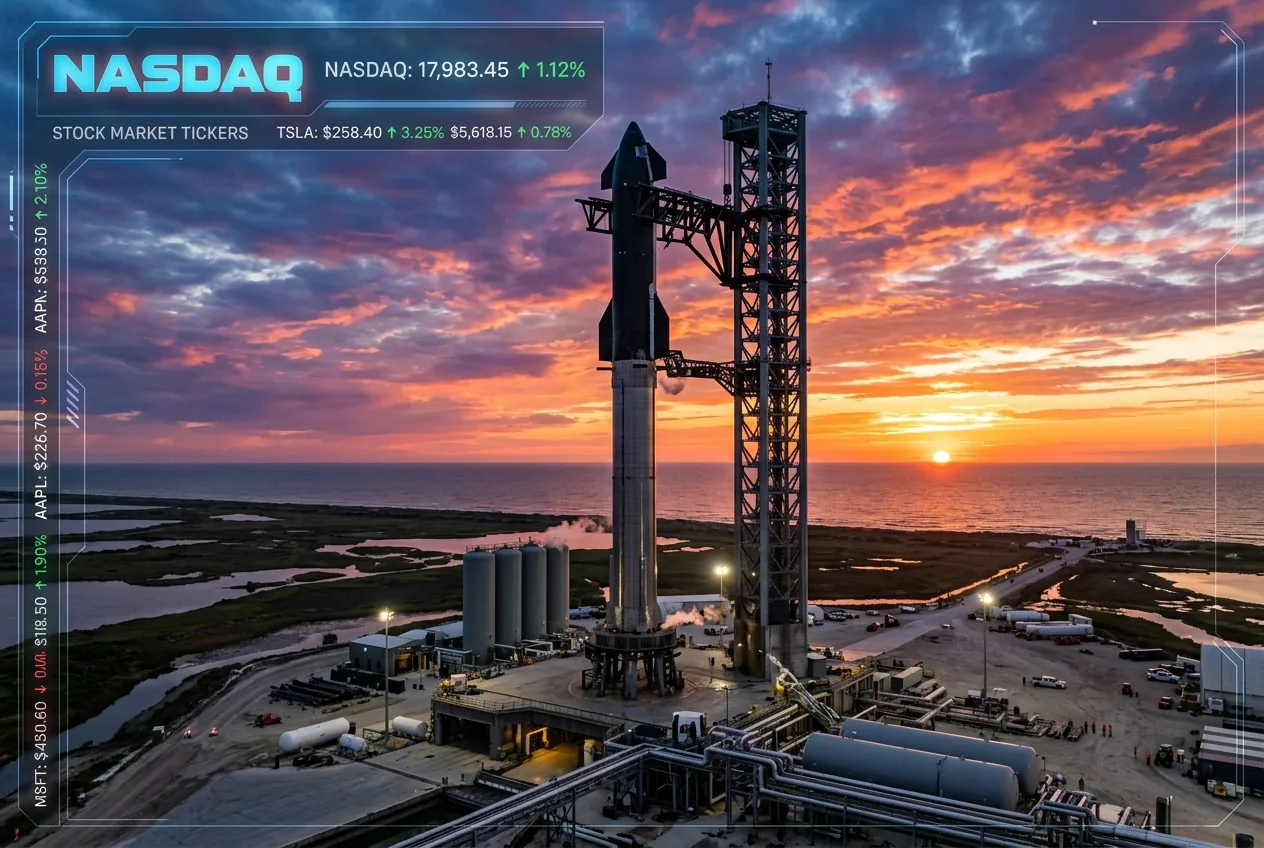
In a move that marks the transition of the private space race into a mature industrial era, SpaceX has officially filed its prospectus with U.S. regulators for an initial public offering (IPO) on the Nasdaq. The filing, which identifies the company under the ticker SPCX, reveals a valuation target of approximately $1.75 trillion. This debut, tentatively scheduled for June 12, 2026, is not merely a financial milestone; it represents a fundamental restructuring of Elon Musk’s technology empire. By simultaneously announcing the acquisition of xAI, the artificial intelligence firm behind the Grok chatbot, SpaceX is positioning itself as a vertically integrated entity capable of managing the complex robotics and compute requirements of a multiplanetary economy.
For observers of industrial automation and mechanical engineering, the merger of a rocket manufacturer with an AI firm is a pragmatic response to the challenges of deep-space operations. Space is not just a vacuum of air; it is a vacuum of low-latency infrastructure. To operate effectively on the Moon or Mars, hardware cannot rely on Earth-based cloud processing. The integration of xAI into SpaceX’s core operations suggests a future where Starship and Starlink hardware are powered by onboard, high-performance silicon designed to handle autonomous navigation, life-support maintenance, and resource extraction without a tether to terrestrial servers.
The Financial Mechanics of a $1.75 Trillion Valuation
The prospectus offers the most transparent look yet at the internal economics of the world’s most successful launch provider. In the first three months of 2026, SpaceX reported sales of $4.7 billion, a 15.4 percent increase over the previous year. However, the company also reported an operating loss of $1.9 billion. This deficit is largely attributed to the aggressive research and development costs associated with the Starship program and the initial costs of integrating xAI’s massive compute clusters into the SpaceX ecosystem.
Starlink remains the primary engine of liquidity. It was the only profitable division in the first quarter of the year, demonstrating that the satellite internet constellation has successfully moved past its capital-intensive infancy into a steady state of revenue generation. The IPO aims to raise approximately $75 billion, a war chest intended to bridge the gap between Starlink’s current profitability and the long-term industrialization of the lunar and Martian surfaces. For investors, the appeal lies in the company’s claim of a $28.5 trillion total addressable market (TAM), a figure that includes not just satellite communications, but also point-to-point terrestrial transport, orbital manufacturing, and asteroid mining.
The scale of this float is set to make Elon Musk the world’s first trillionaire. With an 85.1 percent stake in the combined voting power of the company, Musk’s personal net worth is projected to exceed $1 trillion if the market sustains the $1.75 trillion valuation. While the headlines focus on the wealth, the mechanical reality is that this capital provides the first realistic path toward the mass production of the Starship launch system, which requires significant economies of scale to bring the cost per kilogram to orbit down to the levels required for colonization.
Why Merging AI with Aerospace is an Engineering Necessity
From a technical perspective, the decision to fold xAI into SpaceX is more than a branding exercise. The next phase of space exploration is essentially a massive robotics problem. Whether it is the precision landing of a 5,000-ton Starship or the autonomous deployment of lunar habitats, the complexity of the tasks exceeds the capabilities of traditional scripted software. xAI’s large language models and neural network architectures provide a framework for "physical AI"—intelligence that can interpret sensor data in real-time and make split-second adjustments to hardware.
Furthermore, the prospectus highlights the role of AI in "terawatt-scale compute growth." SpaceX envisions utilizing the cold vacuum of space and the high solar irradiance of the lunar surface to power massive data centers. These orbital and lunar server farms would support the compute needs of both the colony and Earth-based users, effectively turning SpaceX into the world’s first interplanetary cloud provider. The xAI merger provides the software stack necessary to manage this distributed, extra-terrestrial network.
Is the Kardashev Type II Goal Historically Viable?
One of the most striking elements of the SEC filing is the explicit mention of propelling humanity toward "Kardashev Type II status." In the realm of theoretical physics, a Type II civilization is one capable of harnessing the total energy output of its parent star. While currently speculative, SpaceX’s road map suggests a calculated approach to this transition. It begins with the "stepping stone" of a permanent lunar presence, which serves as a testing ground for the industrial processes required for Mars.
The industrialization of the Moon involves more than just scientific research; it requires the development of orbital refineries and automated mining facilities. The prospectus mentions asteroid mining as a long-term revenue stream, which would involve identifying and capturing Near-Earth Objects (NEOs) rich in platinum-group metals and water ice. Water, in particular, is the "oil" of the solar system, providing the hydrogen and oxygen necessary for rocket propellant. By establishing a propellant depot in orbit, SpaceX can decouple the size of its payloads from the limitations of Earth’s gravity well, enabling the transport of heavy industrial equipment to the Martian surface.
Critics point to the substantial debt and ongoing losses as a sign of overextension. However, for a company that has already achieved the reuse of first-stage orbital boosters—a feat once thought impossible by the legacy aerospace industry—the financial risks are viewed as secondary to the engineering milestones. The IPO serves as a mechanism to distribute these risks across the public market while providing the immense liquidity required for infrastructure projects that have timelines measured in decades rather than quarters.
Managing the Risks of Gravity and Market Volatility
The transition from a private to a public company brings with it a new set of challenges, particularly the pressure of quarterly earnings reports. For a firm like SpaceX, which often prioritizes long-term developmental breakthroughs over short-term fiscal neatness, the scrutiny of Wall Street could be abrasive. The operating loss of $1.9 billion in early 2026 is a reminder that the path to the stars is paved with significant burn rates.
Investment analysts suggest that while the potential rewards are unprecedented, the risks are equally scaled. The integration of xAI adds a layer of complexity; AI companies currently command high valuations, but they are also subject to intense regulatory scrutiny and rapid technological obsolescence. If the promised synergies between the AI and the rockets fail to materialize, or if the Starship program faces significant hardware setbacks, the $1.75 trillion valuation could face a sharp correction. The prospectus itself warns of "existential risks" and the inherent unpredictability of space operations.
However, the timing of the IPO, arriving just as OpenAI is also expected to file its own paperwork, suggests a broader market appetite for high-frontier technology. SpaceX is betting that the public is ready to invest in the "age of abundance" it describes in its filing. By June 12, when the first shares of SPCX are expected to trade on the Nasdaq, the world will have a clearer picture of whether investors are willing to fund the infrastructure for a multiplanetary future or if they are simply chasing the hype of a historic trillionaire moment.




Comments
No comments yet. Be the first!