The long-anticipated public listing of SpaceX has finally moved from the realm of industry rumor to financial reality. However, for those expecting a traditional aerospace prospectus focused solely on launch cadence and orbital mechanics, the filing—set to list under the ticker SPCX on Nasdaq and Nasdaq Texas—offers a profound surprise. The document outlines a company that has strategically outgrown its origins as a mere transportation provider. Instead, SpaceX is positioning itself as a vertically integrated titan across three distinct but symbiotic sectors: Space, Connectivity, and Artificial Intelligence (AI). This pivot is backed by a staggering $28.5 trillion total addressable market (TAM) claim, a figure that dwarfs the current global aerospace industry and signals a new era of industrial ambition.
From a mechanical engineering and industrial logistics perspective, the filing illustrates how SpaceX is leveraging its hardware dominance to capture software-level margins. The company’s valuation, projected to sit between $1.75 trillion and $2 trillion, would make it the largest initial public offering in history, eclipsing even the record set by Saudi Aramco in 2019. This valuation is not merely a reflection of the number of rockets launched per year; it is a calculation of the synergistic value between the Starship heavy-lift system, the Starlink satellite constellation, and the newly integrated xAI infrastructure. For CEO Elon Musk, the IPO represents more than a liquidity event; it is the financial foundation for the colonization of Mars, with specific compensation milestones tied to the establishment of a self-sustaining city of one million people on the Red Planet.
The Financial Engine of the Starlink Constellation
Conversely, the Space division remains a loss leader, albeit a necessary one. This segment, which encompasses the Falcon 9, Dragon, and the ongoing development of the Starship program, posted an operating loss of $657 million in 2025 against $4.08 billion in revenue. The primary culprit for this deficit is the $3 billion annual research and development spend on Starship. From an engineering standpoint, Starship is the ultimate high-risk, high-reward asset. Its success is required to deploy the larger, more capable Starlink v3 satellites, which are essential for capturing the high-bandwidth enterprise and mobile connectivity markets mentioned in the filing. Without the mass-to-orbit capabilities of Starship, the Connectivity division’s growth would eventually hit a ceiling imposed by the payload limits of the Falcon 9.
Integrating Intelligence into the Orbital Infrastructure
The most surprising revelation in the IPO filing is the prominence of Artificial Intelligence within the company’s core strategy. Following the acquisition of xAI—the maker of the Grok large language model—SpaceX has moved aggressively into AI infrastructure. While the AI division is currently a significant drain on resources, posting an operating loss of $6.35 billion on $3.2 billion in revenue in 2025, the strategic rationale is clear. The filing identifies a $26.5 trillion opportunity in AI, suggesting that SpaceX intends to use its satellite network as a global distributed computing platform. Capital expenditure in this sector reached $12.7 billion in a single year, indicating a massive investment in GPU clusters and data center integration.
The technical synergy between SpaceX and xAI is rooted in the need for low-latency, high-bandwidth data processing. Modern robotics and automated systems, whether on a factory floor or a future Mars base, require localized intelligence that can operate without constant reliance on a central server. By embedding AI capabilities directly into the Starlink network, SpaceX can offer edge computing services on a planetary scale. This is particularly relevant for the $22.7 trillion enterprise application market cited in the prospectus. Companies operating in remote locations—such as offshore oil rigs, mining sites, or autonomous logistics hubs—will be able to run complex AI models with minimal lag, using Starlink as the primary data conduit.
Furthermore, the integration of xAI suggests that SpaceX is preparing for the extreme automation required for Mars colonization. Building and maintaining a habitat on another planet is not a task that can be managed by human labor alone; it will require a massive fleet of autonomous robots capable of making real-time decisions in a hostile environment. The Grok-based systems are likely being developed to serve as the 'operating system' for these robotic workers. The massive CapEx currently being funneled into xAI is, in essence, the R&D cost of the labor force that will eventually build the Martian infrastructure. From a technical perspective, the hardware and software are being co-developed to ensure that the robotics of the future are perfectly tuned to the communication constraints of space.
The Economic Reality of a Trillionaire CEO
The projected $2 trillion valuation of SpaceX has significant implications for Elon Musk’s personal net worth, potentially making him the world’s first trillionaire. This is not just a matter of wealth accumulation but a deliberate structural alignment between Musk’s personal incentives and the company’s long-term survival. The filing reveals a complex compensation structure that links massive share grants to the progress of the Mars program. Specifically, Musk is slated to receive 200 million shares, but only if he successfully establishes a colony of one million people on Mars. This metric is unprecedented in corporate history, shifting the definition of 'performance' from quarterly earnings to the survival of the human species on another world.
This incentive structure ensures that SpaceX remains focused on its stated mission, even after becoming a public company. Standard public firms often fall into the trap of short-termism, sacrificing long-term R&D for immediate dividends. However, with Musk holding significant voting control and his primary financial rewards tied to multi-decadal goals, SpaceX is structured to resist these market pressures. The $28.5 trillion total addressable market provides the necessary narrative to keep investors focused on the future. While the AI and space divisions currently burn through billions, the promise of capturing even a fraction of that astronomical TAM is enough to sustain a premium valuation.
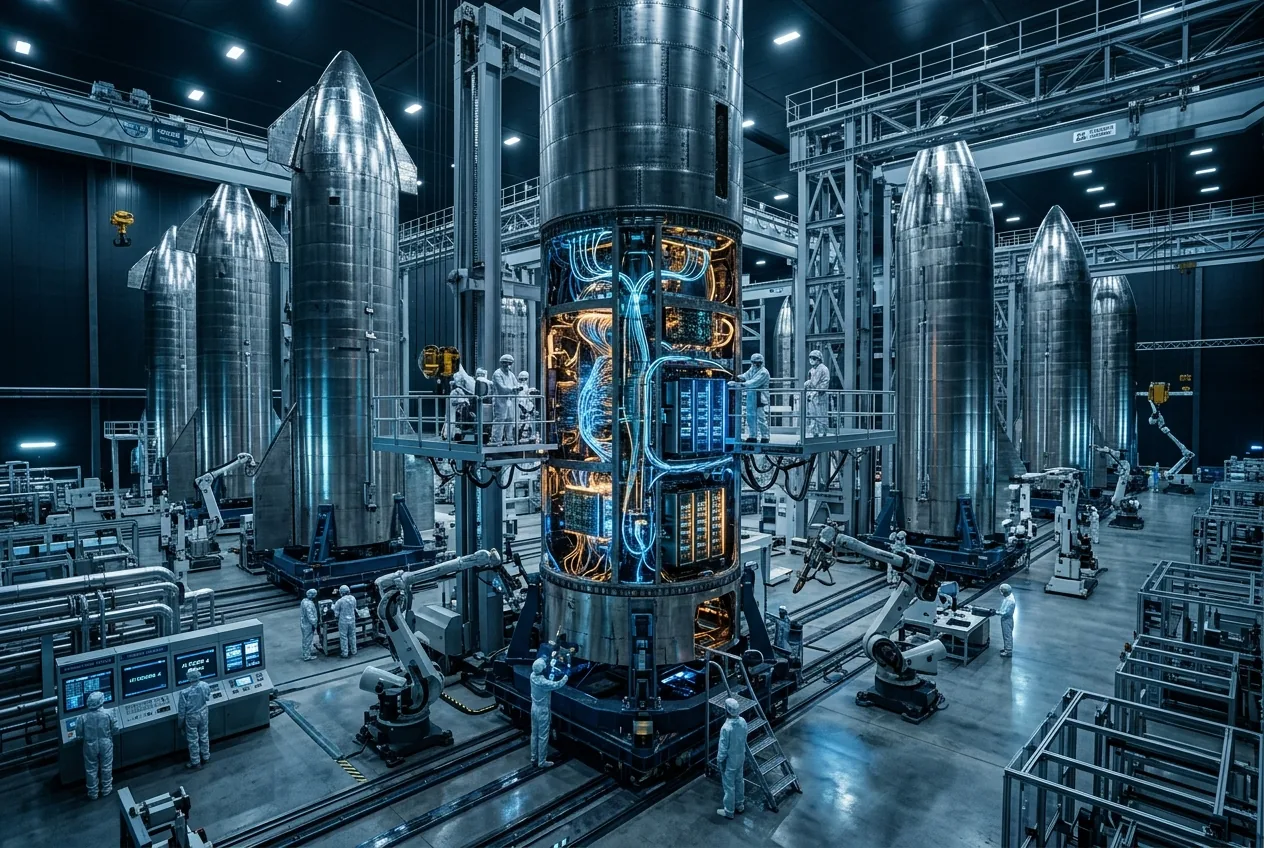
From a mechanical engineering viewpoint, the path to this valuation relies on the successful transition of Starship from a prototype to a reliable, reusable workhorse. The filing notes that the company is currently scaling up its manufacturing capabilities in South Texas to produce one Starship every few days. This level of production volume is unheard of in the aerospace industry and mirrors the high-throughput manufacturing lines seen in the automotive sector. If SpaceX can treat rocket production like car production, the cost of access to space will drop by orders of magnitude, finally making the commercialization of the moon and Mars economically feasible.
Technical Challenges and the $28.5 Trillion Bet
Despite the optimistic projections, the filing does not ignore the immense technical hurdles ahead. The 'Space' portion of the TAM ($370 billion) is actually the smallest segment, highlighting that the real money is in the applications that space enables, rather than launch itself. To capture the $26.5 trillion AI market, SpaceX must solve the problem of power density and cooling for space-based or remote data centers. Silicon-based chips generate significant heat, and managing that thermal load in a vacuum or a thin Martian atmosphere requires innovative radiator designs and possibly liquid-cooling systems that are still in their infancy for space applications.
Moreover, the reliability of the Starlink v3 constellation is paramount. As the company moves into digital advertising and consumer subscriptions, any significant downtime in the network could lead to massive churn and loss of enterprise trust. The filing indicates a heavy reliance on automated station-keeping and collision avoidance systems to manage the thousands of satellites currently in orbit. As the constellation grows toward its planned 42,000 units, the complexity of managing orbital traffic will require AI-driven logistics that can react faster than any human operator. This further justifies the acquisition of xAI, as the intelligence required to manage the network is as critical as the hardware itself.
Ultimately, the SpaceX IPO filing is a document of extreme engineering and economic ambition. It represents a bet that the future of the global economy will be built on three pillars: the ability to move mass efficiently (Space), the ability to move data everywhere (Connectivity), and the ability to process that data intelligently (AI). For a company that started with a single failed launch of a small rocket in the Pacific, the scale of this vision is breathtaking. Whether it can deliver on these promises depends on its ability to turn the high-loss divisions of today into the high-margin monopolies of tomorrow. As it prepares for the Nasdaq listing, SpaceX is no longer just a rocket company; it is an infrastructure provider for the 21st century and beyond.




Comments
No comments yet. Be the first!