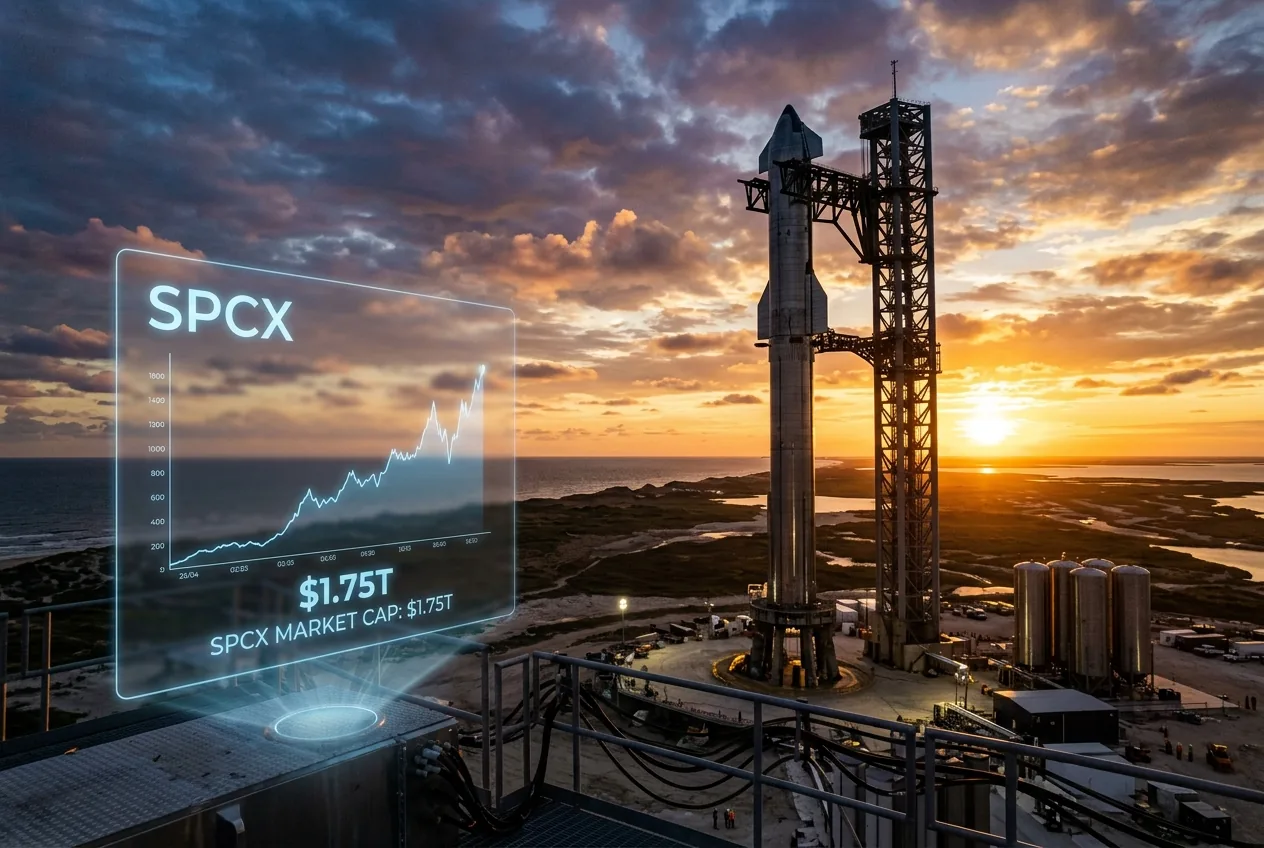
In a move that marks the single largest shift in the history of private aerospace and artificial intelligence, Space Exploration Technologies Corp.—better known as SpaceX—has officially filed for an initial public offering (IPO) on the U.S. stock market. The filing, which has long been the subject of intense speculation across Wall Street and the tech corridors of Silicon Valley, reveals a company that has evolved far beyond its origins as a commercial launch provider. Under the proposed ticker symbol SPCX, the offering is poised to be the largest in history, potentially valuing the firm at a staggering $1.75 trillion.
The implications of this public listing extend beyond the financial markets. According to the S-1 filing, the successful flotation is expected to push the net worth of SpaceX founder and CEO Elon Musk beyond the $1 trillion mark, making him the first person in history to achieve such a valuation. This projected wealth is driven by Musk’s significant majority ownership in SpaceX, which is now revealed to be a sprawling conglomerate encompassing not only the Starship launch system and the Starlink satellite constellation but also the integrated assets of xAI and the social media platform X.
The Economic Engine of a $1.75 Trillion Giant
To understand the $1.75 trillion valuation, one must look at the diversified revenue streams SpaceX has cultivated over the last decade. While the company is famous for its reusable Falcon 9 rockets and the massive Starship prototype, the financial filing paints a picture of a firm that is increasingly becoming a critical infrastructure provider for the digital age. SpaceX reported $18.6 billion in revenue for the previous fiscal year, a significant sum for an aerospace firm, yet the company continues to operate at a net loss of $4.9 billion. This gap highlights the capital-intensive nature of Musk’s long-term strategy: aggressive reinvestment into hardware and infrastructure.
The balance sheet reveals that SpaceX currently holds $102 billion in assets, largely comprised of its fleet of rockets, ground stations, and the thousands of Starlink satellites currently in orbit. However, this growth is supported by $60.5 billion in debt. From an engineering and industrial perspective, this debt-to-asset ratio is characteristic of high-growth manufacturing firms that prioritize scaling over immediate profitability. The IPO is designed to de-leverage some of this debt while providing the liquidity necessary to complete the Starship development cycle and expand the xAI compute clusters.
Consolidating AI and Aerospace Under One Roof
Perhaps the most surprising revelation in the IPO filing is the formal consolidation of xAI into the SpaceX corporate structure. Musk has indicated his intention to dissolve xAI as a standalone entity, folding its intellectual property and hardware assets into SpaceX. This move creates a vertically integrated powerhouse where the satellite data from Starlink, the robotics expertise from the aerospace division, and the large-scale language models of xAI operate under a single balance sheet.
The strategic logic behind this merger is rooted in the immense compute requirements of modern artificial intelligence. The filing reveals that xAI has entered into a massive infrastructure agreement with Anthropic, the developer of the Claude AI models. In a deal that underscores the scarcity of high-end compute, Anthropic will reportedly pay $15 billion annually—approximately $1.25 billion per month—to access data centers located in the American South. These facilities are managed by the xAI division of SpaceX, positioning the company as a major landlord and utility provider for the broader AI industry.
How Does the Anthropic Deal Change the Math?
Furthermore, the integration of the social media platform X into the SpaceX ecosystem provides xAI with a continuous stream of real-time data. While X has faced significant challenges as a standalone business, its value as a training ground for Grok—the xAI-developed chatbot—is central to the IPO’s narrative. The filing suggests that the synergy between Starlink’s global connectivity and xAI’s processing power could eventually lead to a global, decentralized AI network, though this remains a long-term technical objective rather than an immediate revenue source.
Addressing the Risks of Legal and Regulatory Headwinds
Despite the optimistic valuation, the SpaceX IPO filing is not without significant red flags. The company has flagged more than $500 million in expected legal costs stemming from a variety of ongoing litigation. Most notable among these are multiple lawsuits alleging that Grok has been used to generate non-consensual sexualized deepfakes. These claims pose a significant reputational and regulatory risk, particularly as the European Union intensifies its content moderation requirements under the Digital Services Act.
Beyond the AI-related legal troubles, the company is also battling patent infringement claims and allegations of non-compliance with EU data protection laws. From a mechanical and operational standpoint, there are also concerns regarding worker safety at the company's Texas and California facilities. These risks are inherent in high-velocity industrial environments, but as a public entity, SpaceX will face a level of scrutiny and transparency that Musk-led private companies have historically avoided. The transition from a private, founder-led visionary project to a publicly traded corporation with fiduciary duties to a diverse shareholder base will be the ultimate test of Musk’s leadership style.
Starship and the Physical Reality of Scaling
While the financial markets are focused on the AI and compute revenue, the physical reality of SpaceX’s success remains tied to the Starship program. The IPO comes at a time when the megarocket is nearing operational readiness. The ability of Starship to deliver massive payloads to orbit at a fraction of current costs is the 'how' behind the entire SpaceX ecosystem. Without the low-cost delivery of hardware to orbit, the Starlink network cannot reach the density required to support global high-speed internet, which in turn feeds the data needs of the integrated AI systems.
The industrial viability of SpaceX depends on its ability to maintain a comfortable lead over government-backed competitors and new private entrants. The filing indicates that SpaceX intends to use a portion of the IPO proceeds to build out 'Starfactory'—a massive production facility designed to mass-produce Starships with the same efficiency that Tesla achieved with its automotive Gigafactories. This shift from bespoke rocket manufacturing to assembly-line production is the core engineering challenge that will determine if SpaceX can justify its nearly two-trillion-dollar price tag over the next decade.
As the IPO date approaches, the global market is watching to see if Musk can successfully bridge the gap between the volatile world of social media and AI and the rigorous, physics-driven world of orbital mechanics. For the investors and enthusiasts watching from the sidelines, the SPCX listing represents more than just a stock; it is a massive bet on the future of human industry, both on Earth and beyond.




Comments
No comments yet. Be the first!