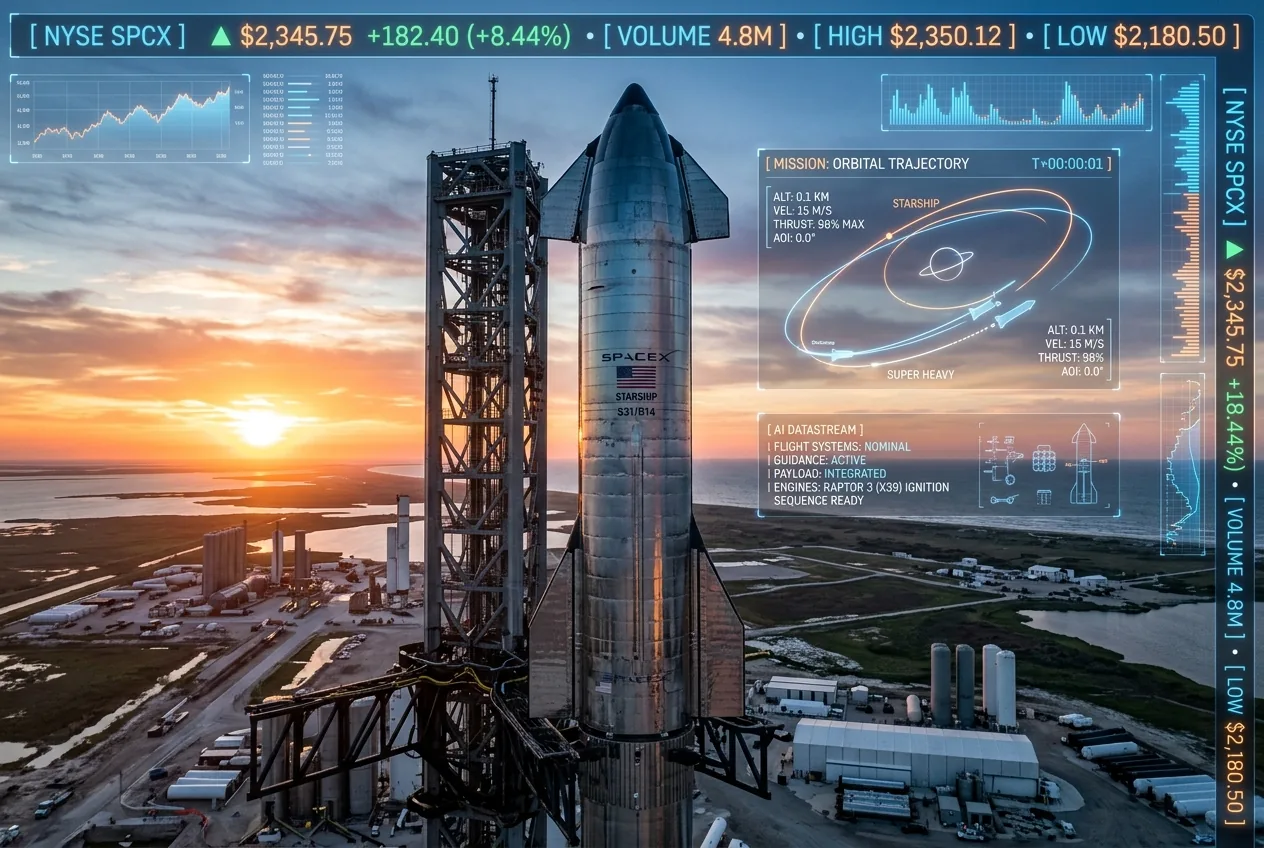
After years of private dominance and intense market speculation, SpaceX has officially filed its S-1 prospectus with the U.S. Securities and Exchange Commission, setting the stage for what could be the largest initial public offering (IPO) in history. The company has confirmed a debut date of June 12 on the Nasdaq under the ticker symbol “SPCX,” with pricing expected to be finalized on June 11. Targeting a valuation between $1.75 trillion and $2 trillion, the move signals a shift from an experimental aerospace firm to a foundational pillar of the global industrial economy.
The Mechanics of a $1.75 Trillion Offering
The financial scale of the SpaceX IPO is unprecedented, eclipsing even the most significant tech debuts of the last decade. At the heart of this valuation is a dual-revenue engine: the reliable, high-margin Starlink satellite constellation and the heavy-lift launch services that currently enjoy a near-monopoly on Western orbital delivery. According to the filing, SpaceX recorded $18.67 billion in revenue for the 2025 fiscal year, with Starlink contributing the lion's share of operating income.
Unlike traditional aerospace firms that rely heavily on government cost-plus contracts, SpaceX has transitioned into a commercial service provider. The S-1 reveals that the company’s internal rate of return on Falcon 9 launches has stabilized, allowing it to treat Starlink as a recurring-revenue utility. This utility model is what justifies the $1.75 trillion floor. For investors, the appeal lies in the fact that SpaceX owns the entire stack—from the foundries that cast the Raptor engine components to the phased-array antennas sold to Starlink subscribers. This level of vertical integration is rare in mechanical engineering at this scale, providing a moat that competitors like United Launch Alliance or Blue Origin have yet to effectively bridge.
Starlink and the Economics of Low Earth Orbit
While the rockets capture the headlines, the satellite constellation is the economic engine. Starlink has moved past its beta phase into a global broadband provider, servicing rural areas, maritime fleets, and military assets. The IPO filing highlights that Starlink is now generating consistent cash flow, which is being redirected into the development of Starship V3. This internal subsidization model is a critical piece of the SpaceX financial puzzle.
Integrating xAI: The Intelligence Behind the Hardware
Perhaps the most intriguing disclosure in the IPO filing is the formal acquisition and integration of xAI, Elon Musk’s artificial intelligence venture. While the AI segment currently reports heavy operating losses due to massive compute investment and R&D, its strategic value to SpaceX is immense. Space operations are increasingly becoming an autonomous frontier where latency makes human-in-the-loop control impossible for complex maneuvers.
The integration of xAI is aimed at solving the “autonomy gap” in orbital mechanics and deep-space navigation. For example, the precise landing of Falcon 9 boosters and the complex “chopstick” recovery of the Super Heavy booster require real-time processing of thousands of sensor inputs. By bringing xAI under the SpaceX umbrella, the company is looking to refine the neural networks that manage these high-stakes mechanical events. Furthermore, xAI’s models are expected to optimize the routing of data across the Starlink laser-mesh network, reducing latency and increasing total throughput without adding more physical hardware. For the pragmatic investor, this isn't about “AI hype”; it is about the mechanical efficiency of a global data network.
The Tesla Connection and Cross-Platform Synergies
The IPO filing has also shed light on the deep corporate links between SpaceX and Tesla, another pillar of the Musk ecosystem. Tesla currently holds nearly 19 million shares of SpaceX, a stake that has contributed to a recent rally in Tesla stock as investors realize they have indirect exposure to the space firm. This cross-pollination extends beyond equity into tangible industrial cooperation.
In 2025 alone, the filing reveals that Tesla sold $144 million in goods and services to SpaceX. This includes specialized battery modules for Starship, high-performance power electronics, and joint projects like “Terafab,” a modular chip manufacturing initiative designed to produce the radiation-hardened silicon required for space environments. The two companies share a fundamental philosophy in mechanical design: mass reduction and parts consolidation. By utilizing Tesla’s expertise in high-volume casting and battery thermal management, SpaceX reduces its engineering overhead. For the market, this creates a “magnetic effect” where the success of one venture reinforces the valuation of the other, though it also introduces risks of narrative-driven volatility if one company faces a setback.
Technical Hurdles: Starship V3 and the Path to Mars
Despite the financial optimism, the path forward is fraught with technical challenges. The success of the SpaceX business model over the next decade depends almost entirely on the operational maturity of Starship V3. The current Falcon 9 architecture, while reliable, is a medium-lift platform with limited volume. To achieve the economies of scale necessary for a $2 trillion company, SpaceX must move from delivering kilograms to delivering tons.
Starship V3 represents the pinnacle of current mechanical engineering in the aerospace sector. It utilizes 33 Raptor 3 engines on the booster alone, each producing over 280 tons of thrust. The sheer complexity of managing the thermal stresses and vibrations of such a massive propulsion system is immense. The IPO capital will specifically target the completion of the second and third launch towers at Starbase in Texas, as well as the build-out of a dedicated Starship manufacturing facility at the Kennedy Space Center. Without a fully reusable Starship, the valuation targets of the IPO would be difficult to sustain in a long-term market correction.
Retail Participation and Market Volatility
In a departure from traditional IPO norms, SpaceX has signaled that up to 30% of the shares in the June 12 offering may be allocated to retail investors. This move allows the general public to buy in at the same price as institutional heavyweights, a rarity for a company of this scale. While this democratizes access to the “space economy,” it also introduces a layer of retail-driven volatility that could see the stock price fluctuate wildly based on mission outcomes or social media sentiment.
Analysts warn that the SpaceX valuation is heavily tied to the “Musk premium”—the market's belief in Elon Musk's ability to execute on multi-decade timelines. The dual-class share structure ensures that Musk retains majority voting power, meaning that public shareholders will have little say in the company’s strategic direction, particularly regarding the long-term goal of Mars colonization, which may not offer traditional returns for decades. For the engineering-minded investor, the question is whether the cash-flow-positive Starlink and the high-utility Falcon 9 can continue to fund the ambitious, high-risk development of Starship without being dragged down by the volatility of the broader market or the nascent, loss-leading AI segment.
As June 12 approaches, the industry will be watching more than just the ticker. We will be watching the manufacturing lines in Brownsville and the launch pads in Cape Canaveral. The SpaceX IPO is a bet on the industrialization of space—a transition from exploration to infrastructure. Whether the market is ready to value a rocket company as a trillion-dollar utility remains to be seen, but the technical foundations laid by SpaceX suggest that the era of private orbital dominance is only just beginning.




Comments
No comments yet. Be the first!