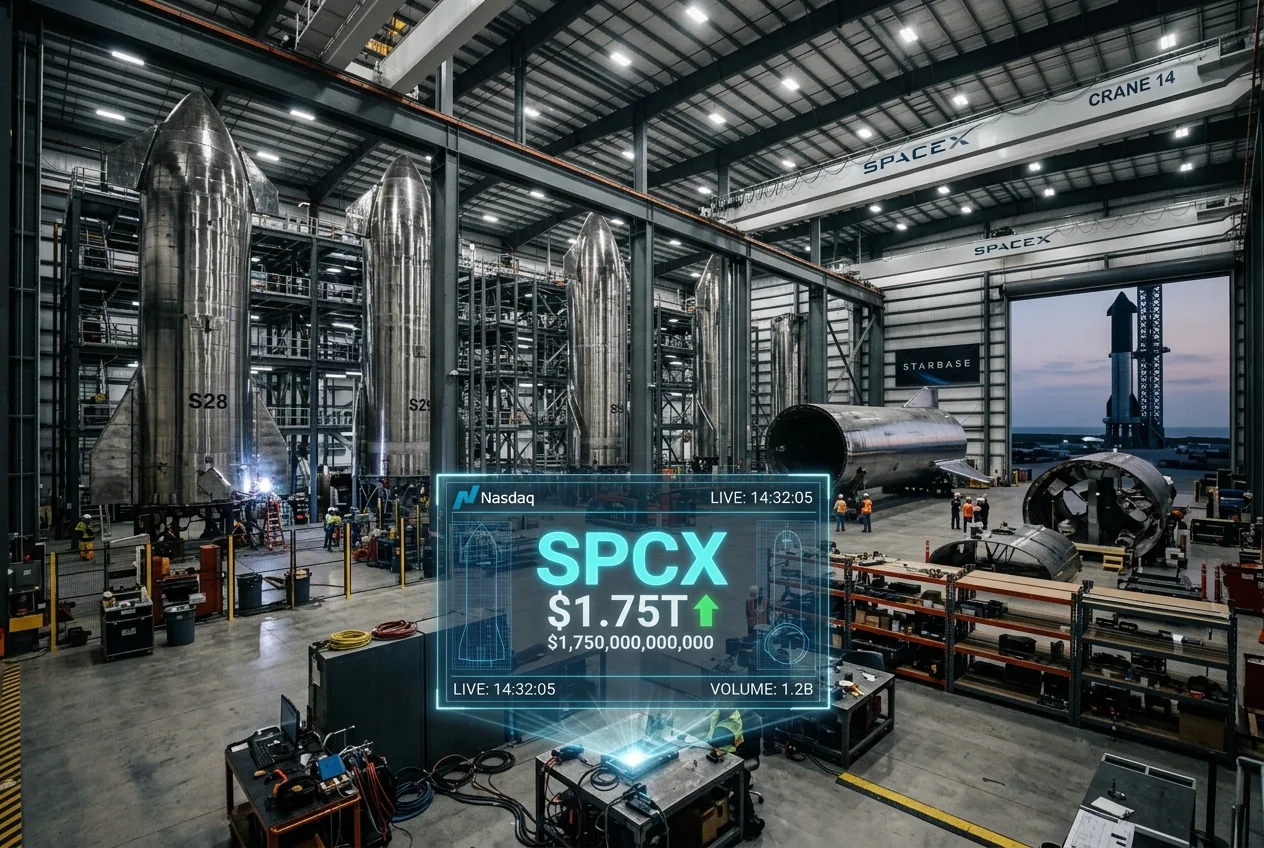
In a move that signals the definitive transition of the private space sector from a venture-backed industry to a corner of global infrastructure, SpaceX has officially filed its S-1 paperwork for an initial public offering (IPO). The filing, targeted for a June 12 debut on the Nasdaq under the ticker symbol SPCX, seeks a valuation of approximately $1.75 trillion. If successful, the offering will raise between $40 billion and $80 billion, effectively shattering the record previously held by Saudi Aramco’s $25.6 billion debut in 2019.
For industrial observers and mechanical engineers, the filing is more than a financial milestone; it is a capital deployment strategy designed to fund the most expensive hardware development cycle in human history. The document reveals a company at a crossroads, balancing the robust, profitable cash flow of its Starlink satellite constellation against the staggering capital expenditures required for the Starship launch system and the recent, high-cost integration of the AI startup xAI. This synthesis of aerospace and artificial intelligence represents a pivot toward an orbital compute economy that remains largely theoretical but requires immediate, massive liquidity.
The Balance Sheet of a Multi-Planetary Infrastructure Company
The financial data contained within the S-1 provides the first transparent look at the mechanical reality of Elon Musk’s aerospace conglomerate. In 2025, SpaceX reported revenue of $18.7 billion, a figure largely buoyed by the maturation of Starlink. Starlink alone generated over $11 billion in revenue, boasting a subscriber base of 10.3 million across 164 countries. For the first time, the satellite division has demonstrated consistent profitability, providing a proof of concept for the economic viability of low-Earth orbit (LEO) telecommunications.
The capital expenditure (capex) requirements for this vision are unprecedented. In the first quarter of the fiscal year alone, SpaceX reported $10.1 billion in capital spending, with 76% of that allocated to AI infrastructure and Starship development. This high burn rate explains the urgency of the June IPO; the company needs a public market to sustain a level of investment that private equity can no longer comfortably support at this scale.
How Starship Acts as the Economic Enabler
The success of the IPO and the eventual valuation of $1.75 trillion hinge entirely on the operational readiness of Starship. While the Falcon 9 remains the workhorse of the launch industry, its payload capacity and refurbish costs are insufficient to support the mass-deployment of the hardware SpaceX envisions. Starship is designed to reduce the cost per kilogram to orbit by orders of magnitude through total reusability of both the Super Heavy booster and the Starship upper stage.
From an engineering perspective, the transition to Starship allows for the deployment of Starlink V3 satellites, which are significantly larger and equipped with the high-performance antennas and compute modules necessary for the xAI integration. The current Falcon 9 fairing limits the number and size of satellites that can be launched per mission. Starship’s 9-meter diameter fairing and 100-plus-ton payload capacity transform the economics of space-based infrastructure from a boutique service to a high-volume industrial utility.
The roadshow, set to begin on June 4, will likely focus on these launch metrics. Investors are being asked to bet on a future where SpaceX controls both the transportation layer (Starship) and the service layer (Starlink/xAI). If Starship achieves its target launch cadence of multiple flights per week, the marginal cost of adding capacity to the orbital network drops to a level that makes terrestrial competitors look sluggish. However, the technical risks remain significant. Any major failure during the ramp-up phase of Starship operations could lead to valuation volatility that public markets are traditionally less equipped to handle than private investors.
Can the Market Absorb a $2 Trillion Valuation?
There is a legitimate debate among market analysts regarding whether the proposed $1.75 trillion to $2 trillion valuation is detached from current fundamentals. Critics point to the $2.47 billion in quarterly losses within the AI unit as evidence of a speculative bubble. They argue that while Starlink is a proven business, the "space-based AI" component is years away from generating meaningful revenue and faces significant thermal management challenges in the vacuum of space.
On the other hand, proponents of the valuation point to the lack of competition. In the heavy-lift category, SpaceX is effectively a monopoly. Blue Origin’s New Glenn and the United Launch Alliance’s Vulcan are still in early operational phases and lack the vertical integration that SpaceX has achieved. Furthermore, the IPO structure is designed to fast-track inclusion into the Nasdaq 100, which would force passive index funds to purchase billions of dollars in SPCX shares, creating a floor for the stock price regardless of near-term earnings.
The dual-class share structure detailed in the filing also presents a unique governance profile. Post-IPO, Elon Musk will retain over 85% of the voting power despite holding roughly 42% of the equity. This concentration of power ensures that the company’s long-term mission—specifically the colonization of Mars—remains the primary strategic objective, potentially at the expense of short-term quarterly dividends. For institutional investors, this means a SpaceX investment is a vote of confidence in Musk’s personal execution rather than a traditional play for corporate dividends.
The Mechanics of an Orbital AI Network
The integration of xAI into the SpaceX ecosystem is the most technically complex aspect of this filing. The objective is to create a distributed neural network across the Starlink constellation. This requires more than just launching servers into orbit; it necessitates a fundamental rethink of satellite thermal architecture. Terrestrial data centers rely on massive amounts of water and air for cooling. In space, heat can only be dissipated through radiation, which is far less efficient.
SpaceX engineers are reportedly working on advanced loop heat pipes and large-scale deployable radiators that would allow Starlink V3 satellites to handle the high TDP (Thermal Design Power) associated with AI training and inference hardware. If this mechanical hurdle can be cleared, the advantages are immense. Data centers in orbit benefit from 24/7 solar power and a cooling environment that, while difficult to manage, is consistent. Furthermore, by placing compute nodes in orbit, SpaceX can provide AI services to any point on Earth with a latency of less than 30 milliseconds, a capability that would be highly valuable for autonomous robotics and industrial automation in remote regions.
This technical ambition is what justifies the "record" nature of the IPO in the eyes of the company’s leadership. They are not just building a better satellite; they are attempting to build a new layer of the internet. The $75 billion capital raise is the fuel required to clear the 'valley of death' between current experimental AI satellites and a fully functional global compute grid.
The Geopolitical and Economic Ripple Effects
Economically, the IPO marks a shift in how mega-cap companies are formed. Historically, companies went public to provide an exit for early investors. SpaceX is going public to fund a massive expansion of its balance sheet to meet the hardware demands of the next decade. The "Musk Premium"—the tendency for his companies to trade at valuations far exceeding their immediate cash flows—will be put to its ultimate test. Unlike Tesla, which faced a crowded automotive market, SpaceX is entering the public market with a decade-long head start in reusable rocketry.
As the May 20 filing deadline approaches and the roadshow kicks off in June, the focus will remain on the numbers: the launch cadence of Starship, the subscriber growth of Starlink, and the burn rate of the xAI division. For Noah Brooks and the team at Apollo Thirteen, the story isn't just about the money; it’s about the massive engineering effort that this money will unlock. We are witnessing the industrialization of the solar system, one share at a time.




Comments
No comments yet. Be the first!