The intersection of aerospace engineering and high-frequency finance has reached a critical flashpoint. Recent reports concerning a potential public offering for SpaceX—or at the very least, a massive secondary market valuation jump—suggest that the aerospace giant is no longer just a disruptor; it is becoming the foundational infrastructure for the next century of industrial expansion. For Elon Musk, the founder and primary shareholder, this trajectory points toward a historical anomaly: the birth of the world’s first trillionaire. While much of the public discourse focuses on the sheer scale of the wealth, the more compelling story lies in the mechanical and economic efficiencies that have made such a valuation possible. From the perspective of industrial automation and mechanical engineering, SpaceX represents a masterclass in vertically integrated manufacturing and marginal cost reduction.
The Economic Engine of Orbital Reusability
To understand how a private aerospace company could propel an individual to trillionaire status, one must look at the technical specs of the Falcon 9 and the forthcoming Starship system. For decades, the space industry operated on an expendable model. Every launch involved throwing away tens of millions of dollars in precision-engineered hardware. SpaceX’s primary breakthrough was not just landing a rocket, but creating a refurbishable asset. The Falcon 9 fleet has demonstrated that a single first-stage booster can be flown upwards of twenty times. This has effectively decoupled the cost of a launch from the cost of the hardware, leaving only the fuel, range fees, and recovery operations as variable costs. This technical achievement turned the launch market into a high-margin logistics business, a shift that is the primary driver behind the company’s skyrocketing valuation.
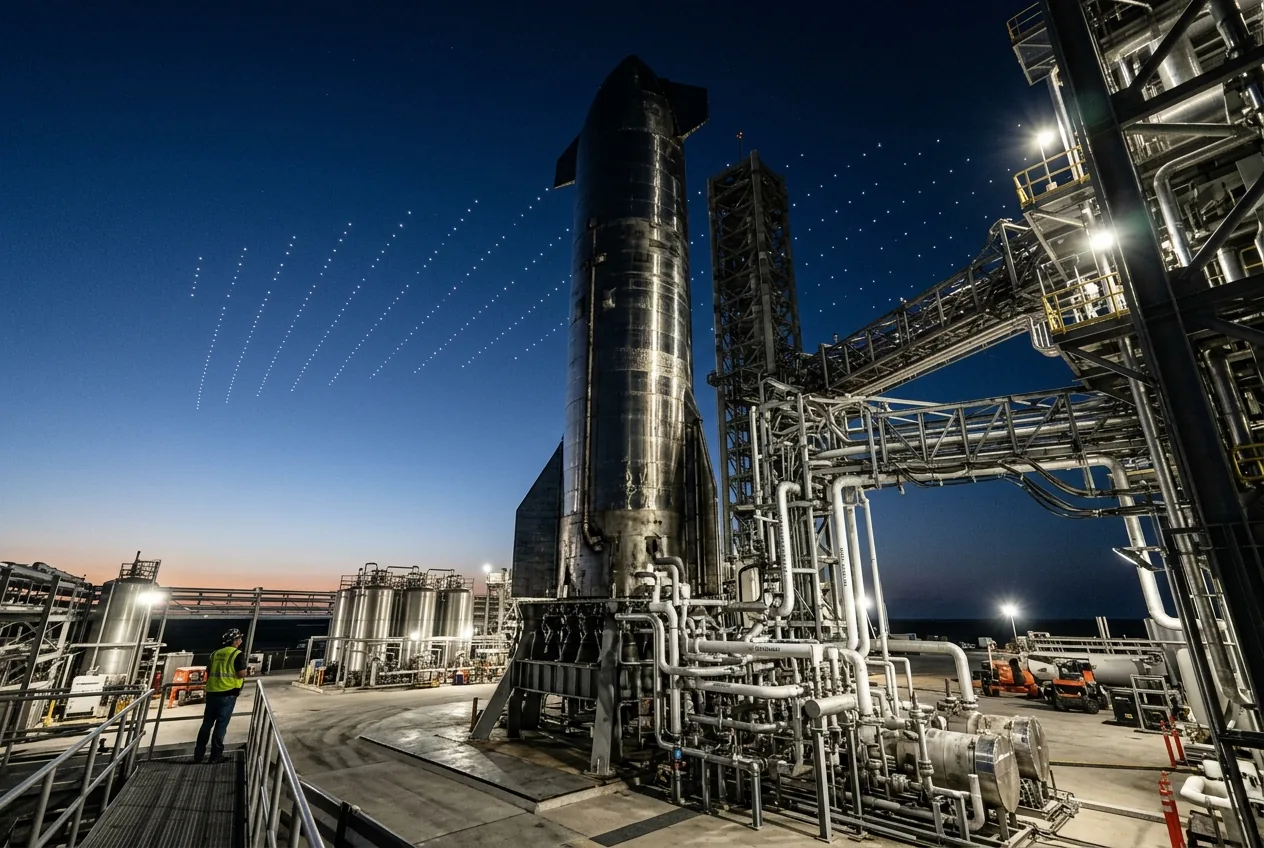
The financial world is now looking toward Starship, the fully reusable heavy-lift vehicle currently in testing at Starbase, Texas. Unlike the Falcon 9, which only recovers its first stage and fairings, Starship is designed for total reusability. From a mechanical engineering standpoint, the challenge is immense: surviving the thermal stresses of reentry while utilizing a stainless-steel hull and the high-performance Raptor engine, which operates on a full-flow staged combustion cycle. If Starship achieves its goal of carrying 100 metric tons to orbit for a fraction of current costs, SpaceX will hold a functional monopoly on heavy-lift logistics. This isn't just about satellites; it's about the industrialization of the Moon and Mars, creating a market that does not currently exist but which SpaceX will be uniquely positioned to capture and control.
Starlink and the Recurring Revenue Model
The technical hurdles of Starlink are often overlooked in favor of the business success. Operating a constellation of this size requires sophisticated autonomous station-keeping and inter-satellite laser links. Each satellite is essentially a high-speed router in a vacuum, exposed to extreme radiation and temperature fluctuations. The ability to mass-produce these satellites at a rate of several per day is an industrial feat that mirrors the automotive assembly lines of Tesla. By treating satellites as mass-produced commodities rather than bespoke scientific instruments, SpaceX has achieved a scale that no other competitor—private or sovereign—has yet matched. This infrastructure is the bedrock upon which any future IPO or spin-off valuation will be built.
The Role of xAI and Compute Scaling
The narrative of the first trillionaire cannot be limited to SpaceX alone; it requires an analysis of Musk’s newest venture, xAI. In the modern industrial landscape, data is the raw material, and AI is the refinery. xAI’s recent developments, including the construction of the "Colossus" supercomputer cluster, signal an aggressive move into the AI hardware and software space. For a mechanical engineer, the interest here is in the optimization of complex systems. The telemetry data from thousands of Starlink satellites and the flight dynamics of Starship launches provide a massive dataset for training neural networks. The synergy between aerospace hardware and artificial intelligence is where the next leap in efficiency will occur.
xAI’s goal of understanding the "true nature of the universe" may sound like marketing fluff, but the underlying utility is grounded in industrial application. Large-scale AI models are becoming essential for materials science, allowing engineers to simulate new alloys for rocket engines or more efficient battery chemistries for energy storage. By integrating xAI’s computational power with SpaceX’s manufacturing and Tesla’s robotics, Musk is building a closed-loop system of innovation. This cross-pollination of technology ensures that each company benefits from the advancements of the others, creating a compounding effect on his total net worth that is difficult to replicate in more siloed corporate structures.
Market Dominance and Geopolitical Utility
From an economic perspective, SpaceX is currently operating in a vacuum of competition. While Blue Origin and various European and Chinese initiatives are making progress, they remain years behind in terms of flight-proven reusability. In the world of industrial technology, being first-to-market with a working, scalable solution often leads to a winner-take-all scenario. The infrastructure cost for a competitor to catch up to SpaceX’s current capabilities is estimated in the tens of billions of dollars. This "moat" is not just financial; it is technical. The institutional knowledge gained from hundreds of successful landings and the iterative design of the Raptor engine cannot be simply purchased; it must be built through the same rigorous, often failure-prone testing that SpaceX has mastered.
Is a Trillion-Dollar Valuation Sustainable?
The question for investors and observers is whether this trajectory can be sustained without a significant market correction. A trillion-dollar net worth for a single individual assumes that SpaceX, Tesla, and xAI will continue to grow at exponential rates without facing significant regulatory or technical setbacks. From a mechanical standpoint, the risks are real. A single catastrophic failure of the Starship system during a high-profile mission could result in lengthy grounding periods and FAA investigations, stalling progress. Furthermore, the sheer volume of satellites in LEO has raised concerns about orbital debris and the "Kessler Syndrome," which could theoretically render certain orbits unusable and destroy the Starlink business model.
However, the pragmatic view suggests that the momentum is too great to ignore. The industrial world is moving toward increased automation and a presence beyond Earth’s atmosphere. Musk’s companies are not just speculative tech plays; they are hardware companies that build physical assets. In a market often dominated by software and financial services, the tangible nature of SpaceX’s fleet and Tesla’s manufacturing plants provides a level of fundamental value that is harder to erode. If SpaceX successfully completes its IPO—reportedly aimed at being the largest in history—it will likely be because the market recognizes that the company is no longer a gamble on the future, but the primary architect of it. For the mechanical engineer, the focus remains on the hardware: if the rockets keep flying and the satellites keep connecting, the math of the trillionaire becomes less a matter of if, and more a matter of when.




Comments
No comments yet. Be the first!