The era of the private, opaque aerospace titan is coming to an end. SpaceX has officially filed paperwork with the U.S. Securities and Exchange Commission for an initial public offering that seeks to redefine the scale of the global space economy. Valued at an internal benchmark of $1.25 trillion following its recent merger with xAI, the company is targeting a capital raise of between $40 billion and $80 billion. If successful, this move will not only eclipse Saudi Aramco’s $25.6 billion debut as the largest IPO in history but will also provide the capital necessary to transition from a launch provider to a mass-manufacturer of interplanetary hardware.
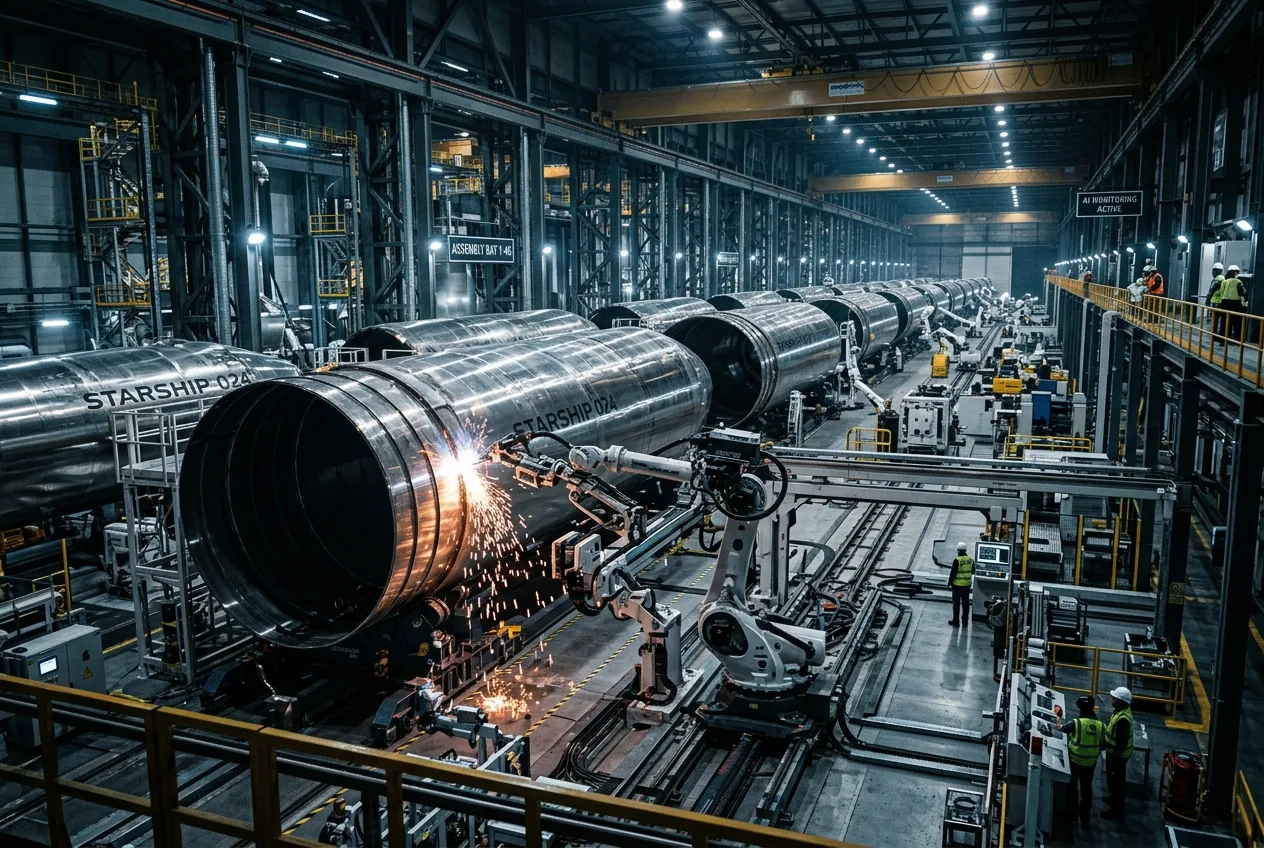
For those of us tracking the industrialization of orbit, the filing—set for a Nasdaq listing under the ticker SPCX—offers more than just financial data. It provides a blueprint for an organization attempting to apply automotive-style mass production to the most complex machines ever built. Central to this vision is a production goal that sounds like science fiction: the capacity to manufacture and launch hardware at a cadence that could eventually reach thousands of units per year. While the Federal Aviation Administration (FAA) recently noted SpaceX’s intent to launch 10,000 satellites annually, the underlying manufacturing infrastructure is being geared toward a much larger prize: the mass production of the Starship launch system.
The Economics of Vertical Integration
The prospectus reveals a company that is effectively three distinct business units under one roof: the launch services division, the Starlink telecommunications constellation, and the newly integrated xAI. Financially, the company remains in a period of high-intensity capital expenditure. SpaceX reported a net loss of approximately $4.3 billion in the first quarter of 2026, driven largely by the massive R&D costs associated with Starship’s iterative testing and the build-out of 'Starfactory' in Texas. However, the unit economics of Starlink provide the necessary ballast. Starlink generated $3.2 billion in revenue over the same period, yielding an operating profit of $1.2 billion.
Can Manufacturing Scale to 10,000 Rockets?
The most staggering figure to emerge from recent discussions between SpaceX leadership and the FAA is the ambition to scale launch operations to a level that mimics commercial aviation. To support 10,000 satellites a year, the company must master the art of rapid refurbishment. In the world of mechanical engineering, 'flight-proven' is a euphemism for 'used,' and the reliability of used components is the primary bottleneck. FAA Administrator Bryan Bedford has been clear: the authority requires a demonstration of 'a lot more reliability' before such volumes are approved. This is an engineering challenge of the highest order.
Furthermore, the manufacturing of the Raptor engine remains the primary technical hurdle. Achieving the thrust-to-weight ratio required for Starship while ensuring the engine can be fired dozens of times without a complete teardown is an exercise in materials science. Each Raptor engine is a masterpiece of complex plumbing and regenerative cooling. To scale to the levels Musk envisions, SpaceX must treat the Raptor not as an engine, but as a commodity. The shift to a public company will force SpaceX to disclose exactly how many of these engines are surviving the stress of flight and what the true cost of 'rapid reusability' actually is.
The Governance of a Trillion-Dollar Privateer
Investors eyeing the June 12 trading debut must contend with a unique corporate structure. Despite the massive public float, Elon Musk is set to retain roughly 42 percent of the equity but over 85 percent of the voting power through a dual-class share structure. This 'founder-control' model is common in Silicon Valley but rare in industries with the capital intensity of aerospace. It ensures that while the public provides the funding, the strategic direction—including the high-risk colonization of Mars—remains insulated from quarterly earnings pressure.
The risk profile is unlike any other company on the Nasdaq. SpaceX is a critical contractor for the U.S. Department of Defense and NASA, yet its CEO’s extracurricular activities and political alliances have introduced a level of 'key man risk' that will be detailed extensively in the 'Risk Factors' section of the prospectus. The slump in Tesla’s sales in 2025 serves as a cautionary tale for how brand association can impact market cap. However, SpaceX’s moat is significantly deeper than Tesla’s. While there are many electric vehicle manufacturers, there is currently only one company capable of landing a heavy-lift orbital booster on a consistent basis.
From an industrial standpoint, the SEC’s review of the prospectus will be a landmark event. For the first time, we will see the depreciation schedules for used rockets and the true churn rate of Starlink subscribers. This data will allow the market to determine if SpaceX is a sustainable industrial powerhouse or a high-stakes venture capital project that has simply reached its maximum private valuation. The 'SPCX' ticker represents a bet on the industrialization of the solar system, and the $1.25 trillion valuation suggests the market believes the age of the rocket as a mass-produced machine has finally arrived.
The Path to June 12
As the middle of June approaches, the focus will shift from engineering specifications to institutional roadshows. The $80 billion that SpaceX hopes to raise will likely be funneled into three specific areas: the completion of the Starship orbital launch infrastructure at Kennedy Space Center, the deployment of the Starlink 'v3' constellation which requires the massive fairing capacity of Starship, and the build-out of xAI’s 'Colossus' supercomputer clusters. This is a capital-intensive trifecta that seeks to own the future of communication, computation, and transportation.




Comments
No comments yet. Be the first!