On Wednesday, May 20, 2026, the long-anticipated financial veil over SpaceX was finally lifted. In a move that market analysts expect to result in the largest initial public offering (IPO) in history, Elon Musk’s aerospace giant disclosed its formal filing with the Securities and Exchange Commission (SEC). While the prospect of a public SpaceX has long been a subject of Wall Street speculation, the filing reveals a company that has evolved far beyond its origins as a launch provider. The modern SpaceX is a vertically integrated titan of aerospace, telecommunications, and artificial intelligence, positioned to leverage orbital mechanics to solve the escalating compute demands of the AI era.
The filing follows a confidential submission to the SEC on April 1, but the data released this week provides the first granular look at the company’s post-merger financials. Since acquiring xAI—Musk’s frontier artificial intelligence lab—and integrating the data-rich ecosystem of X (formerly Twitter), SpaceX has rebranded its core mission. It is no longer just a company aiming for Mars; it is an infrastructure provider building what it calls "orbital data centers." This strategic pivot explains the massive capital expenditure and the staggering net losses reported in the filing, as the company scales Starship to deploy a new generation of compute-heavy satellite clusters.
The Mechanics of the xAI and X Integration
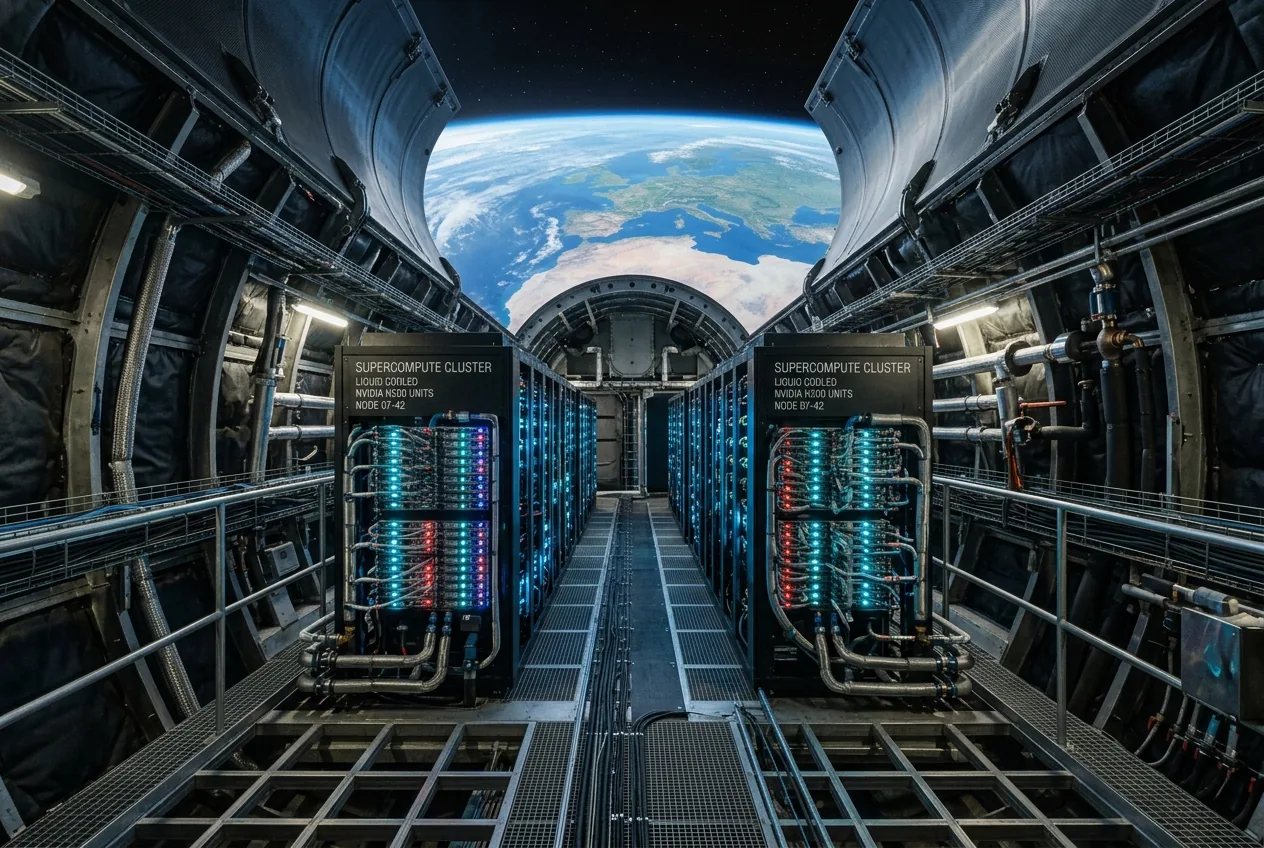
The filing highlights a significant investment in "high-density orbital compute nodes." From a mechanical engineering perspective, the transition from simple communication satellites to orbital servers represents a massive leap in hardware complexity. Satellites must now manage not only signal processing but the thermal loads generated by high-performance GPU clusters in a vacuum. SpaceX’s solution, according to the disclosure, involves proprietary liquid-cooling systems that radiate heat into the cold sink of space, effectively bypassing the terrestrial challenges of data center cooling and land use. This shift positions SpaceX as a direct competitor to terrestrial cloud providers, offering low-latency AI processing that is physically decoupled from national power grids and sovereign borders.
Analyzing the Financial Burn Rate
The numbers disclosed in the filing are massive, reflecting the high-stakes nature of aerospace manufacturing and AI development. For the fiscal year 2025, SpaceX reported a net loss of $4.9 billion on $18.67 billion in revenue. The trend intensified in the first quarter of 2026, where the company booked a $4.27 billion loss on just $4.69 billion in revenue. While these figures might cause alarm in a traditional tech company, they are characteristic of a firm in the midst of a heavy capital expenditure cycle.
Much of this loss is attributed to the scaling of the Starship program at Starbase, Texas. Starship is the linchpin of SpaceX’s economic viability. As a fully reusable launch system, it is designed to reduce the cost per kilogram to orbit by orders of magnitude. The current financial strain represents the "valley of death" in hardware development: the period where research and development costs are at their peak while the system has yet to reach its full commercial flight cadence. However, the $18.67 billion in revenue—largely driven by Starlink subscriptions and NASA contracts—demonstrates a robust cash-generating engine that terrestrial AI competitors lack.
How Does Orbital Compute Solve the AI Bottleneck?
A central question for investors is why AI compute belongs in orbit. The current global AI boom is hitting a wall regarding power consumption and latency. Terrestrial data centers are straining local power grids, leading to regulatory pushback and skyrocketing operational costs. By moving the compute layer into orbit, SpaceX leverages solar energy that is available 24/7 (with minimal shadowing) and utilizes the near-absolute zero temperature of deep space for passive thermal management. This is not merely a novelty; it is a pragmatic solution to the thermodynamic limits of high-performance computing on Earth.
Furthermore, the integration of xAI’s models into the Starlink network allows for "edge intelligence" at a global scale. In an automated future, where robotics and autonomous vehicles require split-second decision-making, the ability to process data at the closest possible orbital node rather than routing it through thousands of miles of fiber-optic cables provides a distinct competitive advantage. This is the "how" behind the IPO: SpaceX is selling the future of the global internet, upgraded with an integrated AI brain.
Governance and the Trillion-Dollar Valuation
The filing also clarifies the power dynamics within the company. Elon Musk maintains an 85.1% voting power through a dual-class stock structure, ensuring that even as the company goes public, he retains absolute control over its strategic direction. This structure is intended to insulate the company from the short-term pressures of quarterly earnings calls, allowing it to focus on long-term goals like the colonization of Mars and the expansion of the orbital compute grid. Analysts suggest that upon its debut next month, SpaceX could reach a valuation that would make Musk the world’s first trillionaire.
The impact of this filing has already sent ripples through the aerospace sector. Competitors like Rocket Lab, Firefly Aerospace, and AST SpaceMobile saw their stocks rally in anticipation of the SpaceX debut. The logic is that a successful SpaceX IPO validates the "Space 2.0" economy, signaling to institutional investors that orbital infrastructure is a viable and necessary asset class. However, the risks remain high. The complexity of managing a constellation of thousands of AI-enabled satellites involves significant regulatory, debris-management, and technical hurdles that have never been cleared at this scale.
The Role of Starship in Industrial Automation
From an industrial perspective, the SpaceX IPO is a testament to the power of automated manufacturing. The company’s ability to produce Raptor engines and Starlink satellites at scale is what makes these financials possible. SpaceX has applied the principles of automotive mass production to the aerospace industry, moving away from the artisan, low-volume approach of traditional contractors. This industrial automation is the bedrock of the company’s economic moat.
As the IPO approaches, the focus will remain on the reliability of Starship. If SpaceX can prove that its heavy-lift vehicle can launch with the frequency of a commercial airliner, the cost of data and intelligence will plummet. The May 20 disclosure is more than a financial document; it is a blueprint for a decentralized, orbital economy where the barriers between space travel and digital intelligence have completely dissolved. For a world increasingly dependent on AI, the high ground is no longer just a metaphor—it is a literal location in Low Earth Orbit.




Comments
No comments yet. Be the first!