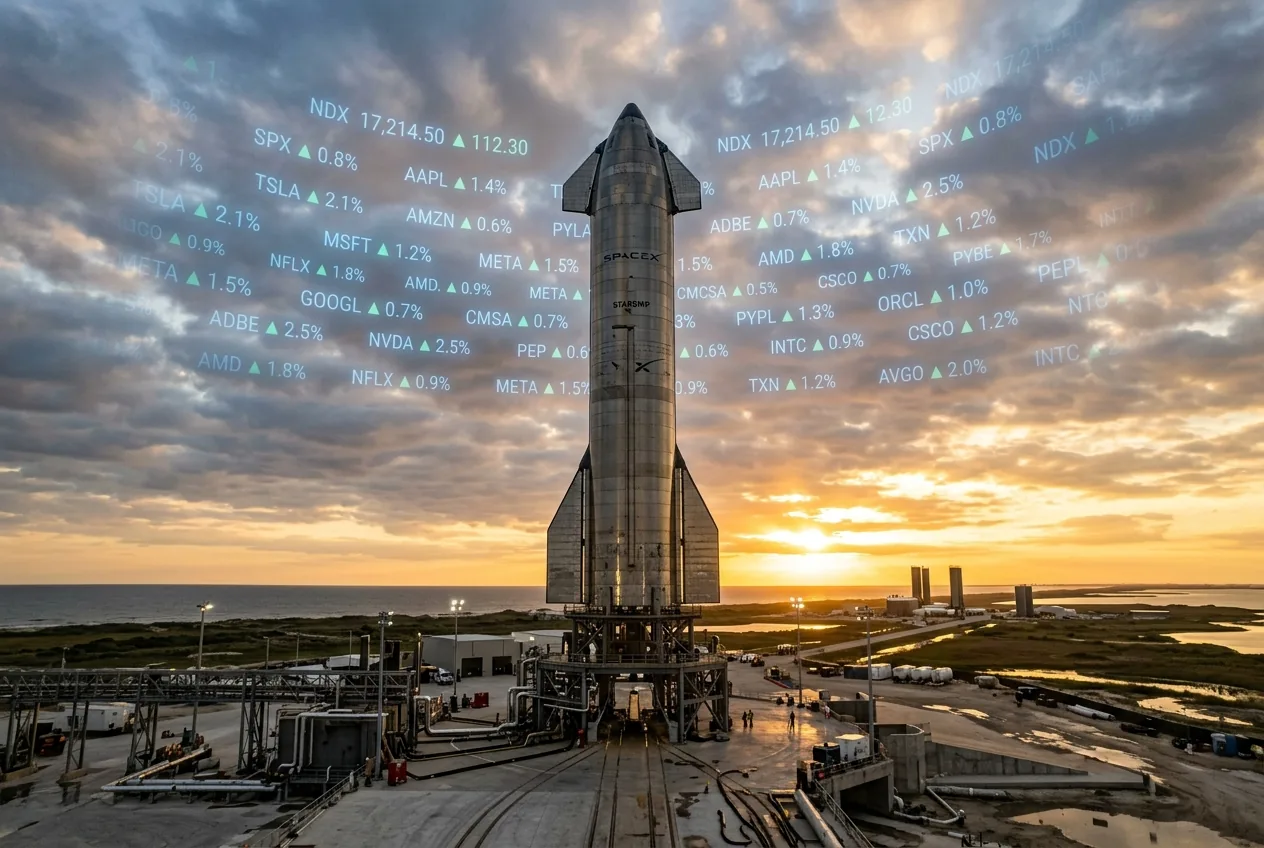
In a move that could fundamentally recalibrate the global financial landscape, SpaceX is reportedly accelerating its plans for an initial public offering (IPO), with internal targets pointing toward a Nasdaq listing as early as June 12. According to recent filings and market reports, the aerospace giant, led by Elon Musk, has already filed confidentially and is preparing to release its public prospectus as early as next week, likely on May 21. This timeline represents a significant acceleration from previous estimates, which had suggested a late-summer or year-end debut.
From an industrial and mechanical engineering perspective, this IPO is more than just a financial milestone; it is the ultimate capitalization of a vertically integrated manufacturing powerhouse. SpaceX is seeking a valuation between $1.75 trillion and $2 trillion, aiming to raise between $50 billion and $75 billion in fresh capital. This would not only make it the largest IPO in United States history but would also provide the liquidity necessary to scale the most ambitious hardware projects currently in development, including the Starship deep-space transport system and the second-generation Starlink satellite constellation.
The Mechanics of a Fast-Track Listing
The speed at which SpaceX is moving toward the public markets suggests a high level of confidence in its internal audit processes and governance structures, despite historical scrutiny of Musk’s various ventures. By targeting a June 12 debut, the company is leveraging Nasdaq’s "fast entry" rules. Under these regulations, a company of SpaceX’s scale could be integrated into the Nasdaq-100 index within 15 trading days. This technical maneuver is critical for institutional capital flows; analysts estimate that such an inclusion would trigger an immediate $22 billion to $27 billion in forced buying from exchange-traded funds (ETFs) that track the index. When considering the broader index ecosystem, the total institutional demand could exceed $60 billion before the company has even released its first public quarterly earnings report.
This rapid integration creates a unique market dynamic. For the institutional investor, the entry of SpaceX into the public sphere offers a direct play on the "space economy," a sector previously confined to legacy defense contractors with slower growth profiles. However, the sheer size of the valuation—potentially approaching the market cap of tech giants like Alphabet or Amazon—leaves little room for execution errors. The company is essentially asking the public to value its orbital delivery and global telecommunications infrastructure at a premium that mirrors high-margin software-as-a-service (SaaS) companies rather than traditional heavy industry.
Capitalizing the Starship Architecture
The core of the SpaceX valuation lies in its hardware capabilities. As an engineer, one must look at the Starship program not just as a rocket, but as an industrial platform designed for rapid reuse. The capital raised in this IPO is widely expected to fund the mass production of the Raptor engine and the construction of multiple launch towers at both Boca Chica, Texas, and the Kennedy Space Center in Florida. To reach the flight cadences Musk has proposed—eventually reaching multiple launches per day—SpaceX requires an unprecedented level of capital expenditure. Moving from the prototype phase to a stabilized, high-rate manufacturing cycle is a capital-intensive bridge that few private entities could cross without public funding.
The Synergy Between xAI and Orbital Infrastructure
While SpaceX is the primary vehicle for this listing, the broader ecosystem of Musk’s companies, specifically xAI, plays a subtle but pivotal role in the narrative. In recent months, the connection between high-bandwidth orbital data and decentralized artificial intelligence has become a focal point for late-stage venture investors. Starlink provides the physical layer of connectivity that can enable AI model training and inference in remote or mobile environments where terrestrial fiber is nonexistent. Analysts suggest that the success of xAI’s turnaround and its integration into the SpaceX ecosystem could serve as a secondary driver for the $2 trillion valuation, positioning SpaceX not just as a launch provider, but as the backbone of a new, AI-driven global communications network.
This intersection of robotics and AI is where the technical utility of the IPO becomes clear. SpaceX already employs some of the most advanced automated manufacturing systems in the world for its Starlink satellite production lines. By going public, the company gains the resources to further automate the assembly of the Starship airframe, potentially utilizing the same AI-driven robotics logic being developed at Tesla and xAI. The goal is to treat the manufacture of spacecraft with the same efficiency as the automotive industry, a feat that requires billions of dollars in specialized robotic tooling and supply chain optimization.
Assessing the Risks of a Scarcity-Driven Bubble
Despite the technological prowess of the company, the financial community has issued stark warnings regarding the potential for a market bubble. Analysts such as Jim Cramer have pointed out that if underwriters release too few shares into the public float, the resulting scarcity could drive the valuation toward an unsustainable $5 trillion. This scenario mirrors the dot-com era, where limited supply met massive demand, leading to volatile first-day gains followed by a painful correction. For retail investors, the risk is particularly high; most of the value creation occurred in the private markets, where the company’s valuation grew fivefold from $350 billion to the current target. Public investors are entering at the "top" of the private growth curve.
The price-to-sales ratio is another metric that demands pragmatic scrutiny. For SpaceX to justify a $2 trillion valuation, it must demonstrate that it can capture not just the launch market, but a significant portion of the global telecommunications and Earth-observation markets. Any delay in the Starship timeline or a stagnation in Starlink subscriber growth could lead to a sharp revaluation. Unlike a software company, SpaceX’s assets are physical and subject to the harsh realities of orbital mechanics and aerospace engineering. A single systemic failure in a new satellite generation or a major setback in the Starship testing program has far more reaching financial consequences than a bug in a software update.
Why the Timing Matters Now
The decision to move the IPO date forward to June 12—shifting away from a previous target that coincided with Musk’s birthday in late June—suggests a strategic desire to capture current market liquidity. With other major AI and tech firms like OpenAI and Anthropic reportedly eyeing the public markets for later this year or 2025, SpaceX is positioning itself as the "first mover" in this new wave of mega-cap tech debuts. By being first, SpaceX can secure the lion's share of institutional allocation before market fatigue sets in.
For the broader robotics and aerospace industries, the SpaceX IPO serves as a litmus test. If the market absorbs a $2 trillion aerospace company with enthusiasm, it will signal a new era where hardware-centric firms can achieve the same valuation multiples as big tech. It validates the idea that the future of industry lies in the fusion of heavy mechanical engineering, autonomous robotics, and global connectivity. Whether the June 12 target holds or slips due to SEC scrutiny, the filing next week will provide the first truly transparent look at the unit economics of the most successful private space company in history, and for that, the engineering and financial worlds alike are holding their breath.




Comments
No comments yet. Be the first!