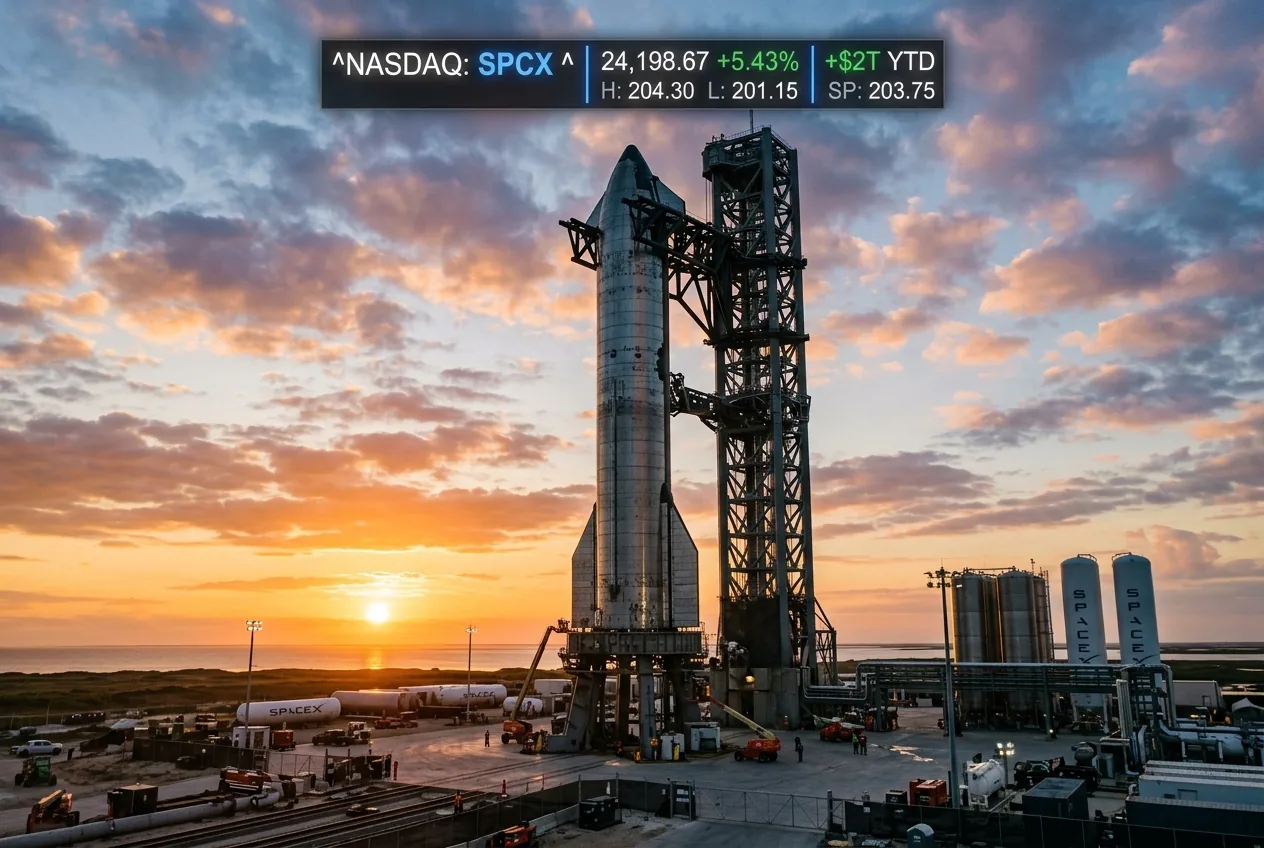
The long-awaited transition of SpaceX from a private aerospace disruptor to a public market titan has finally found its place on the calendar. According to recent filings and institutional reports, SpaceX has selected June 12, 2026, for its initial public offering (IPO) on the Nasdaq. Trading under the ticker symbol SPCX, the company is aiming for a valuation that could reach as high as $2 trillion, a figure that would not only make it one of the most valuable corporations on Earth but would also represent the largest public offering in history.
For those of us tracking the mechanical and industrial evolution of the space sector, this is the inevitable conclusion of a twenty-year experiment in vertical integration. SpaceX is no longer just a launch provider; it is an orbital infrastructure company, a telecommunications giant, and, following its recent acquisition of xAI, a primary player in the sovereign artificial intelligence race. The IPO is expected to raise upwards of $80 billion, providing the massive capital injection required to fund the colonization of Mars and the completion of the Starlink mega-constellation.
The industrial logic of a two trillion dollar valuation
To understand the $2 trillion target, one must look past the spectacle of rocket launches and into the cold mechanics of the company’s revenue streams. SpaceX’s valuation is built on three distinct pillars: the launch business, the Starlink satellite network, and the newly integrated xAI stack. While the launch business remains the most visible aspect of the operation, Starlink has emerged as the high-margin engine that justifies such an aggressive market cap.
As of late 2025, Starlink reported nearly 10,300 satellites in low-Earth orbit (LEO), serving over 9 million users globally. The company’s long-term goal of 42,000 satellites suggests that the current revenue is only a fraction of its total addressable market. By providing high-speed, low-latency internet to regions where traditional fiber and cellular infrastructure are economically unfeasible, Starlink is effectively capturing the world’s most difficult-to-reach digital consumers. From an engineering perspective, the scalability of Starlink—enabled by the rapid reuse of Falcon 9 and the impending high-cadence deployment of Starship—creates a barrier to entry that legacy aerospace firms have found impossible to breach.
Why did SpaceX acquire xAI before going public?
Gene Munster of Deepwater Asset Management has highlighted that SpaceX is uniquely positioned to build "sovereign AI." This means the company does not rely on third-party cloud providers or terrestrial bottlenecks. Instead, it utilizes the Starlink network as a decentralized edge-computing platform. The integration of Grok, xAI’s digital assistant, into the SpaceX ecosystem allows for advanced autonomous flight controls, predictive maintenance on a scale never before seen in manufacturing, and real-time processing of orbital telemetry.
The engineering of the Starship economy
The IPO is also a bet on the industrial viability of Starship, the world’s first fully reusable heavy-lift launch vehicle. While Falcon 9 proved that reusability could lower costs, Starship is designed to make space travel as routine as commercial aviation. The ability to place 100-plus tons of cargo into LEO at a marginal cost that is an order of magnitude lower than current rates is the fundamental "why" behind the $2 trillion valuation.
For industrial automation and global supply chains, Starship represents a paradigm shift. If the cost of transport to space drops sufficiently, the manufacturing of certain high-value goods—such as ZBLAN optical fibers, specialized pharmaceuticals, and high-purity protein crystals—becomes economically viable in microgravity. SpaceX is not just selling shares in a rocket company; it is selling shares in the platform that will host the next industrial revolution.
The technical precision required to land and reuse the Super Heavy booster is the ultimate proof of SpaceX’s lead in robotics. The "Mechazilla" arms used to catch returning boosters are, in essence, the largest and most precise robotic actuators ever built. This level of mechanical sophistication is what allows SpaceX to target a launch cadence that its competitors can only imagine. By the time the June 2026 IPO arrives, the market will be pricing in a future where SpaceX is the sole provider of heavy infrastructure for the lunar and Martian economies.
Can the market support an eighty billion dollar raise?
The sheer scale of the $80 billion fundraising goal has led some market analysts to issue warnings. To raise that much capital in a single offering requires a level of institutional buy-in that is almost unprecedented. However, the unique nature of SpaceX’s revenue—splitting between recurring subscription fees (Starlink) and government contracts (NASA and the Space Force)—provides a diversified risk profile that few other high-growth companies can match.
SpaceX has already completed 18 crewed missions, with a significant majority conducted for NASA. These contracts provide a stable floor for the company's valuation, while the exponential growth of the satellite-to-cell market provides the ceiling. The Nasdaq listing is expected to draw heavily from sovereign wealth funds, large-scale pension funds, and retail investors who have been sidelined for years as the company’s private valuation climbed from $100 billion to over $1 trillion.
What happens after June 12?
The day the SPCX ticker goes live will mark the end of the first era of private space exploration and the beginning of the orbital industrial age. The $80 billion in fresh capital will likely be channeled immediately into the construction of a Starship fleet and the expansion of orbital manufacturing hubs. We are likely to see SpaceX move from being a transporter of payloads to a developer of payloads, potentially launching its own branded orbital laboratories and fuel depots.
For the broader technology sector, the SpaceX IPO will serve as a bellwether for the future of AI and robotics. If the market rewards the integration of xAI and SpaceX, it will validate the idea that the next generation of "Big Tech" will be hardware-centric, vertically integrated, and physically distributed across the solar system. The June 12 date is not just a financial deadline; it is a signal that the frontier is open for business, and the mechanical infrastructure to support it is finally ready for the world to own a piece of it.




Comments
No comments yet. Be the first!