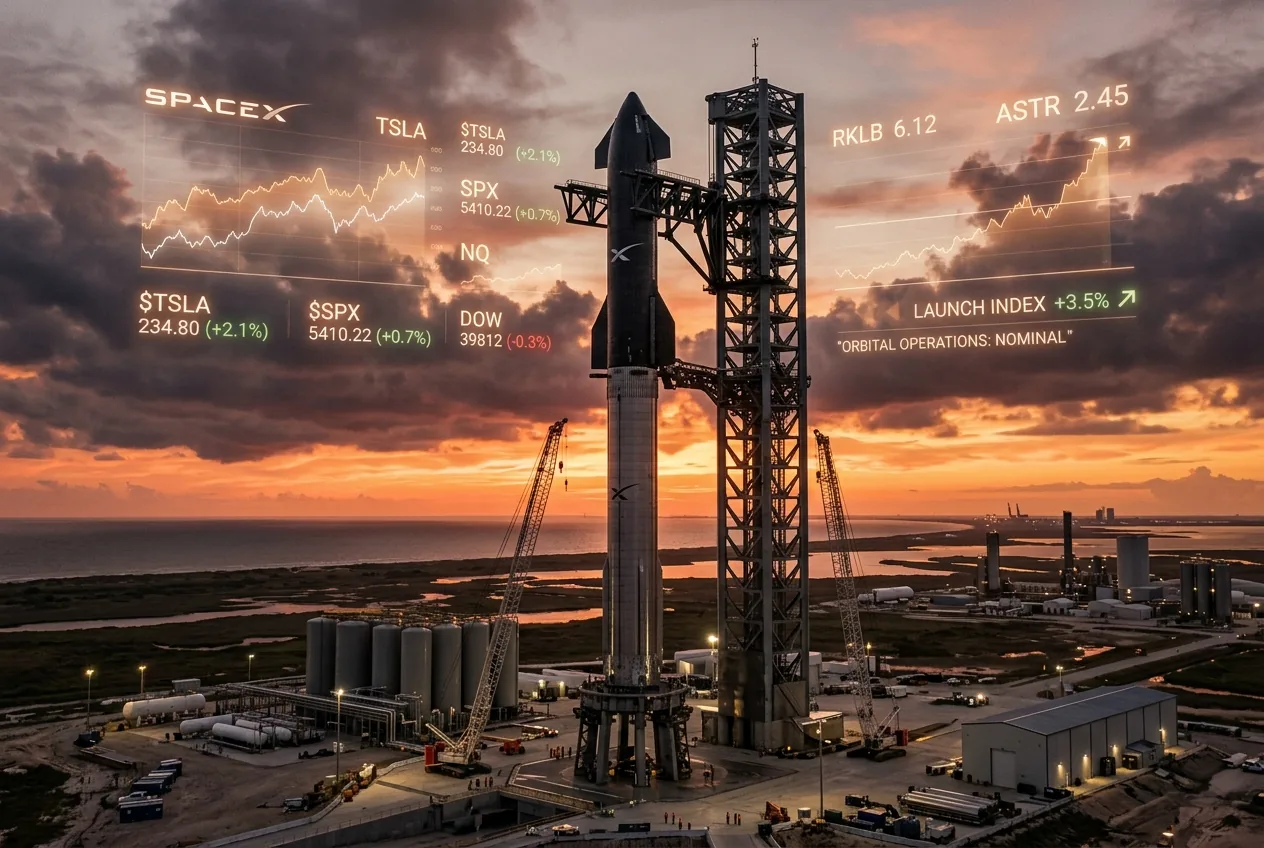
The long-standing wall between retail investors and the most dominant force in the private space sector appears to be crumbling. Insider reports and market speculation have coalesced around June 12 as the tentative date for Space Exploration Technologies Corp. (SpaceX) to initiate its initial public offering (IPO). While the company has historically resisted the transparency and quarterly pressures of public markets, the sheer scale of its current capital requirements—spanning the rapid iteration of the Starship launch system to the global expansion of the Starlink constellation—is forcing a strategic pivot. Current projections suggest the company aims to raise approximately $80 billion, a figure that would underpin a total valuation north of $1.75 trillion, with some analysts pushing that estimate toward the $2 trillion milestone.
The Mechanics of a $2 Trillion Valuation
To understand the gravity of a $2 trillion valuation, one must look past the spectacle of rocket launches and toward the industrial utility of the Starlink backbone. SpaceX is no longer merely a launch provider; it is an infrastructure giant. The valuation represents a significant premium over traditional aerospace competitors like Boeing or Lockheed Martin, reflecting SpaceX’s vertical integration and its near-monopoly on reusable heavy-lift capabilities. The market is pricing in not just the delivery of cargo to orbit, but the dominance of the orbital telecommunications layer.
The proposed June 12 date represents a calculated gamble on market liquidity. Financial analysts indicate that an IPO of this magnitude would force index funds to rebalance their portfolios, potentially requiring them to purchase $7 billion in SpaceX shares in a single trading session. This mandatory buying pressure could act as a floor for the stock price, though historical precedents—most notably the 2012 Facebook IPO—serve as a warning that initial enthusiasm does not always prevent a post-listing correction.
The xAI Integration and the Move Toward an AI Powerhouse
One of the most debated aspects of the impending IPO is the rumored merger or close operational tie-in with xAI, Elon Musk’s artificial intelligence venture. Gene Munster and other prominent technology analysts have recently assigned a greater than 50% probability to a formal merger between Tesla, SpaceX, and xAI. From a technical standpoint, this synergy is more than just branding. AI models require massive amounts of data and compute power, while SpaceX provides the physical infrastructure to deploy that compute globally without the constraints of terrestrial geography.
The 'Grok' factor remains the wild card in this equation. While xAI's Grok model is currently battling established giants like OpenAI and Google, its value to SpaceX lies in autonomous system management. The complexity of managing a constellation of tens of thousands of Starlink satellites, coupled with the telemetry required for deep-space missions, exceeds human-driven logistical capacity. Integrating xAI directly into the SpaceX corporate structure would internalize these capabilities, creating a vertically integrated loop of launch, connectivity, and intelligence.
However, this integration carries risks. Critics point to the competitive landscape of generative AI, suggesting that if Grok fails to achieve enterprise-level adoption, it could become a drag on SpaceX’s valuation. The market is currently weighing whether xAI is a force multiplier for orbital logistics or an expensive R&D distraction that could dilute the core mission of making life multi-planetary. For investors, the question is whether they are buying a rocket company or a piece of a broader, Musk-led technological ecosystem.
Starship as the Catalyst for Capital Expansion
The fundamental reason for SpaceX’s transition to public markets is the capital-intensive nature of the Starship program. Unlike the Falcon 9, which has become a reliable revenue generator, Starship is a multi-billion-dollar development project with no immediate commercial parallel. To achieve the flight cadence necessary for a Mars mission or a lunar base, SpaceX requires a level of liquid capital that private funding rounds, however successful, can no longer sustain. The IPO is the mechanism to fund the industrialization of the Starship production line in Boca Chica, Texas.
From a mechanical engineering perspective, Starship represents the transition from 'crafting' rockets to 'manufacturing' them. The shift to stainless steel construction and the development of the Raptor 3 engine are designed for mass production and rapid turnaround. This industrial scale is the only way to justify a $2 trillion valuation. If SpaceX can prove that Starship can launch multiple times per day with minimal refurbishment, it effectively devalues every other launch vehicle in existence, including those currently under development by competitors like Blue Origin.
The IPO proceeds would likely be directed toward building a fleet of hundreds of Starship vehicles. This fleet would not only serve NASA’s Artemis program but would also be the delivery vehicle for the next generation of Starlink satellites, which are too large for the Falcon 9's fairing. The synergy is clear: Starship lowers the cost of Starlink deployment, and Starlink provides the recurring revenue to pay for the IPO’s promised dividends or share buybacks. It is a closed-loop economic model that depends entirely on the technical success of the world’s largest flying machine.
Will Market Volatility Drown the Launch?
Despite the technical triumphs, the timing of the June 12 IPO is fraught with economic uncertainty. High interest rates have historically cooled the appetite for growth-stage companies that prioritize R&D over immediate profits. While SpaceX is reportedly cash-flow positive thanks to its launch services and Starlink subscriptions, the $80 billion raise is a massive ask of the public markets. The comparison to the Facebook IPO of 2012 is frequently cited; Facebook saw its share price drop from $38 to $18 in its first year before eventually becoming a multi-trillion-dollar entity. SpaceX investors must be prepared for similar short-term volatility.
There is also the matter of 'key man risk.' The valuation of SpaceX is inextricably linked to Elon Musk’s personal involvement and his ability to navigate multiple high-stakes ventures simultaneously. Any perceived instability in his other holdings, such as Tesla or the X social media platform, could bleed into the SpaceX stock price. This is particularly relevant given the proposed xAI integration. If xAI's valuation is viewed as inflated, it could lead to a downward revision of the SpaceX IPO price during the final roadshow phase.
The Long-Term Industrial Outlook
Should the June 12 IPO proceed as speculated, the influx of capital will accelerate several 'Blue Sky' projects that have remained on the periphery of the SpaceX roadmap. This includes point-to-point Earth transport via Starship, which could disrupt the long-haul aviation industry, and the establishment of dedicated orbital manufacturing hubs. These ventures require a public-market level of funding and a multi-decade horizon that venture capital rarely permits.
The technical journalist’s view is one of cautious optimism. The hardware is proven, the market demand for satellite internet is insatiable, and the launch manifest is full for years to come. The primary challenge for SpaceX as a public company will be maintaining the 'fail fast, iterate faster' engineering culture that defined its rise while answering to a Board of Directors and public shareholders who may prioritize quarterly stability over experimental test flights. If SpaceX can bridge this gap, the $2 trillion valuation may eventually look like a conservative estimate in the rear-view mirror of the new space age.




Comments
No comments yet. Be the first!