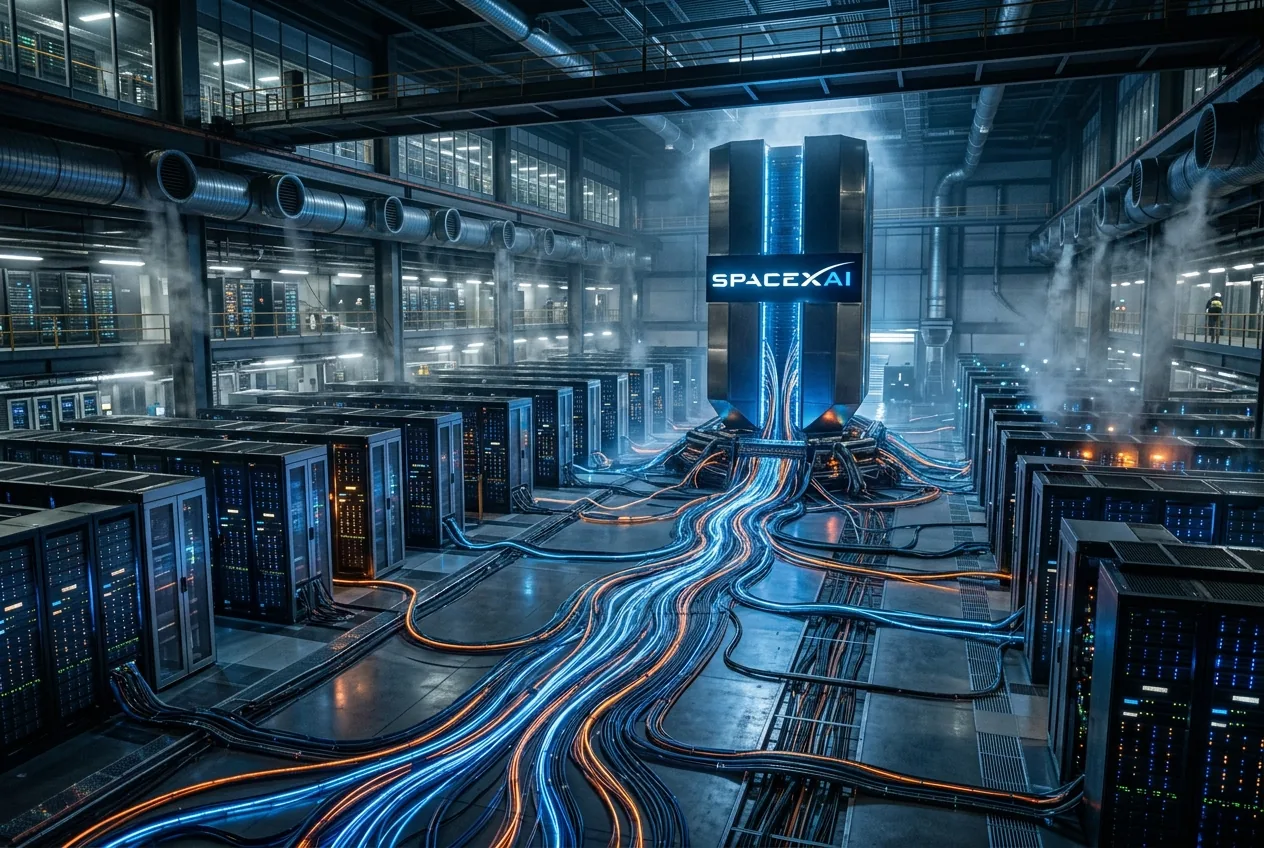
The dissolution is not merely a change in letterhead. It represents the conclusion of an era where xAI was viewed as the primary challenger to OpenAI. At its peak, xAI commanded a valuation that rivaled legacy industrial giants, fueled by the sheer force of Musk’s personality and a rapid-fire fundraising cycle that brought in over $40 billion. However, the technical and financial reality of maintaining a top-tier AI lab proved incompatible with the independent venture model in an era where infrastructure costs have scaled exponentially. By folding the unit into SpaceX—now valued at an estimated $1.25 trillion post-merger—Musk is effectively insulating the AI development cycle within the cash-flow-heavy ecosystem of his most successful venture.
The immediate fallout of this restructuring is the redistribution of one of the world's most valuable physical assets: the Colossus 1 supercomputing cluster. Located in Memphis, Tennessee, this facility represents the pinnacle of current-generation AI infrastructure, drawing 300 megawatts of power to drive 220,000 NVIDIA GPUs. In a development that has sent shockwaves through the venture capital community, SpaceXAI has entered into a historic agreement to sub-lease the entirety of this computing power to Anthropic. The deal is a pragmatic pivot for Musk, who once characterized Anthropic as an ideological adversary, but now views the company as a necessary counterweight to OpenAI’s dominance.
The Engineering Logic Behind the Consolidation
To understand why a $250 billion unicorn would vanish into its parent company, one must look at the balance sheet and the silicon. SpaceX’s 2025 financial disclosures revealed a stark contrast to its previous year. In 2024, the space exploration firm posted a healthy profit of $791 million; by 2025, it reported a net loss of $4.94 billion. This massive swing was attributed almost entirely to the capital expenditures required to stand up xAI’s hardware infrastructure. Building a cluster of 220,000 high-end GPUs is not just a software challenge; it is a massive civil engineering project requiring dedicated power substations, advanced liquid cooling loops, and specialized networking fabric that pushes the limits of modern data center design.
The operational overhead of maintaining Colossus 1 as a proprietary asset for xAI’s internal use—specifically for training the Grok series of models—became untenable. While Grok achieved significant penetration on the X platform, reaching 600 million monthly active users, the commercialization lag between training and revenue generation created a liquidity trap. By sub-leasing the hardware to Anthropic, SpaceXAI transforms a multi-billion dollar liability into a recurring revenue stream. This allows SpaceX to keep the hardware on its books while letting Anthropic shoulder the operational costs and electricity bills, which are estimated to exceed several hundred million dollars annually.
This technical surrender is also a reflection of an internal talent collapse. Within a 13-month window leading up to the dissolution, all 11 original co-founders of xAI departed the company. These exits included the leads for core reasoning, pre-training, and image generation—the technical bedrock of any large model laboratory. The final departure of Ross Nordeen in late March 2026 signaled the end of the original vision for xAI. Without a top-tier research staff to utilize the world's largest supercomputer, Musk was left with a massive engine and no one to drive it. Integrating the remnants into SpaceX allows the remaining engineers to focus on narrow, mission-critical AI for orbital mechanics, Starship telemetry, and Starlink optimization, rather than chasing general-purpose intelligence in a crowded market.
How Anthropic Seized the Infrastructure Advantage
Anthropic, the primary beneficiary of the xAI dissolution, has undergone a metamorphosis of its own. Once considered the more cautious, safety-focused alternative to OpenAI, the company has leveraged its recent technical successes to achieve a valuation of $1.2 trillion, effectively eclipsing OpenAI’s $852 billion mark. The sub-lease of the Colossus cluster provides Anthropic with the missing piece of its growth puzzle: raw, unadulterated compute capacity. For months, Anthropic’s flagship products, including Claude Code, were hamstrung by strict rate limits and usage restrictions due to a lack of available GPU cycles.
With the acquisition of 220,000 NVIDIA GPUs, Anthropic has moved to eliminate these bottlenecks. The company immediately announced a doubling of rate limits for its developer tools and the removal of peak-hour restrictions for Pro and Max users. This is a vital move for maintaining its 80-fold year-over-year revenue growth. For Dario Amodei, Anthropic’s CEO, the deal represents a strategic victory. By utilizing Musk’s infrastructure, Anthropic can scale its training runs for future iterations of Claude without the lead times required to build its own hyper-scale data centers from scratch.
The geopolitical and competitive implications of this partnership cannot be overstated. Musk’s public shift from calling Anthropic "evil" to praising their management reflects a "realpolitik" approach to the AI arms race. OpenAI, facing slowing user growth for ChatGPT and a $3.5 billion revenue shortfall in the first half of 2026, now finds itself sandwiched between an infrastructure-rich Anthropic and a consolidated SpaceXAI. The competitive moat that OpenAI once enjoyed through its early-mover advantage and Microsoft partnership is being eroded by the sheer scale of the hardware now available to its rivals.
The Rise of the East and the New Global Order
While the Western AI market is consolidating around infrastructure giants, the Chinese AI landscape is experiencing a period of explosive, decentralized growth. In the same four-month window that saw the dissolution of xAI, Chinese large-model startups raised a staggering $6.4 billion. Companies like DeepSeek and Moonshot (Kimi) are quietly building strength, focusing on efficiency and vertical integration within the Chinese industrial ecosystem. DeepSeek is currently in talks for a financing round that would value the company at $45 billion, backed by the National Integrated Circuit Industry Investment Fund.
Kimi, another major player in the region, has secured $3.9 billion in financing since the start of 2026, pushing its valuation past the $20 billion mark. These firms are not following the Western model of building the largest possible general-purpose model at any cost. Instead, they are focusing on technical optimizations that allow for high-performance reasoning on more modest hardware footprints—a necessity born from global GPU export restrictions. This divergence in strategy creates a two-track global AI market: a Western track focused on massive, centralized super-clusters like Colossus, and an Eastern track focused on efficiency, algorithmic breakthroughs, and specialized industrial applications.
The emergence of Zhipu and MiniMax as contenders for public listings in Hong Kong further highlights the maturity of the Chinese AI sector. Unlike the American unicorns, which are increasingly being absorbed into existing tech conglomerates (as seen with xAI and the tightening Microsoft-OpenAI relationship), the Chinese labs are maintaining a degree of independence while being heavily integrated into the national strategic framework. This setup allows them to move rapidly into industrial sectors like manufacturing and logistics, where the pragmatic application of AI can yield immediate economic returns.
Will Vertical Integration Save the AI Business Model?
The dissolution of xAI poses a fundamental question for the industry: Can a standalone AI company survive without being part of a larger industrial or cloud-computing ecosystem? The absorption into SpaceX suggests that the answer may be no. The capital requirements for the next generation of models are shifting from the billions into the tens of billions, and the energy requirements are shifting from megawatts into gigawatts. Only entities with existing, massive cash flows or control over energy and hardware supply chains—like SpaceX, Amazon, or Google—can afford to play at the highest level.
As we move into the second half of the decade, the "disappearance" of xAI will be remembered not as a failure, but as the moment the AI industry grew up. The frenzy of the unicorn era is being replaced by the cold, hard logic of infrastructure and integration. Whether it is Anthropic leveraging Musk’s hardware to overtake OpenAI, or Chinese labs innovating within the constraints of silicon scarcity, the second phase of the AI revolution is about who can best manage the interface between complex hardware and the global market. The $250 billion unicorn may be gone, but the intelligence it sought to create has simply found a more stable home within the machines that will take us to the stars.




Comments
No comments yet. Be the first!