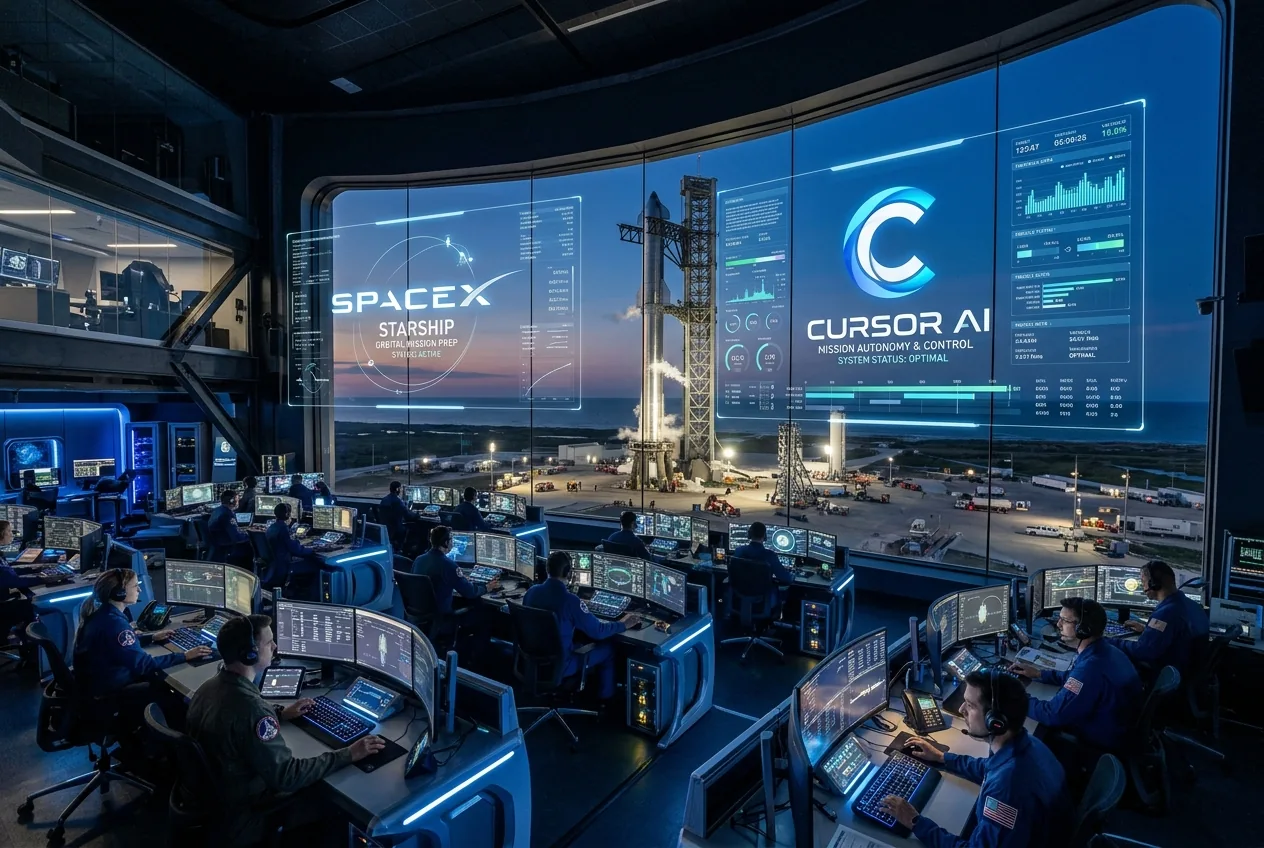
In a move that fundamentally redefines the boundaries between aerospace engineering and software development, SpaceX has entered into a strategic partnership with the AI coding startup Cursor. The deal, which was revealed through corporate communications and social media updates, is not merely a service agreement; it includes a provision for SpaceX to either invest $10 billion into the startup or acquire it outright later this year for a staggering $60 billion. This potential transaction marks a pivotal moment in Elon Musk’s broader strategy to consolidate his various enterprises into a unified, AI-driven industrial ecosystem.
For those tracking the rapid evolution of large language models (LLMs), Cursor has emerged as a standout tool. Unlike general-purpose chatbots, Cursor is a specialized fork of VS Code designed specifically for "vibe coding"—a term developers use to describe a high-level, iterative process where the AI handles the bulk of the boilerplate and logic implementation based on natural language prompts. By integrating Cursor, SpaceX isn't just buying a tool; it is securing a pipeline for the automated generation of the complex software that governs its Falcon rockets, Starship prototypes, and the Starlink satellite constellation.
The Compute Bottleneck and the Colossus Advantage
The technical core of this partnership lies in infrastructure. Cursor has struggled with the same limitation facing every modern AI firm: the availability of high-end compute. In a public statement, the Cursor team admitted that their efforts to scale the intelligence of their coding models have been consistently "bottlenecked by compute." Training a model to understand the nuances of C++, Python, and specialized aerospace telemetries requires massive amounts of GPU hours that most startups simply cannot afford without significant dilution or hardware partnerships.
Enter xAI’s Colossus. Earlier this year, SpaceX absorbed xAI, Musk’s artificial intelligence venture, effectively turning the space company into a data center powerhouse. Colossus, a massive supercomputer cluster located in Memphis, is rumored to be one of the most powerful AI training grounds on the planet. By tethering Cursor to SpaceX, Musk provides the startup with unfettered access to this hardware. This allows Cursor to move beyond fine-tuning existing models from OpenAI or Anthropic and begin training proprietary, specialized models optimized for the specific industrial demands of SpaceX and Tesla.
Why a Coding Startup is Worth $60 Billion
On the surface, a $60 billion valuation for a company that was recently seeking a $2 billion funding round seems like an astronomical leap. However, within the context of the current AI arms race, the valuation reflects the strategic utility of "agentic" AI. Cursor is transitioning from an assistant that suggests lines of code to an agent capable of understanding entire repositories and executing complex refactoring tasks autonomously. In the industrial sector, where specialized software talent is both expensive and scarce, an AI that can perform the work of a thousand senior engineers is a force multiplier of immense economic value.
The deal also mentions ongoing talks with Mistral, the French AI champion. A three-way alliance between SpaceX/xAI, Cursor, and Mistral would create a formidable Western alternative to the Microsoft-OpenAI partnership. While Cursor provides the interface and developer experience, and Colossus provides the raw power, Mistral offers high-efficiency, open-weight models that can be adapted for the edge-computing needs of SpaceX’s orbital assets.
Is the Musk Ecosystem Becoming Too Enmeshed?
As SpaceX, X (formerly Twitter), xAI, and Tesla become increasingly interconnected, questions regarding corporate governance and data silos inevitably arise. SpaceX now effectively controls xAI, which in turn controls the data from X to train its Grok models. By adding Cursor to this mix, Musk creates a feedback loop where developer data, real-world physical telemetry from rockets and cars, and social sentiment data all feed into a single intelligence engine.
For engineers at SpaceX, this means the AI will eventually have a deeper understanding of the Falcon 9’s flight history than any human developer could. It will be able to analyze post-flight data and automatically suggest code optimizations for the next mission. This level of automation is critical for Musk’s long-term vision of a self-sustaining colony on Mars, where human intervention in software maintenance must be minimized. The ability to "vibe code" a life-support system patch while in transit to another planet isn't just a convenience—it is a survival requirement.
However, the $60 billion price tag remains a point of intense debate among market analysts. Critics argue that the "AI bubble" is driving valuations to unsustainable heights. Yet, for SpaceX, which operates on a scale where a single failed launch costs hundreds of millions of dollars, the cost of the best possible software is a secondary concern. If Cursor’s tools reduce the probability of a software-related mission failure by even a few percentage points, the acquisition pays for itself over the decade.
The Industrialization of Intelligence
The SpaceX-Cursor partnership is a harbinger of a broader trend: the industrialization of artificial intelligence. We are moving away from a period where AI was a novelty used for generating images or writing emails, and into an era where it is the primary engine of heavy industry. In the robotics and automation sectors, the bottleneck has long been the complexity of programming robots to handle unstructured environments. AI coding platforms like Cursor represent the bridge across that gap.
As Cursor leverages the Colossus infrastructure, we should expect to see a new class of "heavyweight" coding models. These won't just be trained on web data; they will be trained on CAD files, structural analysis reports, and real-time sensor streams. This creates a specialized intelligence that understands the laws of physics as well as it understands the syntax of a programming language.
For the broader technology market, this deal is a wake-up call. It suggests that the most valuable AI companies of the next five years won't be those that build the most general models, but those that provide the most effective tools for the engineers building the physical world. Whether the $60 billion acquisition finalized or SpaceX chooses the $10 billion partnership route, the message is clear: the future of space exploration is being written in code, and SpaceX intends to own the pen.




Comments
No comments yet. Be the first!